
Ever felt that little knot of worry when you click "Book Now" on a hotel room? You know the one. That awesome voice in the back of your head asking, what if my plans fall through?
That's where the hotel cancellation policy comes in, and trust us, it's your new best friend for stress-free travel! It’s simply the set of rules that dictates how, when, and if you can change or cancel your reservation—and what it might cost you. Getting a handle on this is the absolute key to booking with confidence and dodging those nasty, unexpected fees.
What Is a Hotel Cancellation Policy?
Let's be real, trying to decipher a hotel's cancellation policy can sometimes feel like you need a secret decoder ring. They’re often buried in fine print, filled with jargon and confusing deadlines. But it doesn't have to be that complicated!
Think of it as a pre-trip handshake between you and the hotel. It's a straightforward agreement that lays out the ground rules in case your plans hit a speed bump. It sets the expectations for everyone involved before you even pack your bags, making the whole experience way more exciting.
This guide is your key to cracking the code. We’ll break down everything, from the crucial differences between flexible and non-refundable rates to some insider strategies for getting your money back when you need to cancel. By the time you're done, you'll be booking trips with a huge smile and zero worries.
Your Ally in Smart Travel
To make your life even easier, we want to introduce you to your new secret weapon in travel: Sgt. Travel Deals Army. As a veteran-owned platform, we’re all about transparency and no-nonsense service. Our powerful booking engine, www.stdarmydeals.com, is built to make policies crystal clear and great deals easy to find. We're a community of travel lovers dedicated to helping you explore the world without the headaches!
Here’s what we’re going to cover:
- The different types of cancellation policies you’ll run into out in the wild.
- How to actually read the fine print so you never get caught by surprise.
- Actionable, real-world tips for canceling a reservation and maximizing your refund.
- How to use great platforms like Sgt. Travel Deals Army to book with total peace of mind.
Ready to become a cancellation policy pro? Let’s dive in! Booking travel is supposed to be thrilling, not a source of stress. We'll make sure your plans are always secure, no matter what life throws at you.
Flexible vs. Non-Refundable Policies Explained
When you book a hotel, you’re almost always staring down two different paths: the safe, scenic route or the faster, riskier shortcut. I’m talking about flexible and non-refundable rates. Getting a handle on these is the absolute first step to becoming a master of hotel policies, and it’s the key to snagging great deals without putting your travel fund at risk.

Think of a flexible rate—often called "Free Cancellation"—as your travel safety net. It’s built for those times when life throws you a curveball. A meeting gets pushed back, a family member gets sick, or your plans just change. This policy lets you cancel your booking up to a certain deadline and get a full refund, no questions asked.
This gives you an incredible amount of freedom. The most common deadline you'll see is 24 to 72 hours before your scheduled check-in. If your plans fall apart before that cut-off, you can walk away without losing a single dime. Sure, this peace of mind usually comes at a slightly higher price, but for many travelers, that security is worth every penny.
The Allure of Non-Refundable Rates
On the flip side, you’ve got the non-refundable rate. This is that eye-popping, lower-priced deal that feels like a total steal. And it can be, but it comes with one massive string attached: the second you click "book," your money is locked in for good.
Think of it like buying something from the final-sale rack. The deep discount is your reward for making a firm commitment. The hotel is giving you a better price because you're guaranteeing them the income, whether you actually show up or not.
This option is perfect if your plans are carved in stone. If you are 100% certain you will make the trip, a non-refundable rate can save you some serious cash. But if there’s even a tiny chance your plans could go sideways, that great deal can quickly turn into a costly gamble.
Finding the Middle Ground
It's not always a black-and-white choice between total freedom and zero refunds. Some hotels offer a happy medium with partially refundable policies. These hybrid options might have rules like:
- Tiered Cancellation Windows: You might get a full refund if you cancel 30 days out, a 50% refund for canceling 14 days out, and no refund at all if you cancel within a week of your stay.
- Deposit Forfeiture: Instead of losing the entire booking amount, you might just forfeit your initial deposit (like the cost of the first night) if you cancel past the deadline.
These policies try to balance the risk for both you and the hotel. They offer more savings than a fully flexible rate but give you a better safety net than a strictly non-refundable one.
How to Choose the Right Policy for You
So, which hotel cancellation policy should you go for? It all boils down to your personal travel style and the kind of trip you’re taking. Just ask yourself a few quick questions before you book:
- How certain are my travel dates? If your plans are set in stone, that non-refundable rate is a fantastic way to save money.
- What’s my risk tolerance? If the thought of losing your hotel payment keeps you up at night, the slightly higher cost of a flexible rate is a smart investment in your peace of mind.
- What does the price difference look like? Sometimes the savings on a non-refundable rate are pretty small. In those cases, the flexible option is almost always the smarter play.
Ultimately, being informed is your best weapon. When you're browsing for your next trip on a platform like www.stdarmydeals.com, always take a second to click on the policy details. Understanding the fine print upfront lets you book with confidence and makes sure your adventure starts on a positive—and financially secure—note. The team at www.stdarmy.com is all about making travel simple and transparent, so you can focus on the fun stuff.
Why Booking Channels and Deadlines Matter
Alright, let's get into the savvy traveler playbook. Where you book your hotel and when you hit that "cancel" button are the two biggest factors that decide whether you get a full refund or end up kissing your money goodbye. Think of it like this: not all booking paths are created equal, and every policy has a ticking clock.
Understanding this game is your secret weapon. It’s the difference between feeling powerless when plans change and being in total command of your travel funds. We're going to show you why making a smart choice upfront saves you a massive headache later.
The Direct Booking Advantage
Ever wonder if it’s better to book through a big-name travel site or go straight to the source? The numbers don't lie. Booking directly with a hotel, or through a platform that prioritizes direct-style deals like www.stdarmydeals.com, almost always puts you in a much stronger position.
Why? Hotels love direct bookers. Simple as that. When you book with them, they don't have to pay a fat commission to an Online Travel Agency (OTA), so they see you as a more valuable customer. This often translates into better service, more flexibility, and a friendlier ear if you need to bend the rules just a little.
Recent industry data blows the lid off this. When it comes to dodging cancellations, direct bookings are the unsung heroes of the hotel world, with just 18% of revenue canceled in Europe during 2023—compared to a whopping 42% from major OTAs. This matters big time for Sgt. Travel Deals Army members because platforms that emphasize direct deals cut through the OTA nonsense, delivering deeper discounts with lower no-show risks. You can read the full report on hotel distribution trends to see just how much this gap has widened.
Bottom line: Booking direct or through a transparent engine like www.stdarmydeals.com aligns your interests with the hotel's. You're not just another anonymous booking from a giant OTA; you're their customer, and they're way more invested in keeping you happy.
Navigating Cancellation Deadlines
Now, let's talk about the clock. Every flexible hotel cancellation policy is governed by a deadline, and missing it by even a few minutes can be a costly mistake. For most hotels, these cut-offs are non-negotiable, so you absolutely have to know the common ones.
Think of these deadlines as checkpoints in a race. Pass the checkpoint before time runs out, and you’re golden. If you’re late, you face a penalty.
- The 24-Hour Rule: This is one of the most common and generous policies out there. It lets you cancel your reservation for a full refund up to 24 hours before the hotel’s official check-in time (e.g., by 3:00 PM the day before you're supposed to arrive).
- The 48- or 72-Hour Cut-Off: A little stricter, this policy demands you cancel two or three full days before your arrival to dodge a penalty. You'll see this a lot during busier seasons or at popular properties.
It's super important to check the exact time. A policy might say "48 hours before check-in," which means if check-in is at 3:00 PM on Friday, you must cancel by 3:00 PM on Wednesday. Waiting until Thursday morning is too late. Pro tip: always set a calendar reminder. It’s a simple trick that can save you hundreds.
Why OTA Bookings Can Be Tricky
While OTAs offer convenience, they add an extra layer of complexity to cancellations. When you book through a third-party site, you're getting into a three-way agreement: you, the OTA, and the hotel. This can sometimes create a massive communication breakdown.
For instance, the OTA might have its own cancellation policy that sits on top of the hotel's rules. If you need to cancel, you almost always have to go through the OTA's system, not the hotel directly. This can be slower and more rigid, leaving you with way less room to negotiate if you have a special circumstance.
The team at Sgt. Travel Deals Army works to simplify this process, giving you clear info upfront. Want to become a pro at finding the best deals with the clearest terms? Check out our guide on how to find cheap hotel deals for more powerful tips. By choosing the right channel and respecting the deadline, you’ll always keep yourself in the driver’s seat.
Common Cancellation Fees and How to Ambush Them
Let's be honest, unexpected fees are the sworn enemy of any traveler. When it comes to hotel cancellation policies, they can pop up in some pretty sneaky ways, ambushing your travel budget when you least expect it.
These penalties aren't just for those iron-clad "non-refundable" rates, either. Even a supposedly "flexible" booking can land you a surprise charge if you're not paying attention. Getting wise to these financial landmines is your first and best line of defense.
The most obvious penalty is losing your entire pre-payment on a non-refundable rate. That one’s simple—you book it, you bought it. No surprises there. But the fees that catch most people off guard are the ones hiding in flexible bookings. Miss that cancellation deadline by just a few minutes, and you'll almost certainly get hit with a one-night penalty. That's when the hotel charges your card for the full cost of the first night of your trip. Ouch.
Decoding the Different Fee Types
Beyond the big ones, other costs can materialize out of thin air. Some hotels might tack on a smaller processing fee for any cancellation, no matter when you make it. Others might require an upfront deposit, which you'll forfeit if you cancel outside the approved window.
And if you’re booking for a group or a longer stay? The penalties can get much steeper, sometimes demanding weeks of notice to avoid a serious hit to your wallet.
Let's break down the usual suspects you'll encounter on the battlefield:
- Full Forfeiture: This is the non-refundable special. You cancel, you lose 100% of what you paid. End of story.
- One-Night Penalty: The most common consequence for missing the deadline on a flexible rate. The hotel bills you for that first night as a "no-show" fee.
- Deposit Forfeiture: If you put down a deposit to hold the room, the hotel keeps it as their fee for the trouble.
- Processing or Administrative Fees: A smaller, flat fee they charge just for the "inconvenience" of handling your cancellation.
Knowing which of these applies to your booking is absolutely critical. That’s a big reason why my team at www.stdarmy.com built our booking site, www.stdarmydeals.com, to display these terms loud and clear. No guessing games.
Smart Strategies to Avoid Cancellation Fees
Protecting your cash from surprise charges is all about going on the offensive. A few simple habits can make all the difference, keeping you in command of your booking and your money.
The best defense is a good offense. Don't wait until you have a problem to understand the rules. Read the hotel cancellation policy before you even think about entering your credit card details, not after.
Here are some powerful, easy-to-implement tips straight from the field manual:
- Set a Calendar Reminder: The second you book, find that cancellation deadline. Plug it into your phone's calendar with an alert set for 24 hours before the cut-off. This five-second action is your number one defense against a costly mistake.
- Take a Screenshot: Always, and I mean always, grab a screenshot of the cancellation policy when you book. If a dispute pops up later, you've got dated, photographic evidence of the terms you agreed to. It's your ace in the hole.
- Know Your Rights: Policies are supposed to be fair and transparent. If a fee feels wrong or the terms were buried in tiny print, don't be afraid to politely challenge it with the hotel's management. Sometimes, a calm, reasonable conversation is all it takes to win the day.
For a masterclass on handling these kinds of travel hiccups, check out this video from travel expert Rick Steves. He offers timeless advice on navigating hotel interactions and getting issues resolved without a fight.
By combining smart planning with the upfront, clear information you get on platforms like www.stdarmydeals.com, you can book your next mission with confidence, knowing your budget is secure no matter what surprises lie ahead.
How to Cancel and Secure Your Refund
When your travel plans get torpedoed, your mission is simple: get your booking canceled and your money back in your wallet. Success here is all about acting fast and having a game plan. This is your step-by-step guide to navigating the process like a pro and getting the refund you deserve.
The second you know a trip isn't happening, it's go-time. Don't put it off. The absolute first rule is to document everything. Even before you book, take a screenshot of the hotel's cancellation policy. Trust me, this little piece of evidence can be a lifesaver if a dispute pops up later.
Kicking Off the Cancellation Process
Your first move depends entirely on how you booked. If you went through a big third-party site, you're playing by their rules. You have to start the cancellation through their website or app. Calling the hotel directly will just get you bounced right back to the booking site.
But if you booked directly with the hotel, you’re in a much better position. You’ve got a direct line to the people who can actually help, which makes for a smoother, more personal chat. This is a huge advantage, especially when you need a little flexibility.
This simple infographic breaks down the proactive steps you can take to avoid fees right from the start.
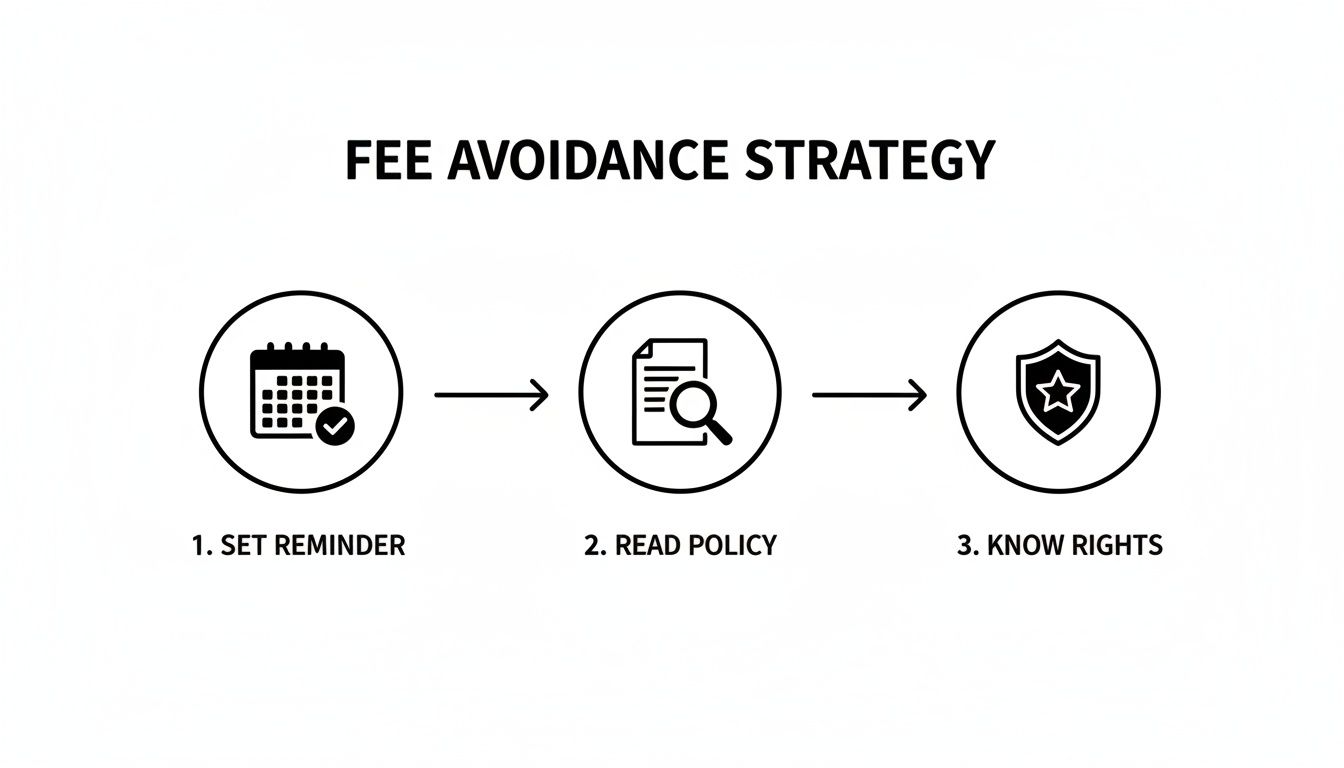
As you can see, a little prep work—like setting a simple reminder and knowing your rights—can save you from a major headache later on.
Mastering the Art of Communication
Whether you're firing off an email or picking up the phone, your tone is your greatest weapon. Be polite, be clear, and get straight to the point. Remember, the person on the other end is way more likely to help a friendly voice than a demanding one.
Flexibility is the name of the game now. A whopping 59% of global travelers in 2023 said free cancellation was a top reason for picking a hotel. Guests now demand the freedom to change plans without getting dinged. Younger travelers are leading the charge, with 66% of Gen Z and 64% of Millennials willing to pay more for that peace of mind. You can see more insights into these global hospitality stats to understand just how massive this shift is.
Here are a couple of scripts you can adapt for your own use.
Sample Email Template:
- Subject: Cancellation Request for Booking #[YourConfirmationNumber] – [Your Name]
- Body: Dear [Hotel Name] Team, Hope you're having a good day. I'm writing to request the cancellation of my reservation, confirmation number [YourConfirmationNumber], for [Your Dates]. My plans have unfortunately changed, and I won't be able to make the trip. I believe I'm within the window for a full refund according to your policy. Could you please confirm the cancellation and process the refund for me? Thanks so much for your help.
Friendly Phone Script:
- You: "Hi there, hope your day is going well. My name is [Your Name], and I need some help canceling my reservation—the confirmation number is [YourConfirmationNumber]. I'm so bummed I won't be able to stay with you! Could you walk me through getting that processed?"
Polite Negotiation for Tough Situations
So, what happens if you're just outside the free cancellation window? Don't throw in the towel. This is where a little polite negotiation comes into play. Hotels will sometimes make exceptions for legitimate, unavoidable problems, especially if you have proof.
Key Insight: At the end of the day, hotels are in the hospitality business. A little kindness and a reasonable story can go a long way. They often have the power to waive a fee to keep you happy, hoping you'll book with them again down the road.
Here are some valid reasons that often work, as long as you can provide some documentation:
- Medical Emergencies: A doctor's note is your golden ticket.
- Flight Cancellations: That official email from the airline is powerful proof.
- Family Bereavement: Explain the situation with sincerity.
- Severe Weather Events: If a major storm makes travel impossible, they are usually very understanding.
If you find yourself in a tricky spot, it helps to understand the bigger picture. At Sgt. Travel Deals Army, we believe in being completely transparent, and you can always read our platform's refund policy here for more info. Just remember, a calm, respectful approach backed by solid reasons gives you the best shot at getting your money back.
The Sgt. Travel Deals Army Advantage
Alright, soldier, you've made it through basic training. You're now an expert on the ins and outs of hotel cancellation policies, armed with the intel to book smarter and protect your budget. It's time to put that knowledge to work on the front lines of deal-hunting, and that's where we come in.
The Sgt. Travel Deals Army was founded by veterans on a simple mission: to bring you incredible travel deals without the usual nonsense. Our platform, www.stdarmy.com, and our powerful booking engine, www.stdarmydeals.com, were designed with total transparency in mind. No hidden clauses, no confusing jargon—just straightforward service.
Putting Your Knowledge Into Action
We make it ridiculously easy to compare deals and see the cancellation policy clearly before you ever commit to a booking. This is where your new skills become your superpower. You can quickly spot the difference between a flexible rate and a non-refundable bargain, weighing the pros and cons like a seasoned pro.
By enlisting with the S.T.D. Army, you gain access to amazing discounts on hotels and all-inclusive resorts while supporting a business that proudly supports our veterans. It’s a win-win.
The travel landscape shifted dramatically after the pandemic, when cancellation rates in Europe soared to a whopping 52%. While things have settled, a clear trend emerged: Online Travel Agencies (OTAs) saw cancellation rates of 42%, while direct hotel bookings were just 18%. This highlights the power of booking through platforms that prioritize direct-style deals. Lower risk for hotels means more reliable discounts for you.
Your Mission, Should You Choose to Accept It
Joining the Sgt. Travel Deals Army is about more than just saving money. It's about becoming part of a community of savvy travelers who know how to get the best value without taking unnecessary risks. Now that you're armed with this guide's key takeaways, you’re ready for your next mission.
Your objective is simple: start your search for the perfect getaway on our booking site. Apply what you've learned, compare the policies side-by-side, and book your next adventure with the confidence of a true travel veteran. Welcome to the army!
Burning Questions & Straight Answers
You've got questions about the hotel cancellation game, and we've got answers. Let's clear up some of the fog so you can march into every booking with the confidence of a seasoned pro. Think of this as your personal intel briefing before the next mission.
What’s the Best Way to Dodge a Cancellation Fee?
The number one, surefire way to avoid a cancellation fee is to book a ‘Flexible’ or ‘Free Cancellation’ rate right from the start. It’s like having an escape route built right into your plan.
Once you've done that, the critical part is canceling before the deadline. This is usually 24 to 72 hours before you're scheduled to check in. Always, and I mean always, double-check the fine print on a transparent site like www.stdarmydeals.com before you pull the trigger. Know your cut-off time.
Can I Actually Get a Refund on a “Non-Refundable” Booking?
It's a tough fight, but not always a lost cause. While "non-refundable" sounds final, remember that hotels are in the hospitality business. They aren't robots, and sometimes a real, documented emergency can get them to bend the rules.
If you’re dealing with a serious medical issue, a flight cancellation from the airline, or some other major life event, your best shot is to call the hotel manager directly. Explain your situation calmly and politely, and offer to send them any proof you have. They might offer a partial refund, but more often than not, they’ll offer a credit for a future stay as a sign of goodwill.
For a little more insight into how to handle these tricky conversations, this video from a travel expert has some fantastic real-world tips on talking with hotel staff.
Does Travel Insurance Really Cover Hotel Cancellations?
You bet it does! This is exactly what travel insurance is for. Most standard policies will have your back and cover the cost of a hotel cancellation, but only if it's for a specific, unforeseen reason listed in your policy.
Crucial Intel: "Covered reasons" are things like a sudden illness, a family emergency, or severe weather that makes travel impossible. It won't cover you if you just change your mind or find a better deal down the road.
Before you buy any policy, read the terms and conditions. I mean really read them. Know exactly what is and isn't covered so there are no surprises when you need it most.
Ready to put this new intel to work? At Sgt. Travel Deals Army, we make it simple to find deals with clear, upfront policies. Compare your options and book your next mission with total confidence.
1 thought on “Hotel Cancellation Policy: Your Guide to Booking Without the Worry”