
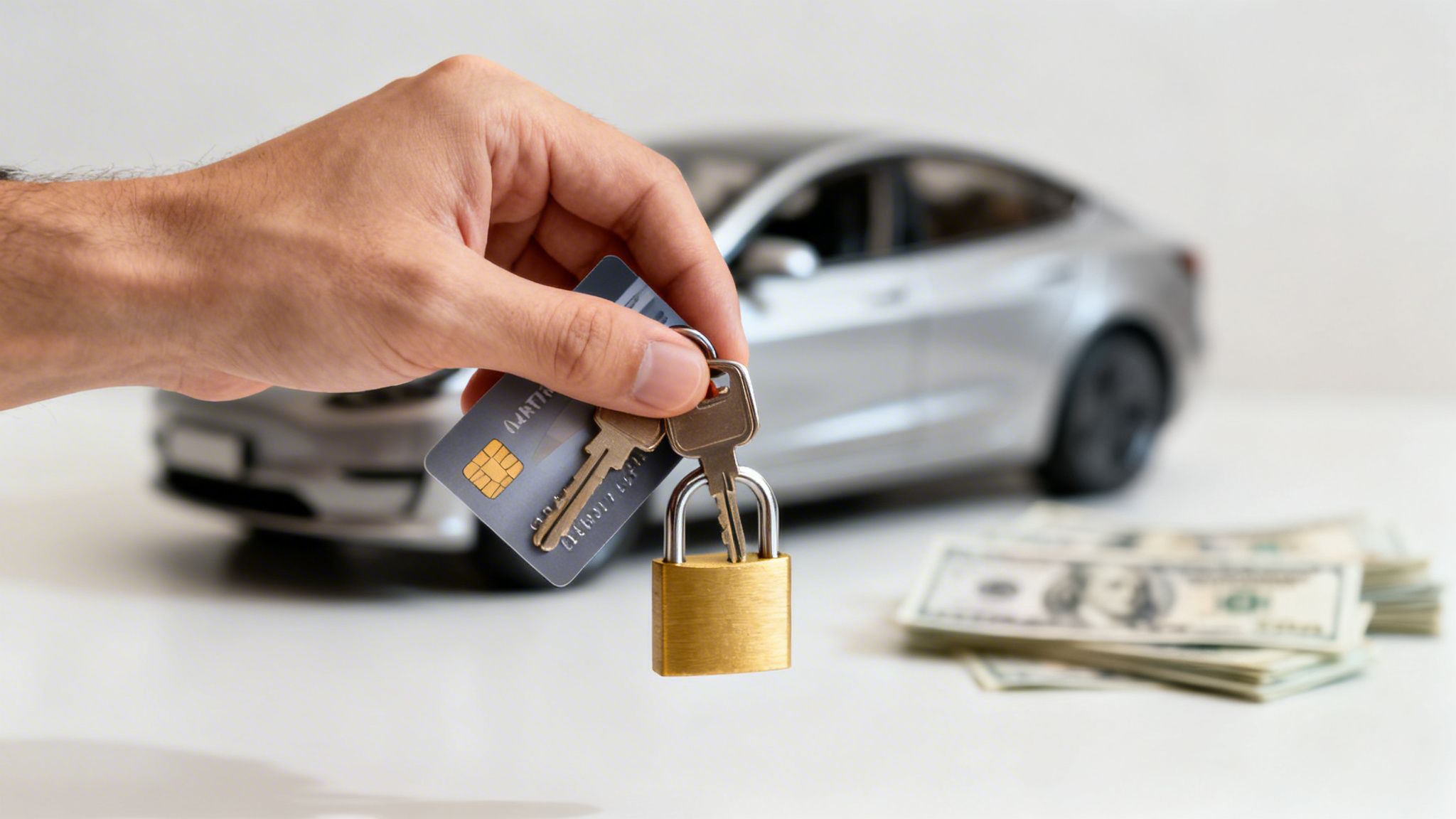
Alright, let's talk about the one thing that can throw a wrench in your travel budget before you even leave the rental counter: the car rental deposit! It's not a fee you're actually paying, but it's a chunk of your money that gets tied up. Think of it as a temporary security hold—a safety net for the rental company.
Understanding this little quirk of the rental world is the first step to making sure it doesn't mess with your vacation funds, and trust me, it's way easier than it sounds!
What Is a Car Rental Deposit and Why Do You Pay It
You've just landed, you're excited to grab your keys and go, but then the agent drops the "D" word: deposit. Suddenly, a wave of confusion hits. Let's clear the air right now! A car rental deposit isn't a charge that snatches money from your account. It's an authorization hold, which means they just freeze a certain amount on your card.
Imagine you're borrowing your buddy's prized electric guitar for the weekend. You'd probably tell him, "Hey, I'll be careful, but here's my watch as collateral just in case." The car rental deposit is the exact same idea. It's the rental company’s insurance that you’ll bring their valuable asset back in one piece.
The Purpose Behind the Hold
Listen, the rental companies aren't trying to pull a fast one on you. They're just protecting their cars! That deposit gives them a financial cushion for a few common headaches, so they don't have to chase you down for money months after you've flown home.
This hold is there to cover things like:
- Minor Damage: Annoying little scratches, dings, or a cracked windshield that your basic insurance might not cover.
- Refueling Charges: You promised to bring it back full but rolled in on fumes. They'll fill it up for you, but they'll charge a premium for the convenience.
- Late Return Fees: Bringing the car back a day later than you said you would? That's gonna cost you.
- Traffic Fines or Tolls: Ran a red light or blew through a toll booth? Those tickets find their way back to the rental company, and they'll use the deposit to handle it.
Once you return the car just as you got it—no new dings, full tank of gas—the company releases the hold. Those funds are then freed up and sent back to your card, usually within 3-10 business days. Easy peasy!
Key Takeaway: The deposit is just a refundable security measure. It's not part of your rental payment, but a temporary hold to cover "what-if" scenarios, giving both you and the rental company some peace of mind.
How Much Should You Expect to Pay
So, what’s the damage? The exact amount of the deposit can vary quite a bit. Here in the US, most companies will hold somewhere between $200 and $500. For example, you might see Hertz put a $200 hold on a credit card but jump to a steep $500 if you use a debit card. Others like Fox Rent A Car might fall in the $150 to $400 range. It's a standard part of the game across the industry, which you can read more about in this global car rental market research.
Here at www.stdarmy.com, we know that every dollar counts. Freeing up your travel funds is our top priority! That's why our booking platform, www.stdarmydeals.com, is built to help our members sniff out deals with low—or even zero—deposit options. We want your money spent on mai tais and memories, not locked up on a temporary hold.
To give you a ballpark idea of what you might be looking at, we've put together a quick cheat sheet.
Typical Car Rental Deposit Ranges by Vehicle Class
Here’s a quick overview of what you can expect to be held on your card, depending on the type of wheels you’re renting.
| Vehicle Class | Average Deposit Range (USD) |
|---|---|
| Economy/Compact | $200 – $350 |
| Mid-size/Standard Sedan | $250 – $400 |
| SUV/Minivan | $300 – $500 |
| Luxury/Premium | $500 – $1,500+ |
As you can see, the fancier the ride, the bigger the hold. A little economy car won't tie up nearly as much as a premium SUV, so keep that in mind when you're booking!
Choosing Your Payment Method: Credit vs. Debit Cards
Listen up! When you step up to that rental counter, the piece of plastic you slap down for the car rental deposit is a mission-critical decision. Choosing between a credit and debit card isn't just about what’s in your wallet; it can completely change the game, from how much money they lock up to the hoops you’ll have to jump through. Let's break this down so you can walk in there like a seasoned pro, not a rookie.
This little flowchart gives you the basic battle plan for getting your wheels on the ground.

The bottom line is simple: have your funds squared away before you book. It's the one move that guarantees a smooth operation and gets your trip started on a high note!
Why Credit Cards Are King
Rental agencies aren't exactly quiet about their love for credit cards, and it all comes down to one thing: risk. Think of it like this—a credit card is your pre-approved line of credit. The rental company knows they have a direct line to funds if anything goes sideways. That makes you a low-risk traveler in their eyes.
This trust gets you some serious advantages:
- Smaller Deposits: Because they trust the card, agencies hit you with a smaller security deposit. We're talking in the $200-$300 range for most standard cars.
- A Painless Process: With a credit card, the deposit is just an authorization hold. The money never actually leaves your account; it’s just frozen for a bit. The whole thing is fast and clean.
- Quick Fund Release: Once you return the car unscathed, releasing that hold is way faster than refunding cash. You’ll usually see your credit freed up within 3-5 business days.
Plus, many solid travel credit cards pack their own rental car insurance. This can save you a bundle on the pricey insurance waivers the rental counter tries to push on you and give you some serious peace of mind. We've got a whole briefing on the best credit cards for travel rewards that you should check out.
Credit Card vs. Debit Card for Car Rental Deposits
Still on the fence? Let's put these two payment methods head-to-head. This table breaks down exactly what you're signing up for when you hand over your card at the rental counter.
| Feature | Credit Card | Debit Card |
|---|---|---|
| Deposit Type | Authorization Hold (funds frozen) | Direct Withdrawal (funds taken) |
| Typical Deposit | Lower ($200-$300) | Much Higher ($500+) |
| Approval Process | Quick and easy | Often requires a credit check |
| Additional Proof | Rarely needed | May need proof of return travel |
| Fund Release | Fast (3-5 business days) | Slow (up to 14 business days) |
| Extra Perks | Potential for built-in rental insurance | None |
As you can see, the choice is pretty clear. Using a credit card is almost always the path of least resistance, saving you from higher costs and bureaucratic headaches.
The Headaches of Using a Debit Card
Now, you can often rent a car with a debit card, but you need to be ready for some extra steps. Using a debit card is like walking up and handing them a wad of cash straight from your bank account. That makes rental companies antsy, so they build a fortress of rules around the process.
Traveler Tip: If you absolutely have to use a debit card, call the exact rental location you're booking from—not the 1-800 number. Policies at airport branches are almost always stricter, and rules can change without any warning.
If you go the debit card route, you're basically volunteering for this:
- A Much Bigger Deposit: That deposit amount can easily double, or worse. It’s not rare to see holds of $500 or more, even for a tiny economy car. Your trip budget just took a direct hit.
- A Full-Blown Credit Check: Get ready for them to run your credit right there at the counter. If your score isn't great, they might just flat-out refuse to rent to you.
- Proof of Your Mission: They'll likely demand to see a return flight itinerary. They want proof you aren't planning on driving their car into the sunset forever.
These policies have shaken up the whole industry. When Hertz jacked its debit card hold up to $500, it forced nearly 60% of its customers to switch to credit cards. This is exactly the kind of intel we provide to our community. At www.stdarmy.com, we arm our members with the truth so they can sidestep these landmines. With the car rental market set to become a $112 billion beast by 2026, knowing how to play the game is everything.
Alright, friend, let's get down to brass tacks. You’ve found a great rental deal, but there’s one giant question mark hanging over your head: the deposit. How much are they going to lock up on your card? It can feel like they just spin a wheel and pick a random, wallet-crushing number, but there's a strategy behind their calculation.
Listen up! The final deposit amount isn't some fixed price tag. It’s all about risk. Think of it like the rental company giving you the once-over, trying to figure out how much of a gamble you are. The riskier you look on paper, the more cash they’re going to hold as collateral.
Vehicle Class and Value
This one’s a no-brainer. The fancier the car, the bigger the hold. It’s just common sense—if you're rolling off the lot in a shiny new luxury SUV, they have a lot more to lose than if you're puttering around in a tiny economy car.
Picture the deposit as a direct reflection of that car's sticker price. A standard compact might only require a $200 hold because any potential dings and dents are a relatively cheap fix. But if you're treating yourself to that convertible you've been dreaming about? Expect that deposit to skyrocket to $1,000 or more. It's their safety net in case that sweet ride comes back looking like it went ten rounds with a shopping cart.
Rental Company and Location
Not every rental counter plays by the same rules. The company you book with and where you pick up the keys can make a huge difference in how much they hold. A small, local outfit in a sleepy town might be pretty laid-back, only asking for a modest deposit.
On the other hand, a major brand at a chaotic airport is a whole different beast. They see a ton of customers, which means, statistically, they deal with more headaches. Picking up a car in a high-traffic city like Miami or Las Vegas will almost always hit you with a bigger car rental deposit than renting that same car in a smaller town. Airport locations are notorious for their tough policies and higher holds.
Traveler Alert: You might find a mid-size sedan in a small town with a friendly $200 deposit. Try to rent that exact same car from a major airport, and you could easily be looking at a $500 hold. You have to do your homework!
Your Age and Driving History
You might not like hearing it, but your age can directly affect your deposit. If you're under 25, rental companies see you as a higher risk. The statistics show younger drivers get into more accidents, so the agencies protect their fleet by demanding a larger security deposit.
They aren't going to pull your entire driving record right there at the counter, but your date of birth is a quick way for them to size you up. It doesn't seem fair, but it's standard procedure across the industry. This is where planning your trip ahead of time is critical.
Planning Ahead with StdArmy
This is where we come in. You know your friends at www.stdarmy.com have your back. We know a surprise $800 deposit can absolutely wreck a vacation budget before you've even left the airport. That's why our booking site, www.stdarmydeals.com, is built to connect our members with rental companies that have clear, fair, and often lower deposit requirements. We do the recon so you don't have to!
Just look at the North American market, which pulls in a massive 36.39% of global car rental revenue. Big players like Enterprise and Hertz routinely hold $200-$500 as a standard car rental deposit. You can read more about these car rental market trends and see the data for yourself. These high upfront costs are a huge barrier for travelers—some reports even show that up to 25% of millennials just skip renting cars because of it.
Our mission at www.stdarmy.com is to make sure you're not one of those statistics. We dig through the info to find partners who get it—your travel money should be spent on your trip, not held hostage. For more great info on how rental costs are built, check out our deep dive into understanding car rental rates.
How to Lower or Completely Dodge That Car Rental Deposit
Alright, let's get into the real insider tips—the moves that keep your cash in your wallet, not locked up in the rental company's coffers. That monster car rental deposit can feel like an ambush on your travel budget, but with the right plan, you can shrink it way down or even make it vanish. It’s all about knowing the secret handshakes before you ever step up to that counter.

Listen up! Your goal is to seize control of that deposit and free up your funds for the fun stuff. Let’s dive into some powerful strategies that will have you feeling like a travel expert.
Flash a Premium Credit Card with Primary Insurance
One of the slickest maneuvers in the book is whipping out a credit card that packs primary rental car insurance. Now, pay attention—not all card insurance is built the same. Most cards just have secondary coverage, which is the wimpy backup that only shows up after your personal car insurance pays first. Primary coverage is the elite unit; it's the first one in, no questions asked.
When a rental agent sees you have legit primary coverage, their whole attitude changes. They see you as a low-risk customer. This often convinces them to demand a much smaller security hold because they know any potential dings or dents are already covered by a rock-solid policy. It's a win-win: you get top-tier protection, and they get peace of mind. For you, that means more money for your actual vacation!
Book Through Zero-Deposit or Low-Deposit Platforms
Some companies are completely changing the rules of the game by getting rid of deposits altogether. Here at www.stdarmy.com, we're constantly on the lookout for these awesome options for our community. Our own booking site, www.stdarmydeals.com, is designed to link you directly with rental agencies offering zero-deposit or ridiculously low deposit options.
This is an absolute game-changer for travelers on a budget. Instead of seeing $500 or more disappear from your card, you can put that money toward amazing food, cool souvenirs, and memories that'll last a lifetime. Our entire mission at www.stdarmy.com is to find these kinds of deals so you can travel smarter, not harder.
Buy Your Own Rental Car Insurance Policy
Don't have one of those fancy-pants credit cards with primary coverage? Don't sweat it. You can buy your own separate, standalone rental car insurance policy before you even pack your bags. These policies often give you incredible, comprehensive coverage for way less than what the rental company tries to sell you at the counter.
When you march up to the desk with proof of your own heavy-duty insurance, you're in command. Show the agent your policy documents. In most cases, they'll drop that deposit amount because you’ve already neutralized their risk. It's a small upfront cost that can liberate hundreds of dollars in frozen funds.
Your Action Plan for Crushing the Deposit
Ready to put these tactics to work? Here’s your handy checklist for minimizing that hold:
- Interrogate Your Credit Card Company: Call your card issuer and ask them straight up: "Do you offer a primary rental car collision damage waiver?" Get them to email you a benefit letter you can show the rental agent as proof.
- Filter for Low-Deposit Allies: Use platforms like www.stdarmydeals.com that do the research for you by flagging partners with friendly deposit policies.
- Shop for Third-Party Insurance: A quick search for daily or trip-based rental insurance can save you a fortune. The savings on the deposit alone usually make it a no-brainer.
- Join the Club (Loyalty Programs): Being a member of a rental company’s loyalty program can sometimes score you a lower deposit requirement and a faster, smoother pickup experience.
By using these strategies, you’re not just renting a car; you’re taking command of your travel finances. You can learn more about finding the most affordable options in our guide to the cheapest car rental companies. Now get out there and enjoy that trip with more cash in your pocket!
Alright, friend, you conquered the open road and made it back in one piece. Success! But hold on, your adventure isn't quite over. There's one final step: getting that rental deposit back.
Let's make sure this last part is a victory, not a headache.

Unlike the rental fee you paid upfront, that deposit doesn't just magically reappear. Think of it more like a final handshake between the rental company and your bank. They need to sync up and confirm all's clear before your funds are released from lockdown.
So, How Long Does It Take?
Listen up, because this is where patience comes in. You can expect that frozen cash to thaw out anywhere from 3 to 14 business days after you return the car. Why the big window? It all comes down to the rental company's process and how fast your own bank moves.
Here's the basic rundown of your money's journey home:
- Vehicle Inspection: The rental crew gives the car a thorough inspection. They're looking for any new dings, scratches, or other damage that wasn't on the initial report.
- Finalizing the Contract: Next, they close out your agreement. This is where they'll add any last-minute charges, like unpaid tolls or a refueling fee if you forgot to top off the tank.
- The "Release" Order: Once you're cleared, the rental company sends the official "release" command to your bank or credit card company.
- Bank Processing: Your bank gets the signal and starts its own process to un-freeze the funds and make them available in your account. That's it, money's back!
Want a full rundown on the rental process? This video from fellow travel pros at Consumer Reports breaks down the basics and is loaded with helpful tips every traveler needs.
Pro Tips for a Speedy Return
Waiting for your money can be agonizing, but you're not powerless here! A few smart moves at drop-off can seriously speed things up and stop problems before they start.
- Demand a Final Receipt: Always—and I mean always—get a final, itemized receipt when you hand back the keys. This is your proof the contract is closed. Make sure it shows a $0 balance due.
- Request a Joint Inspection: If you can, grab an agent and do the final vehicle walk-around together. You can point out that the car is in perfect shape and get them to sign off right then and there.
- Take Your Own Photos: Just like you did at pickup, snap your own evidence. Get shots of the odometer, the fuel gauge (showing it's full!), and all four sides of the car. This is your proof if a dispute pops up later.
Traveler Tip: Your trip isn't over until the deposit is safely back in your account. Document everything! A few seconds spent taking photos or getting a receipt can save you days of headaches and potential disputes.
At www.stdarmy.com, our job is to equip you for every part of your trip. That’s why we only partner with straight-shooting companies on www.stdarmydeals.com who keep the return process fair and square. You should be planning your next adventure, not chasing down old deposits.
Common Reasons for Delays or Deductions
If your deposit is taking forever or it comes back a little light, don't panic. The rental company usually isn't trying to pull a fast one; they're just covering real costs you might have overlooked.
These are the usual suspects behind deposit deductions:
- Unpaid Tolls and Fines: Flew through an electronic toll lane without a pass? The bill gets sent to the rental company, and they'll take it out of your deposit—often with a nice little "administrative fee" tacked on for their trouble.
- Refueling Charges: If your agreement was "full-to-full" and you brought it back running on fumes, they'll happily fill it up for you… at a ridiculously high price per gallon.
- Minor Damage: That tiny scratch from a rogue shopping cart or a chip in the windshield might seem like nothing to you, but you can bet their inspection crew will spot it.
- Excessive Cleaning Fees: Returned the car looking like you drove it through a mud pit or a fast-food explosion? You're probably getting hit with a cleaning fee.
Knowing these potential pitfalls ahead of time is half the battle. Return the car clean, full of gas, and damage-free, and you'll get a full and fast return of your hard-earned cash. Your adventures are our priority at www.stdarmy.com, and we're here to make every part of your travel experience a total victory.
Still Have Questions About Rental Deposits? Let's Clear Them Up.
We’ve covered a lot of ground! But even the most seasoned travelers have last-minute questions before a big trip. Think of this as your final Q&A. Let's run through the most common hang-ups about rental deposits so you can march up to that counter with total confidence.
What if the Deposit is Way Higher Than I Expected?
Alright, first thing's first: don't freak out. If the hold amount blindsides you, your first move is to calmly ask the agent for a line-by-line breakdown. A lot of the time, that higher number is just an estimate for things you might have missed, like a full tank of gas or other optional extras.
If the math still feels off, it's time to whip out your reservation confirmation. The terms you agreed to when you booked are your best tool. If you booked through a trusted ally like us at www.stdarmydeals.com, our support team is on standby to help you square things away with the rental company. The bottom line: always confirm the final deposit amount before you sign anything.
Can They Just Take Money From My Deposit Without Telling Me?
Listen up: no, they can't. That rental agreement you sign gives them permission to charge you for specific, agreed-upon things—think damage, unpaid tolls, or refueling costs. They can't just raid your funds because they feel like it.
If they do make a deduction, the company has to send you an invoice or a statement explaining exactly what the charge is for. If you spot a charge you don't recognize, your first step is calling their customer service to dispute it. If that goes nowhere, you can launch a chargeback with your credit card company. This is precisely why holding onto your paperwork—the agreement, the return receipt, and your photos—is absolutely crucial.
Know Your Rights: Rental companies have to justify every single dollar they take from your deposit. If you see a charge that looks shady, challenge it. Your documentation is the key to winning any dispute.
Can I Really Rent a Car Without a Credit Card?
You can, but get ready for some extra hurdles. While the big rental companies are all about credit cards, some locations will let you use a debit card. Just know that this route usually comes with a whole new set of obstacles.
You should be prepared for:
- A much bigger car rental deposit, often $500 or more.
- A last-minute credit check right there at the counter.
- Having to show proof of a return flight or other travel plans.
A handful of smaller, independent outfits might still take cash, but that's getting rarer by the day. Your best bet is to use a booking tool like www.stdarmydeals.com that lets you filter for companies with friendlier payment options. It's exactly the kind of info we provide at www.stdarmy.com to make sure our members get the wheels they need for their trip.
For even more insider tricks, this video is loaded with great advice.
My Deposit Still Isn't Back After Two Weeks. What Now?
If it’s been over 14 business days and your money is still MIA, it’s time to take action. Don't just sit back and hope it shows up.
Here’s your action plan:
- Check Your Bank Statement: First, give your credit card or bank account a thorough once-over. Sometimes, a pending hold doesn't appear as a "refund"—it just vanishes, freeing up your credit.
- Call the Rental Location: If the money is definitely still tied up, call the exact branch where you dropped off the car. Have your rental agreement number ready and get them to confirm the hold was released on their end.
- Call Your Bank: Once the rental company gives you the all-clear, your next call is to your bank or credit card issuer. Tell them what's going on and ask them to investigate the pending hold.
- Be Persistent (But Polite): Sometimes it takes a follow-up call or two to get things moving. Stay cool, be polite, and have all your documents ready. You'll get your money back.
Remember, a little bit of persistence can work wonders. With these answers in your back pocket, you're ready to handle the rental process like a pro and keep your budget focused on the adventure!
At www.stdarmy.com, our mission is to arm you with the info and deals you need for a successful trip. Join our community for free today and see how much you can save on your next car rental, hotel, or flight at www.stdarmy.com.
1 thought on “Your Guide to Understanding the Car Rental Deposit”