
Hey there, fellow travelers! Let's get down to one of the biggest questions in travel: are round trip tickets cheaper? I hear this all the time, and the vibe is that usually, yes—especially if you're flying domestically on one of the big legacy airlines. They absolutely love bundling fares for leisure travelers, which can save you a ton over buying two separate one-way tickets.
But wait, there's more to the story! The travel game has evolved, and it's super exciting. With the rise of budget carriers and a few clever booking tricks, sometimes locking in two one-ways is the smarter, more adventurous move. Let's dive in and make sure you get the best deal for your next amazing trip!
One-Way Vs. Round-Trip Pricing
Before you even start your search, you need the right intel. And you've come to the right place! To really put this to the test, you have to compare both options. Don't skip this step, it's a game-changer! A powerful booking engine is your best friend here—and at www.stdarmydeals.com, we've got you covered. It does all the heavy lifting for you, so you can focus on planning the fun parts of your trip.
This flowchart gives you a quick visual on how to think about this. Legacy carriers often play by the old rules, rewarding round-trip bookings. The budget guys? They march to the beat of their own drum, which can be awesome for your wallet!
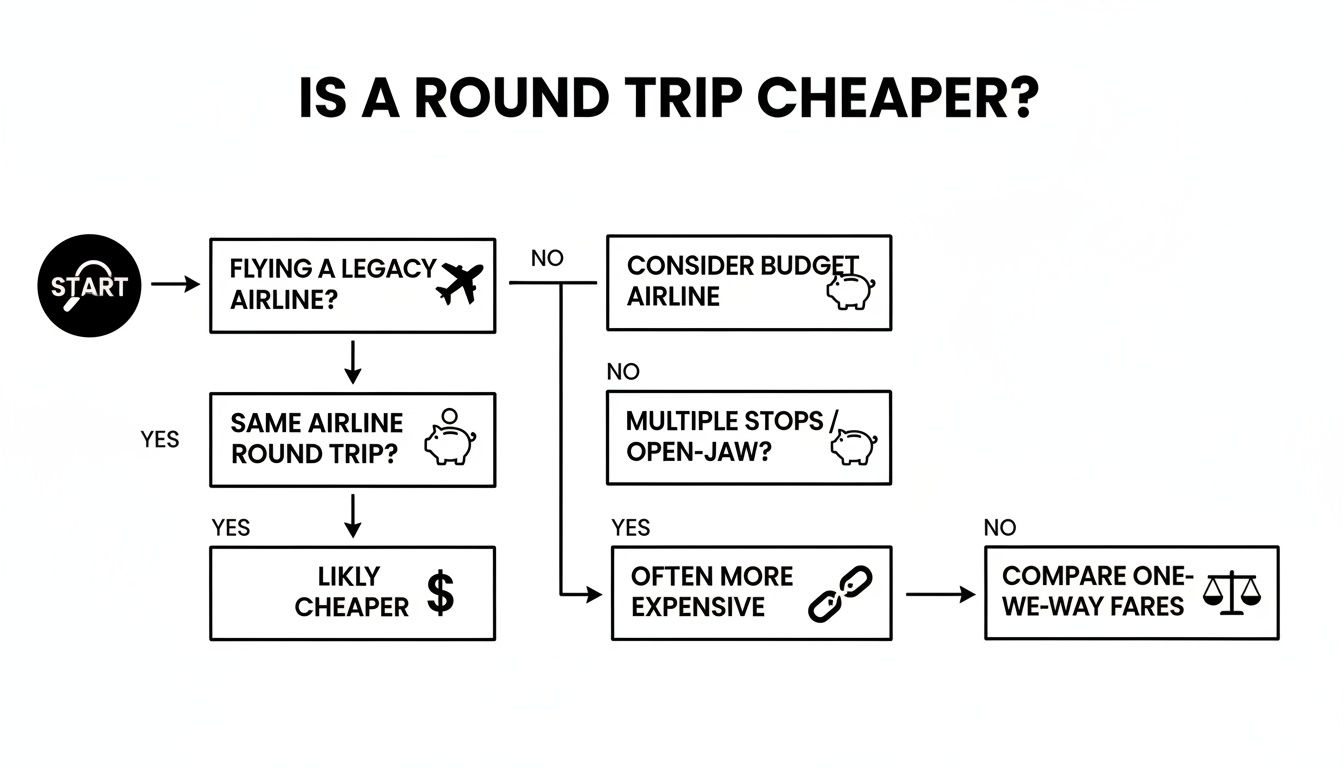
As you can see, knowing who you're flying with is half the fun! One strategy doesn't fit all, and assuming it does is a total newbie mistake.
A Quick Look at Flight Prices
Understanding these pricing habits is your first step to outsmarting the system and traveling like a pro. Think of this table as your pre-flight checklist. For even more awesome strategies, you'll want to check out our full guide on how to save money on flights.
Quick Look: One-Way vs. Round-Trip Pricing
Here’s a quick summary of what to expect in different travel scenarios. Use this to guide your initial search and make a fast, informed decision.
| Travel Scenario | Usually Cheaper Option | Why It's Cheaper |
|---|---|---|
| Domestic Trip on a Major Airline | Round-Trip | Legacy airlines reward travelers with fixed plans, often building discounts around a Saturday night stay. |
| Flying with a Budget Carrier | Two One-Ways | Budget airlines price each flight leg separately, which lets you mix and match to find the cheapest combo. Yay for options! |
| Complex International Trip | Round-Trip | Major international carriers build big discounts into round-trip fares to keep you flying with them. |
| 'Open-Jaw' Travel | Two One-Ways | Flying into one city and out of another? This gives you the ultimate flexibility without the round-trip restrictions. |
This table gives you a solid starting point, but remember, the flight market can be spontaneous and exciting. That's why you always, always verify!
Sgt. Travel's Tip: Hey, listen up! The golden rule is to always search both ways. Never assume one is cheaper. It takes less than a minute to run two separate searches—one for a round-trip and another for two one-ways on www.stdarmydeals.com. This simple check is your secret weapon and could save you hundreds for more souvenirs!
This is the kind of foundational knowledge we love sharing here at Sgt. Travel Deals Army. A smart traveler is a happy traveler, and a happy traveler saves more money for the fun stuff.
How Airline Pricing Really Works

Ever feel like you're going crazy watching a flight price change three times in an hour? You’re not imagining things! It’s not magic, and it’s definitely not random. It's a calculated game of supply, demand, and powerful computer algorithms, all designed to get the most money possible for every single seat.
To win this game and consistently snag cheaper tickets, you need to understand their playbook. And we're here to give you the inside scoop!
At the heart of it all is dynamic pricing. This just means that fares are alive—they're constantly shifting based on what's happening in real-time. Everything from the number of seats left on the plane, the time of year, what competitors are charging, and even how many people are searching that exact route gets fed into the machine.
Decoding Fare Classes
Here's one of the biggest secrets the airlines don't want you to know about: fare classes. Think of them as hidden codes, little letters like Y, B, M, H, K, or L, that secretly dictate the price and all the rules attached to your ticket.
Even though you’re all flying on the same plane, you and the person next to you could have paid wildly different prices. It all comes down to the fare class you booked.
- Higher Fare Classes (Y, B): These are your top-dollar, full-fare economy tickets. They cost a pretty penny but give you total flexibility—think fully refundable or changeable on a whim.
- Lower Fare Classes (K, L, T): This is where the deals are! These are the deeply discounted seats, but they come with a catch. They’re usually non-refundable and hit you with hefty fees if you need to make a change.
When you hit "search," the airline's system dangles the cheapest available fare class in front of you. Once those few seats are gone, it instantly bumps you to the next, more expensive bucket. That's why a price can jump hundreds of dollars overnight. It’s not just "demand"—it’s that an entire cheap fare bucket just sold out.
Understanding fare classes is your inside edge. You're not just buying a seat; you're buying a set of rules. Knowing this helps you understand why some tickets are cheap and restrictive, while others are pricey but flexible.
The Saturday Night Stay Requirement
So, what’s the deal with round-trips often being cheaper? A huge part of the answer lies in the classic "Saturday night stay" rule. For decades, airlines used this to expertly separate two types of travelers: business people and vacationers.
They figured leisure travelers are more price-sensitive and perfectly happy to stay over a weekend. To capture that market, they created lower round-trip fares that required a Saturday night stay.
Meanwhile, the business traveler who needs to fly out Monday and be home by Friday gets cornered into buying much more expensive one-way tickets or a flexible round-trip without a weekend stay. While budget airlines have shaken this up, it’s still a major play in the legacy carriers' books.
Armed with this intel from the Sgt. Travel Deals Army, you can see their strategy coming a mile away. Here at www.stdarmy.com, we know that understanding the pricing system is the first step to beating it. And a great booking site like www.stdarmydeals.com helps you do just that!
The Case For Booking Round-Trip Flights
Alright, let's talk about the classic, go-to plan for booking flights: the round-trip ticket. For most trips you’ll take within the good ol' U.S. of A., this is your default strategy. The big airlines—think Delta, American, and United—have spent decades building their entire pricing system to reward you for booking the whole journey at once.
If your plans are locked in and you know exactly when you're leaving and returning, a round-trip booking is almost always your best bet. Think about that week-long beach vacation or a quick weekend escape. You get one confirmation number, one itinerary to track, and a whole lot less to worry about. So simple and stress-free!
The Round-Trip Price Advantage
And the savings? We're not talking about a few bucks here. Sometimes, a single one-way flight can cost almost as much as the entire round-trip journey. That’s not a typo! The price difference can be huge, making the round-trip a no-brainer for any savvy member of the Sgt. Travel Deals Army.
Don’t just take my word for it; the numbers back it up. A recent deep dive into 2025 travel data showed that on domestic routes, round-trip tickets averaged $291. Booking two separate one-ways for that same trip? A whopping $432. That’s a 33% savings just for booking them together! United was the biggest hero, with round-trip fares coming in 39% cheaper on average. You can dig into the full research on these flight pricing patterns and see the proof for yourself.
S.T.D. Army Intelligence: Always start your domestic search with the round-trip option. It's the baseline. Only after you have that price should you investigate one-way tickets to see if you can beat it. It's a fun little challenge!
Simplify and Save with the Right Tools
The beauty of booking round-trip is its pure simplicity. You lock in your price for both legs of the trip, protecting you from sudden price hikes. It’s the go-to move for anyone flying out of and back into the same airport. Easy peasy!
Now, to make sure you’re getting the absolute best deal, you need the right tools. Head over to our awesome booking site at www.stdarmydeals.com and run a quick comparison. First, search for your round-trip dates. Then, open a new tab and search for the two one-way flights separately. This simple maneuver takes two minutes and ensures you never leave money on the table. At www.stdarmy.com, we give you the intel to travel smarter, not harder!
When Two One-Way Tickets Are Better
Alright, let's get adventurous! The round-trip ticket is the standard move for most travelers. It’s familiar, it’s easy. But a real travel pro knows when to break from formation and have a little fun with their booking.
Booking two separate one-way tickets can be a brilliant move, giving you a massive edge in both cost and flexibility. Think of it as your secret weapon, especially when your trip involves certain airlines or complex itineraries. This is where you get to be the travel hero!
This strategy really shines when you're flying with budget carriers. I'm talking about airlines like Spirit, Frontier, or Allegiant. These guys don't play by the same rules as the legacy giants, and that's great for us!
Their entire pricing model is à la carte, meaning they price each flight segment on its own. There’s no built-in reward for booking your return trip with them.
That’s your opportunity! You can grab a dirt-cheap flight out on Spirit and then find an even better deal for the flight back on Frontier. By booking two one-ways, you stitch together the absolute lowest-cost trip possible—a core tactic we live by here in the S.T.D. Army.
Maximizing Flexibility and Control
The one-way strategy is also the undisputed champ when it comes to flexibility. It’s the only real way to book a complex trip without getting tangled up in an airline's restrictive rules.
Here are the scenarios where going with two one-ways is your best bet:
- 'Open-Jaw' Travel: This is your move when you want to fly into one city and out of another. Picture this: you fly from Chicago to Rome, spend two weeks eating your way through Italy by train, and then fly home from Venice. A round-trip can't handle that. You need two one-ways for that amazing adventure!
- Mixing Airlines: Found an early morning flight on American that’s perfect, but the ideal return flight is a late-night special on Delta? Book ‘em as two separate one-ways. This lets you cherry-pick the exact flights, times, and airlines that work for your schedule, not theirs.
- Uncertain Return Dates: If your return plans are a little fuzzy, booking a one-way out is a lifesaver. It helps you dodge the outrageous change fees that airlines love to slap on cheap round-trip tickets.
Booking two one-ways puts you in complete command. You become the architect of your own trip, building an itinerary that fits your schedule and budget perfectly. You're not stuck with the airline's pre-packaged deal.
Now, hold on a second. This strategy is typically a winner for domestic flights. International travel is a different beast entirely.
Airlines often build in huge incentives to book round-trips for international routes, with savings that can approach 35% compared to two one-ways. For example, a round-trip award flight to Paris on Delta might cost 50,000 SkyMiles. But if you booked those exact same flights separately as one-ways, it could drain your account of 74,000 SkyMiles and hit you with higher fees. You can learn more about these international fare differences to see how carriers cook the books.
Bottom line? For every single trip, whether it’s across the state or across the ocean, you need to run the numbers. Always check both options on a powerful search tool like www.stdarmydeals.com to confirm your winning strategy before you book.
Alright, friend, you've got the intel on how airline pricing works. Now it’s time to put that knowledge into action and win the war on high prices!
This is your field manual for scoring the cheapest flight, every single time.
First rule of engagement: Always search both ways. I’m not kidding. This is the one step most travelers get lazy on, and it costs them. Let's not be lazy!
Here’s your mission. Pull up a flight search engine like www.stdarmydeals.com and run a search for a standard round-trip ticket. Got it? Good. Now, open a new tab and search for two separate one-way tickets covering the exact same trip. This simple two-minute check is your ultimate secret weapon.
Sgt. Travel's Command: The biggest mistake you can make is assuming one way is always cheaper than the other. Never assume! The market changes by the minute, and yesterday's deal is today's ripoff. You have to verify, every single time.
Here at Sgt. Travel Deals Army, our whole game is about being smarter than the average traveler. That’s why we built our own booking site, www.stdarmydeals.com, to make this comparison dead simple and fun.
Your Tactical Flight Booking Checklist
To outsmart the airlines, you need a repeatable strategy. Follow these tips, and you'll consistently find the absolute best deals out there.
Compare Round-Trip vs. Two One-Ways: This is your first and most important move. Use a site like www.stdarmydeals.com to run both searches and see the price difference right in front of you.
Be Flexible With Your Dates: If your schedule has any wiggle room, use it! Shifting your departure or return by just a day or two can save you a fortune. Flying on a Tuesday or Wednesday will almost always beat a Friday or Sunday. For a deep dive on this, check out our guide on the best time to book flights.
Go Incognito: Ever notice how a flight price magically creeps up after you've searched it a few times? That's not a coincidence. Airlines are watching you. Always, and I mean always, search in an incognito or private browser window. This stops them from jacking up the price based on your search history.
This isn't just a hunch, either. The data proves that booking a round-trip often gives you the edge, especially if you’re booking close to your departure date. A recent study of over 2,000 domestic flights showed that 50.7% of one-way tickets were more expensive per leg than the same round-trip flight. That number skyrockets inside 14 days of departure, where over 90% of last-minute trips were cheaper when booked as a round-trip. You can see the full breakdown of the one-way pricing study here to dig into the numbers yourself.
Follow this battle plan, and you'll be living the core mission we have at www.stdarmy.com: be smarter, be prepared, and never, ever overpay for your travels. Happy travels!
Alright, friend, let's clear up some of the questions rattling around in your head. You've got the basic intel on round-trip versus one-way flights, but the mission isn't over. We get these queries all the time from the amazing folks in the Sgt. Travel Deals Army.
Think of this as your rapid-fire Q&A session. Let's get these questions answered so you can book your next trip with the confidence of a seasoned pro.
Can I Book a Round-Trip and Just Not Use the Return Flight?
Listen up, because this is important. We hear this one a lot. The move is called "throwaway ticketing." You find a killer deal on a round-trip, but you only need to fly one way, so you plan to just ditch the return leg. Sounds clever, right? A way to outsmart the system.
Wrong. This is a high-stakes gamble that goes against the airline's "contract of carriage"—the rulebook you agree to when you buy a ticket. If they catch on, and they have ways of tracking this, the fallout can be a real mess. They could wipe out your frequent flyer account, cancel any other flights you have booked with them, or even send you a bill for what a full-priced one-way should have cost.
My advice? Let's play it safe. It’s a rogue tactic that's not worth the risk.
What Happens If I Miss the First Flight of My Round-Trip?
Pay attention, because this trips up even experienced travelers. If you "no-show" for the first flight on your round-trip ticket, the airline will automatically cancel your entire remaining itinerary. Poof. Gone. Your return ticket will vanish, and you won't see a dime refunded.
This isn't just the airline being difficult. It's their defense against people trying to game the system with fare rules, a practice sometimes called "skiplagging."
Critical Intel: If some emergency pops up and you know you're going to miss that first flight, your immediate action is to call the airline. Explain what happened. Sometimes they can work with you, but if you just don't show up, you can kiss that return ticket goodbye.
Are Multi-City Tickets a Good Alternative?
Absolutely! In fact, for complex trips, they’re your best friend. A multi-city booking is the official, 100% legitimate way to build a custom trip. Say you need to fly from City A to City B, spend a few days, then fly from City B to City C.
Booking this as a single multi-city itinerary is almost always cheaper and way easier than juggling a bunch of separate one-way tickets. It also keeps all your flights on one record, which is a lifesaver if a delay in one city might make you miss your next flight.
What About Changing or Canceling Flights?
Flexibility is a huge deal. Generally speaking, those super-cheap round-trip fares from the big airlines are as rigid as they come. If your plans change, you'll likely face a steep change fee plus whatever the new fare costs. If your dates aren't set in stone, this is a risky bet.
Booking two separate one-ways can give you more breathing room. Need to change your return? You only have to deal with that one ticket, not the whole round-trip booking. But if you need the ultimate escape plan, you should really check out our guide on how to book refundable flights for some next-level strategies.
Just remember, every airline plays by its own rules. Always, and I mean always, read the fine print before you hit that "purchase" button. Happy booking
1 thought on “Are Round Trip Tickets Cheaper? Your 2026 Flight Savings Guide”