
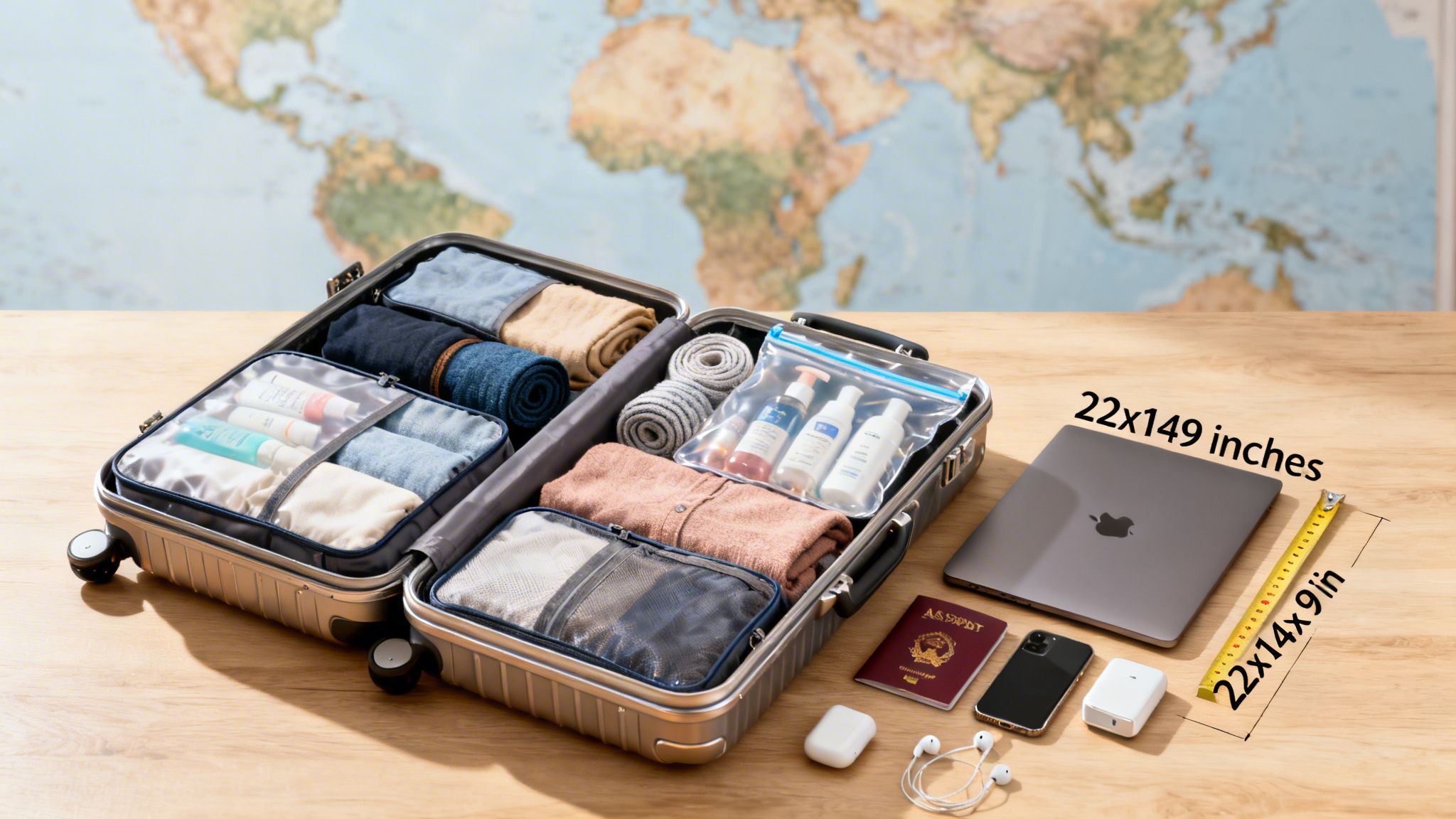
Alright, travel warrior, listen up! Feeling excited about your next big adventure? Let's make sure it's smooth sailing from the get-go. If you want to master international travel, your first mission is to conquer the carry-on. The key to dodging those infuriating surprise fees and the chaos of a last-minute gate check is to aim for the universal standard: a bag around 22 x 14 x 9 inches. But don't forget the second part of your mission brief—weight. Most international airlines will ground you if your bag is over 7-10 kg (15-22 lbs).
Why International Carry On Rules Matter
Picture this: you've navigated security, you're minutes from boarding, and the adventure is about to begin. Then, you hear it. The gate agent points at your bag and delivers the bad news: "Sorry, that's too big. You'll have to check it." Your smooth journey just came to a screeching halt.
Unlike the free-for-all you might see on some domestic flights, international carriers run a tight ship for good reason. It’s not about ruining your day; it’s about safety and logistics. Long-haul aircraft have to be balanced with near-perfect precision, and overstuffed overhead bins are a genuine hazard. Sticking to the rules ensures there’s a fair sliver of space for everyone on a packed flight.
The Community of Smart Travelers
Think of this as your friendly field manual for carry-on dominance. You're not just learning to pack a bag; you're joining a platoon of savvy globetrotters—the S.T.D. Army. We're a fun and disciplined unit of travelers dedicated to finding killer deals and exploring the world without getting bogged down by extra fees or lost luggage.
Over at our booking site, www.stdarmydeals.com, we arm you with incredible prices on flights and hotels. Mastering your carry-on game is how you protect that hard-won cash from falling into the hands of airline baggage fees. It’s a critical skill, especially when you see how many people get it wrong.
Get this: a staggering 87% of international business flyers check at least one bag. That means only a handful of pros are traveling light and smart. This is your chance to break from the pack and avoid the problems they face at the gate.
Mission critical intel for every S.T.D. Army recruit: Your primary objective is a carry-on that hits the 22 x 14 x 9 inches (55 x 40 x 25 cm) target. This is your golden ticket for global compatibility, but always confirm the weight limits before you deploy.
Standard International Carry On Allowances at a Glance
Think of this table as your quick-reference guide for your travel prep. These are the most common specs you'll see out in the field. Use it as your starting point, but remember, always verify the specific rules of your airline before heading to the airport.
| Region/Airline Type | Typical Size Limit (Inches) | Typical Weight Limit (kg/lbs) |
|---|---|---|
| North American Majors | 22 x 14 x 9 | Often no weight limit, but check |
| European Majors | 21.5 x 15.5 x 9 | 8-10 kg (18-22 lbs) |
| Asian Majors | 22 x 14 x 9 | 7-10 kg (15-22 lbs) |
| Budget Airlines (Global) | Often smaller; 18 x 14 x 8 | 7-10 kg (15-22 lbs) |
This intel gives you a strategic advantage, helping you choose the right gear and pack for success from the very beginning.
Your Path to Fee-Free Travel
By committing to carry-on-only travel, you join the elite ranks. You're the one breezing past the baggage claim carousel, never breaking a sweat over lost luggage, and moving through the airport with tactical efficiency. This guide is your first step. We’ll break down everything you need to know, from airline-specific regulations to advanced packing techniques.
And as you get better at traveling light, make sure you're saving heavy. Check out our recon on the best time to book flights to maximize your savings even more.
Welcome to the S.T.D. Army at www.stdarmy.com—now let’s get you ready to conquer the globe, one carry-on at a time.
Decoding Airline Carry On Size and Weight Limits
Hey there, savvy traveler! Think that trusty carry-on you lug around on domestic flights will pass inspection for an international trip? Think again. This is one of the biggest rookie mistakes out there, and it can turn your smooth airport run into a costly, stressful mess.
That bag that flies free in the States can suddenly become a huge liability when you're flying across an ocean. Every international airline has its own strict "dress code" for luggage. Your job is to make sure your bag meets their exact specs. Get it right, and you'll board with the confidence of a seasoned pro, knowing your bag is safe and your money is staying in your wallet.
Don’t believe us? Take a look at this intel. This is how most people are still traveling.
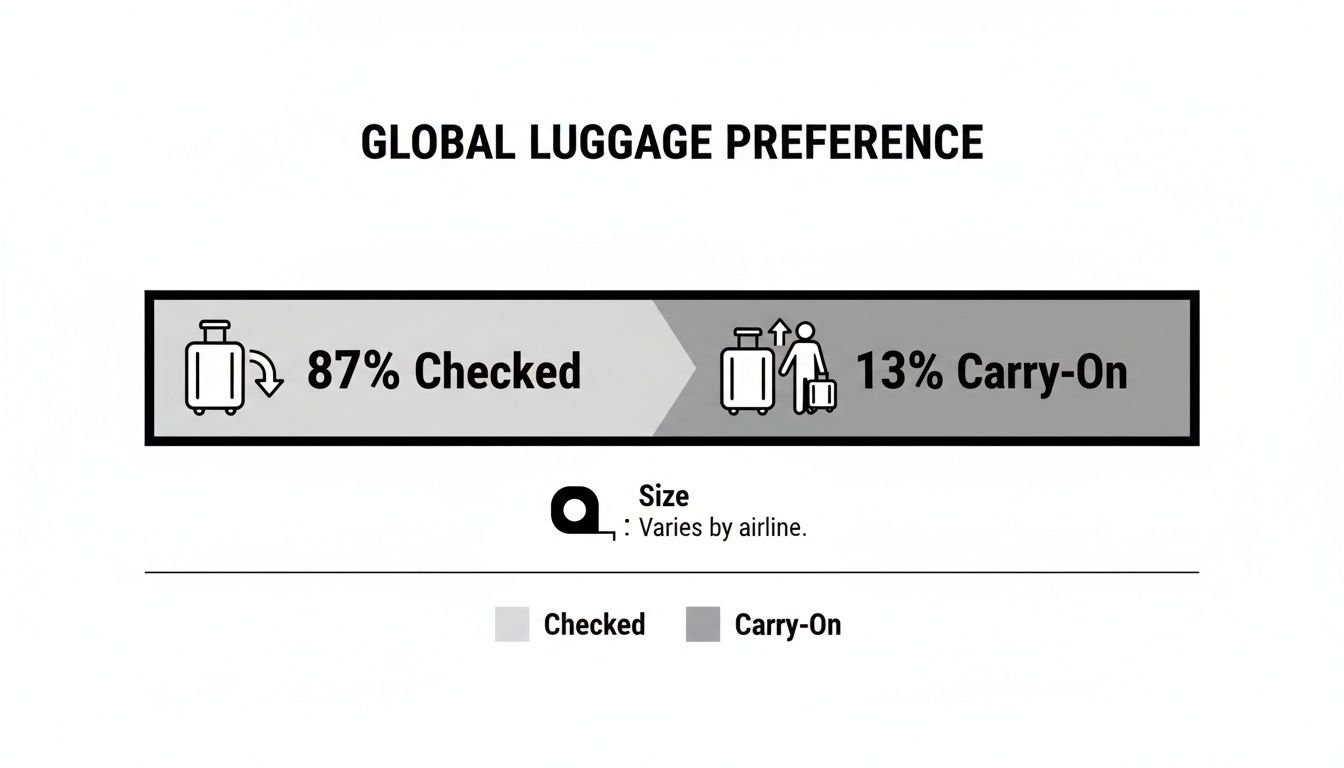
You see that? A massive 87% of travelers are still surrendering to checked bag fees. That leaves a small, elite squad of 13% who travel light and smart with just a carry-on. That’s the group you want to be in.
The Great Weight Debate
Size is only half the battle. The real war for your carry-on is often fought on the scale. This is a massive shift from most U.S. domestic airlines, which often don't even bother listing a weight limit. On the world stage, though, those scales come out at check-in and at the gate.
It's a numbers game, and the rules are all over the map. Airlines like Qantas, Singapore Airlines, and Thai Airways are notoriously strict, holding the line at a lean 7 kg (15.4 pounds). Others, like KLM, give you a bit more breathing room at 12 kg (26 pounds). Then you've got British Airways, which practically lets you pack the kitchen sink with its generous 23 kg (51 pounds) allowance.
Major International Airline Carry On Policy Comparison
Don't get ambushed at the gate! This table is your cheat sheet for what to expect from some of the major players. Study it. It's the key to avoiding those surprise fees.
| Airline | Region | Max Dimensions (cm/in) | Max Weight (kg/lbs) | Personal Item Policy |
|---|---|---|---|---|
| Lufthansa | Europe | 55 x 40 x 23 cm (21.6 x 15.7 x 9 in) | 8 kg (17.6 lbs) | Included, 40 x 30 x 10 cm |
| Air France | Europe | 55 x 35 x 25 cm (21.7 x 13.8 x 9.9 in) | 12 kg (26.4 lbs) total with personal item | Included, 40 x 30 x 15 cm |
| British Airways | Europe | 56 x 45 x 25 cm (22 x 18 x 10 in) | 23 kg (51 lbs) | Included, 40 x 30 x 15 cm |
| Emirates | Middle East | 55 x 38 x 20 cm (21.7 x 15 x 7.9 in) | 7 kg (15 lbs) | Personal item not explicitly guaranteed |
| Singapore Airlines | Asia | Total dimensions must not exceed 115 cm (45 in) | 7 kg (15.4 lbs) | Included, 40 x 30 x 10 cm |
| Qantas | Australia | 56 x 36 x 23 cm (22 x 14 x 9 in) | 7 kg (15.4 lbs) | Included, total dimensions not to exceed 105 cm |
| Air Canada | North America | 55 x 40 x 23 cm (21.5 x 15.5 x 9 in) | No specified limit, but must be liftable | Included, 43 x 33 x 16 cm |
This isn't an exhaustive list, but it shows you just how much the rules can change from one airline to the next. The only way to be 100% sure is to check the airline's official site after you book.
Running The Budget Airline Gauntlet
Flying a budget carrier like Ryanair? Brace yourself. These airlines are famous for their tiny allowances and eagle-eyed enforcement. They don't make their money on the ticket price; they make it on fees. Your bag is their number one target.
Their infamous metal sizers at the gate are the final test, and there's zero room for excuses. If your bag doesn't slide in, you're paying a painful on-the-spot fee to check it. No exceptions.
That's why a few minutes of recon after booking a great deal on our travel booking site, www.stdarmydeals.com, is absolutely mission-critical. It can literally save you hundreds.
Your Pre-Flight Luggage Checklist
To make sure there's no drama at the gate, get in the habit of running this quick pre-flight check on your gear.
- Verify Dimensions: Go to your airline's website. Find the exact numbers for your carry-on and personal item. Write them down.
- Confirm Weight Limit: Find the max weight. For most international airlines, this is not a suggestion.
- Do a Test Run: Pack your bag, then weigh it. A cheap luggage scale is one of the best investments a traveler can make. One saved fee and it’s already paid for itself.
As a member of the S.T.D. Army, you’re part of a crew that travels smarter. We share intel to help each other avoid the traps. By staying briefed on sites like www.stdarmy.com, you're not just another tourist—you're a tactical traveler, ready for anything. Have fun out there!
What You Can and Cannot Pack in Your Carry On
Alright, globetrotter, listen up. Getting your bag to fit is only half the fun. Now for the real strategic op: what goes inside. This is your official briefing on navigating airport security, from the TSA in the States to CATSA in Canada and everywhere in between, so you can glide through screening without a single confiscated item.
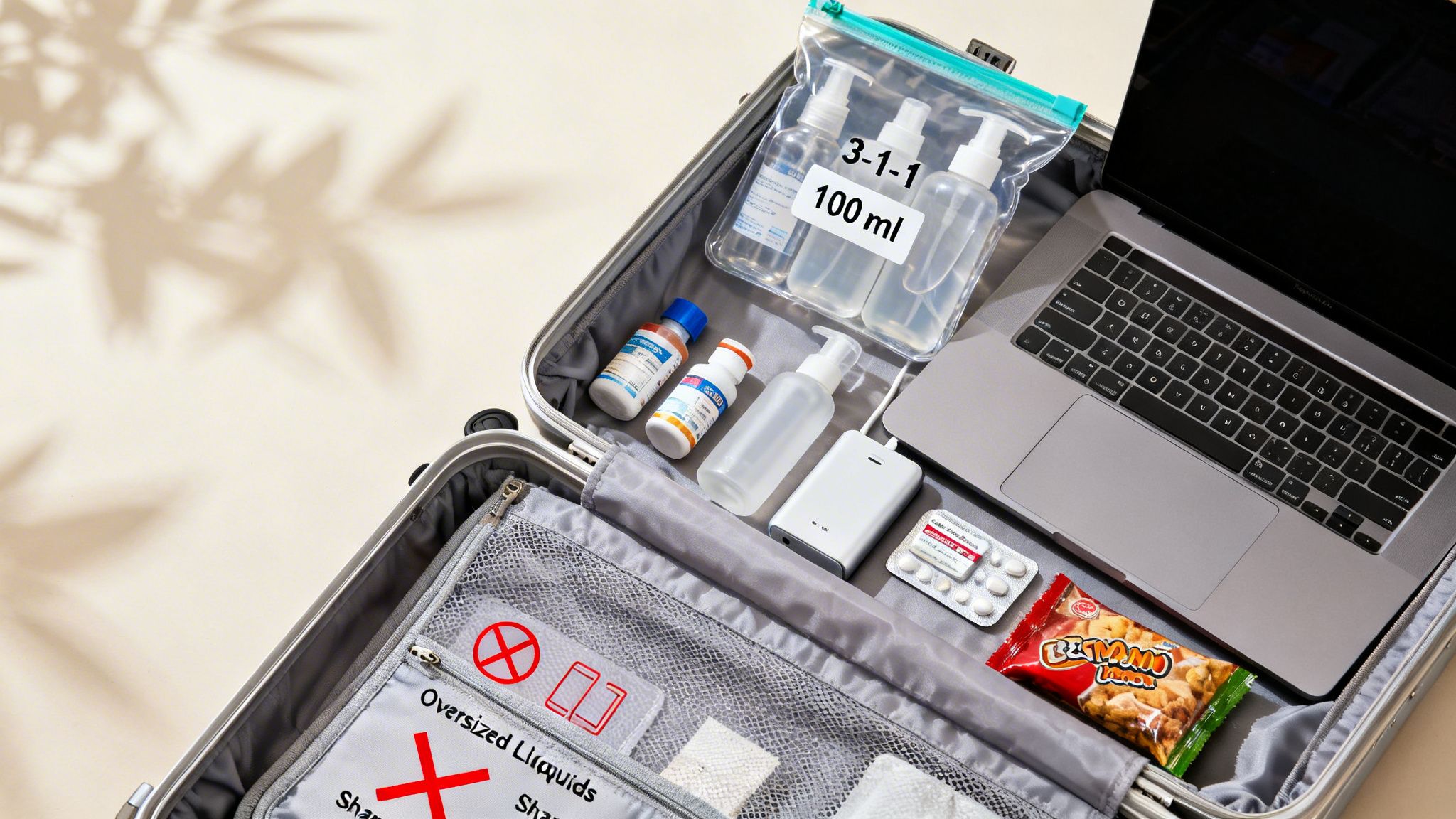
Get this right, and you’ll be the one breezing through security while others are forced to trash expensive toiletries and suffer frustrating delays. This isn't just about following the rules; it's about executing a flawless airport operation.
Master the Liquids Rule
The most infamous rule in the carry-on playbook is the 3-1-1 liquids rule. This is a global standard, so it's a great one to memorize. Think of it as your code of conduct for anything sloshy.
- 3.4 ounces (or 100 milliliters): Each of your liquid containers has to be this size or smaller. And no, a half-empty 6-ounce bottle doesn't count! Don't try to pull a fast one.
- 1 quart-sized bag: All those little bottles have to fit comfortably inside a single, clear, zip-top bag.
- 1 bag per passenger: You get one. Just one. Make it count.
This rule covers anything that qualifies as a liquid, gel, or aerosol. That means your toothpaste, lotion, hair gel, and even that creamy brie or peanut butter you wanted to bring. Want a pro tip? Swap liquids for solids. Solid shampoo bars, conditioner bars, and toothpaste tablets are your new best friends—they don't count towards your liquid allowance and free up precious space in that tiny bag.
Electronics: The Non-Negotiable Carry On Items
Here’s a critical piece of intel: certain electronics must be in your carry-on. We're not kidding. This is non-negotiable, and it’s all about safety. We’re talking about anything with a lithium-ion battery—laptops, tablets, cameras, and especially those power banks.
These batteries are a fire risk. If one acts up in the cabin, the crew can handle it. If it happens in the cargo hold? You've got a potential disaster on your hands. Always pack these in your carry-on or personal item. When you hit the security line, be ready to pull out the bigger gear (laptops, tablets) and put them in a separate bin for the X-ray.
Why Your Carry On Is Your Lifeline
Packing your essentials in your carry-on isn’t just for convenience—it's your best defense against total travel chaos. Get a load of this stat: international routes mishandle bags five times more often than domestic ones. With over 10 million bags delayed, lost, or stolen last year, keeping your critical gear with you is a tactical necessity. You can get the full report from the SITA Baggage IT Insights 2024 report.
Remember: 1 in 20 mishandled bags are gone forever. Packing your medications, electronics, a change of clothes, and travel documents in your carry-on ensures that even if your checked bag takes an unscheduled detour to another continent, your trip continues without a hitch.
Medications, Food, and Other Tricky Items
So, what about the other stuff? The rules can seem a little hazy, but they're simple if you know the drill.
- Medications: Prescriptions and over-the-counter meds are good to go. You don’t have to squeeze liquid medications into your 3-1-1 bag, but you do need to declare them to the security officer for inspection. Our advice? Keep them in their original packaging to avoid any confusion.
- Food: Solid foods like sandwiches, fruit, and granola bars are usually fine. But anything liquid-ish (yogurt, jam, salsa) has to follow the 3-1-1 rule. And watch out for international restrictions on bringing fresh fruits, veggies, and meats into other countries—don’t cause an international incident over an apple.
- Sharp Objects: This one gets people all the time. Cartridge razors? You’re clear. Straight razors or loose blades? They belong in your checked luggage, period. Small scissors with blades shorter than 4 inches are typically okay.
As always, when you score an incredible deal on www.stdarmydeals.com, take a minute to check the security rules for both where you're leaving from and where you're landing. Every smart traveler in the S.T.D. Army knows that a little recon on www.stdarmy.com is the key to a successful trip.
How to Pack Your Carry-On Like a Seasoned Pro
Alright, so you’ve memorized the airline rules and you know what you’re allowed to bring. Now for the fun part—actually fitting it all in. Packing an international carry-on is like a high-stakes game of Tetris, but trust us, with the right strategy, you can win every single time. This isn't about just cramming everything in. It's about building a smart system where every item has its place, making your trip a whole lot smoother.
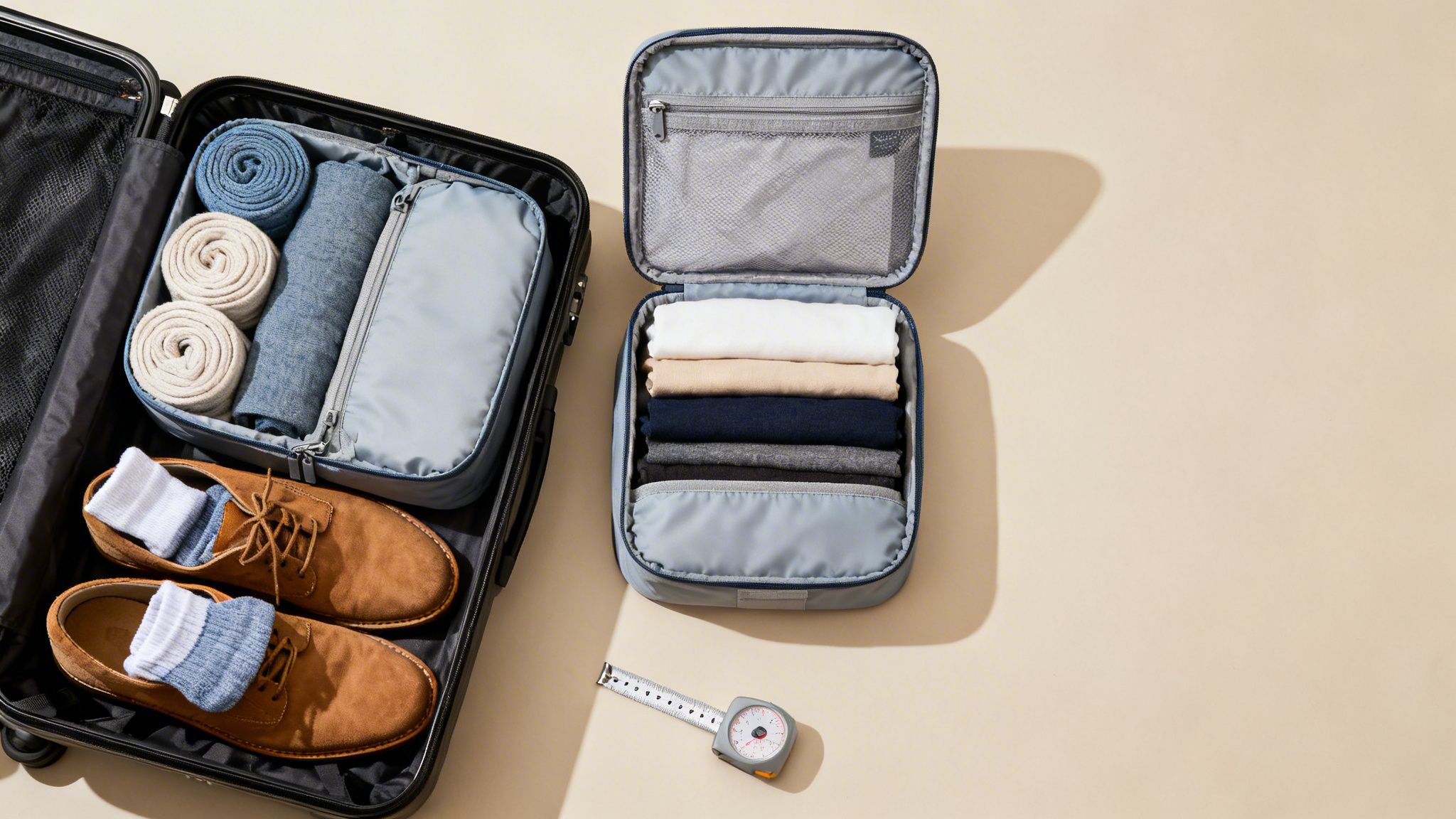
Forget tearing your bag apart on the hotel floor just to find a single clean sock. With these techniques, you'll glide through airports with the confidence of a veteran traveler, leaving the disorganized rookies in your dust. Let's get you packed and ready for action.
The Great Debate: Ranger Roll vs. Flat Fold
When it comes to packing clothes, every traveler has their camp: you're either a roller or a folder. Folding things flat might look neat on your bed, but it creates a ton of wasted air space and leaves you with deep, stubborn wrinkles.
The undisputed champion for maximizing space in your international carry-on is the Ranger Roll. No contest.
This is a clever trick where you roll each piece of clothing into a tight, compact log. It compresses your clothes down to a fraction of their folded size and, believe it or not, seriously cuts down on wrinkles. It’s perfect for almost everything—t-shirts, pants, even dresses.
The Ranger Roll is a total game-changer. By compressing your clothes this way, you can free up as much as 30% more space in your carry-on. That’s extra room for souvenirs or just the sweet relief of a bag that zips shut without a fight.
Now, for a structured blazer or a stiff collared shirt, a careful flat fold might still be the right move. But for 90% of what's in your closet, rolling is the only way to go.
Packing Cubes: The Secret Weapon of Organization
If rolling is your technique, then packing cubes are the tools that make the magic happen. Seriously, these zippered fabric bags are the single greatest investment you can make for staying organized on the road. Think of them as portable drawers for your suitcase.
Instead of one giant, chaotic pile of rolled clothes, you get to neatly categorize everything into its own cube. It's an incredibly slick and efficient system.
- Tops Cube: All your rolled t-shirts, sweaters, and blouses live here.
- Bottoms Cube: Jeans, shorts, and pants get their own dedicated space.
- Smalls Cube: Keep your socks and underwear contained and easy to grab.
- Gadget Cube: All your chargers, adapters, and tangled-up cables stay secure.
This approach transforms your bag from a jumbled mess into an organized masterpiece. Need a clean shirt? Just pull out the "Tops" cube. No more frantic digging. This is a lifesaver, especially for members of the S.T.D. Army who might be bouncing between amazing destinations found on www.stdarmydeals.com and need to pack and unpack in a hurry.
Use Every Last Inch of That Bag
A true packing master knows that empty space is wasted space. Once your big items are cubed and rolled, it’s time to fill in all the gaps. This is where you get to be a little creative.
Your shoes aren't just for walking—they're bonus storage containers! Stuff them with socks, underwear, or even small, fragile items that need a little extra protection. It's a simple trick, but it saves a surprising amount of room.
The little nooks and crannies around your packing cubes are also prime real estate. Tuck in small items like belts (unroll them and snake them around the perimeter of the bag), your toiletry kit, or a slim umbrella. The goal is to create a dense, solid block of stuff, which also keeps everything from shifting around and getting wrinkled.
Of course, starting with a lightweight, durable bag is half the battle, since it won't eat up your precious weight allowance. Here at www.stdarmy.com, we know that having the right gear is just as important as finding the right deal.
Sample Carry On Packing Checklists for Any Trip
Alright, team, enough with the theory. You've got the rules of engagement down, so let's get ready for takeoff. To make sure you’re trip-ready without any guesswork, we've put together a few brilliant packing lists for trips you might book through S.T.D. Army Deals.
Don’t just see these as simple lists. Consider them your personal blueprints for travel victory. They're proof that with the right strategy, you can conquer a week-long trip (or longer!) with just your international carry on. Say goodbye to checked-bag fees and the dreaded baggage claim carousel.
The 7-Day European City Hopper
This trip demands mobility. You'll be navigating cobblestone alleys, jumping on high-speed trains, and maybe even trying to look like you belong. Your pack needs to be light, smart, and ready for anything.
- Clothing (Think Layers, Not Luggage):
- Tops: Pack 3-4 neutral t-shirts or blouses. They need to work with everything else you bring.
- Layers: A merino wool sweater and a packable rain jacket are your best friends. Don't leave home without them.
- Bottoms: One pair of dark, comfortable jeans and one pair of versatile travel pants or chinos. That's it.
- Footwear: One pair of stylish, already broken-in walking shoes. Wear your bulkiest shoes on the plane to save space.
- Essential Gear:
- A universal power adapter and a portable power bank. A dead phone can ruin the day.
- Solid toiletries like a shampoo bar and toothpaste tabs. This keeps your liquids bag free for other essentials.
- A reusable water bottle. Staying hydrated is key!
The All-Inclusive Resort Fanatic
You snagged an incredible deal, and your only objective is total relaxation. This isn't about roughing it; it's about sun, sand, and simplicity. Packing light here means less time wrestling with a giant suitcase and more time with a drink in your hand.
Listen up. A common mistake is packing a dozen outfits for a beach vacation that never see the light of day. A true pro focuses on dual-purpose items. Think of a sarong that can be a beach cover-up by day, a skirt for lunch, or a light scarf on a breezy night.
- Clothing & Gear:
- Swimwear: Bring 2-3 swimsuits. One can be drying while you're wearing the other.
- Cover-Ups: 1-2 lightweight cover-ups or sarongs will do the trick.
- Outfits: Pack 2 casual day outfits (like sundresses or shorts combos) and 2 slightly nicer outfits for the evening.
- Footwear: One pair of flip-flops and one pair of wedges or dressier sandals for dinner.
- Health & Tech:
- A small first-aid kit. You'll want basics like pain relievers, bandages, and some good after-sun lotion. Trust us.
- A waterproof phone pouch. Protect your gear from sand and surf.
- Plenty of reef-safe sunscreen. A solid stick sunscreen is a brilliant space-saver!
For a full tactical breakdown, our complete all inclusive resort packing list has every angle covered.
The Minimalist Business Traveler
Efficiency is the name of the game. Your international carry on is your mobile command center and your closet. The entire operation hinges on wrinkle-resistant clothing and the tech you need to stay sharp and productive.
- Wardrobe (No Wrinkles, No Problem):
- 1 suit or a blazer/skirt combo in a dark, forgiving color.
- 2-3 wrinkle-free dress shirts or blouses.
- 1 pair of dress shoes. If they're bulky, wear them on the flight.
- Tech & Documents:
- Laptop, all necessary chargers, and a multi-port USB hub for good measure.
- A folder with printed copies of every critical document—boarding passes, hotel confirmations, meeting agendas.
- Noise-canceling headphones. Essential for working on the plane or just finding a moment of peace.
Use these checklists as your starting point. As a member of the S.T.D. Army, you already know that preparation is the key to any successful trip. Now, get packing!
Last-Minute Tips to Avoid Gate-Checking Your Bag
Alright, traveler, deep breaths. You’ve navigated the chaos of check-in and breezed through security. But the journey isn't over. The final hurdle is at the boarding gate, and this is where your smart prep truly pays off. One wrong move and you’ll hear those dreaded words, “Sorry, your bag’s too big. We’ll have to check it for a fee.”
We’re not letting that happen. Not on our watch.
With a few tactical maneuvers, you’ll march right onto that plane, your international carry on securely in hand. The final moments before boarding are a high-stakes game. Stay sharp. Here’s how you win.
Last-Minute Tactics for Boarding Success
Gate agents have eagle eyes, but we’re smarter. Time to deploy one of the oldest tricks in the book: wear your bulkiest items. That heavy jacket? Your chunky hiking boots? Put 'em on. This isn't a fashion show; it's a strategic move to free up precious space and weight in your bag.
Next, make sure your personal item is just that—personal. Don't try to pass off a second carry-on. A small backpack or a simple tote that you can easily shove under the seat in front of you is your best bet. It flies under the radar and won't get you a second glance.
Think of a crowded flight as a land grab for overhead bin space. If your bag looks even a hair too big or you’re one of the last to board, you’re a prime target for a forced gate-check. Get to the gate early, line up with your boarding group, and be ready to claim your spot.
Securing Your Overhead Bin Space
Your boarding group isn't just a number—it’s your strategic advantage. Getting into an early group is the single best way to guarantee you’ll find an open spot for your bag. When you snag a killer flight deal on our booking site, www.stdarmydeals.com, ask yourself if paying a few extra bucks for priority boarding is worth the peace of mind. We'll tell you right now: it usually is.
Once you're on board, don't just throw your bag in the bin. Place your international carry on wheels-first. It's the most efficient way to stack 'em, and it leaves room for your fellow travelers. A little airport etiquette goes a long way.
Here’s a pro tip: your choice of luggage matters. A soft-sided bag with compression straps can be cinched down to look smaller and less conspicuous. A hard-shell case, on the other hand, has zero give. If it’s pushing the size limits, it's going to stick out like a sore thumb. And if you’re looking for more ways to keep cash in your pocket, check out our guide on how to save money on flights.
The S.T.D. Army Advantage
Your greatest weapon in this fight is knowledge. And there’s no better source than your fellow travelers in the S.T.D. Army community at www.stdarmy.com. This is our home base, a network of passionate travelers sharing real-time reports from their adventures.
- Airline Intel: Find out which airlines are weighing bags at the gate this week or getting extra-strict with their sizers.
- Airport Alerts: Get a heads-up on specific airports or terminals where gate agents are on the lookout.
- Shared Strategies: Learn new tricks from seasoned veterans on how they consistently pull off carry-on-only travel.
This is about more than just finding cheap deals. We are a community dedicated to helping each other win at every stage of the travel game. We share our knowledge, our victories, and our lessons learned so every single member is prepped for a successful trip. Welcome to smarter travel.
Your Top International Carry On Questions, Answered
Still got questions rattling around in your head? Good. A smart traveler always asks for more intel. We’ve heard these same questions from our S.T.D. Army community, so listen up. Here's the no-nonsense debrief on the trickiest international carry-on rules.
What's the Safest Bet for International Carry On Size?
If you want one bag that gives you the best odds of marching right onto the plane, aim for 22 x 14 x 9 inches (55 x 35 x 23 cm). Think of this as your universal key—it’ll unlock most overhead bins without a fight.
But don't get cocky. Those budget airlines love setting ambushes with smaller, custom size requirements. After you snag a killer deal on www.stdarmydeals.com, your very next move is to verify the exact dimensions with that specific airline. Don't get caught in a surprise attack at the gate.
So, Can I Bring a Personal Item Too?
Yes, you get a sidekick. Most international flights let you bring one personal item—like a small backpack, purse, or laptop bag—on top of your main carry-on. The one non-negotiable rule: it has to slide completely under the seat in front of you. No exceptions.
And listen, they’re getting real strict on this. Don't even think about trying to sneak a second, bloated carry-on past them and call it a "personal item." The gate agents have seen that trick a million times, and they will call you out on it.
Pro Tip: Your personal item is for your mission-critical gear. Load it with your passport, phone, charger, meds, and a snack. That way, you're not digging through the overhead bin every five minutes. Keep your essentials within arm's reach.
How Strict Are They Really About Carry On Weight?
Assume they are extremely strict. This isn't your lazy domestic flight where nobody bats an eye. International carriers, especially across Europe, Asia, and Australia, are notorious for enforcing their weight limits, which are often a lean 7-10 kg (15-22 lbs).
It’s completely normal for them to have scales at check-in and right at the boarding gate, ready to bust anyone who's overweight. Expect your bag to be weighed. Always. Pack smart to avoid those soul-crushing, last-minute fees that can ruin a perfectly good trip.
At Sgt. Travel Deals Army, our whole mission is to arm you with the intel for fee-free, stress-free travel. Ready to become a savvy traveler? Enlist with our community at www.stdarmy.com for more tips and access to incredible deals that make your next global operation possible.