
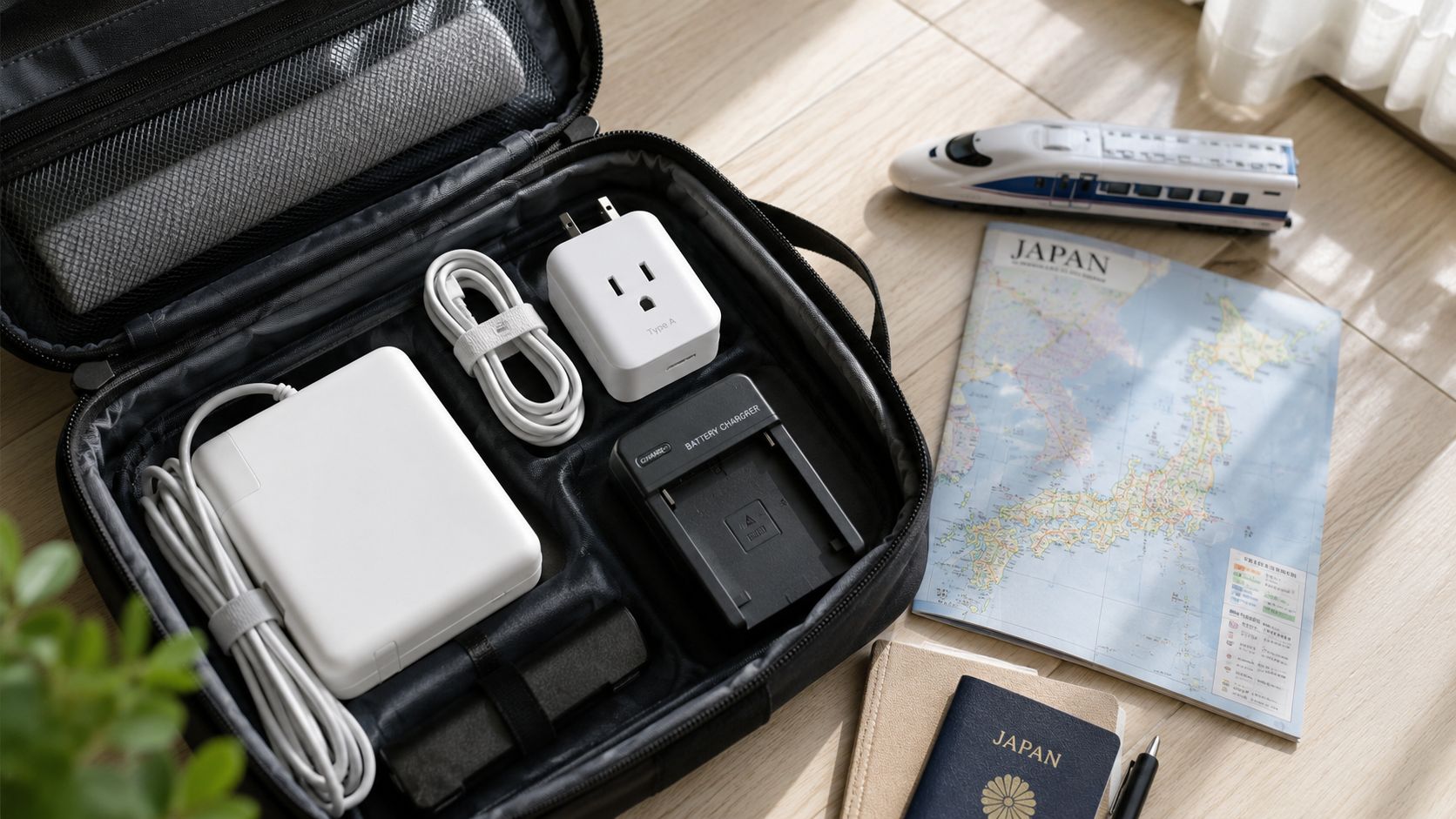
Your Japan trip is coming together. Flights are booked, hotel tabs are open, and your chargers are sitting in a pile on the bed like a last-minute inspection lineup. Then the question hits: do you need an adapter for Japan, or is this one of those travel problems the internet loves to overcomplicate?
The focus often misses the mark. The critical issue usually isn't the plug shape for U.S. travelers. It's grounding and voltage compatibility. That device-specific reality is exactly the gap many travelers miss, as noted by Tourist Japan's guidance on electrical adapters for Japan. If you're also running through your overall packing list, keep your essentials tight and practical with this packing checklist.
Your Pre-Travel Mission Briefing on Power
If you're traveling from the U.S., there's a decent chance you need less gear than you think. Your phone charger probably isn't the problem. Your laptop brick might not be either. The item most likely to cause trouble is the random three-prong plug or single-voltage grooming tool you tossed into your bag without checking.
That's why “Do I need an adapter for Japan?” is the wrong first question.
The right questions are these:
- What plug does my device have
- Is it dual-voltage
- Is it grounded with three prongs
- Is it a charger or a heat-producing appliance
Bring discipline to this, and you'll avoid the classic mistake of buying a bulky converter you never use, or worse, packing a simple adapter and assuming it solves everything.
Here's the clean truth. A lot of U.S. travelers can charge their everyday electronics in Japan with no drama at all. But not every device gets that green light, and that's where people get burned. The issues can be genuine.
Understanding Japan's Unique Power System
Japan keeps the plug question simple and the voltage question sneaky. U.S. travelers usually get tripped up by the second one.
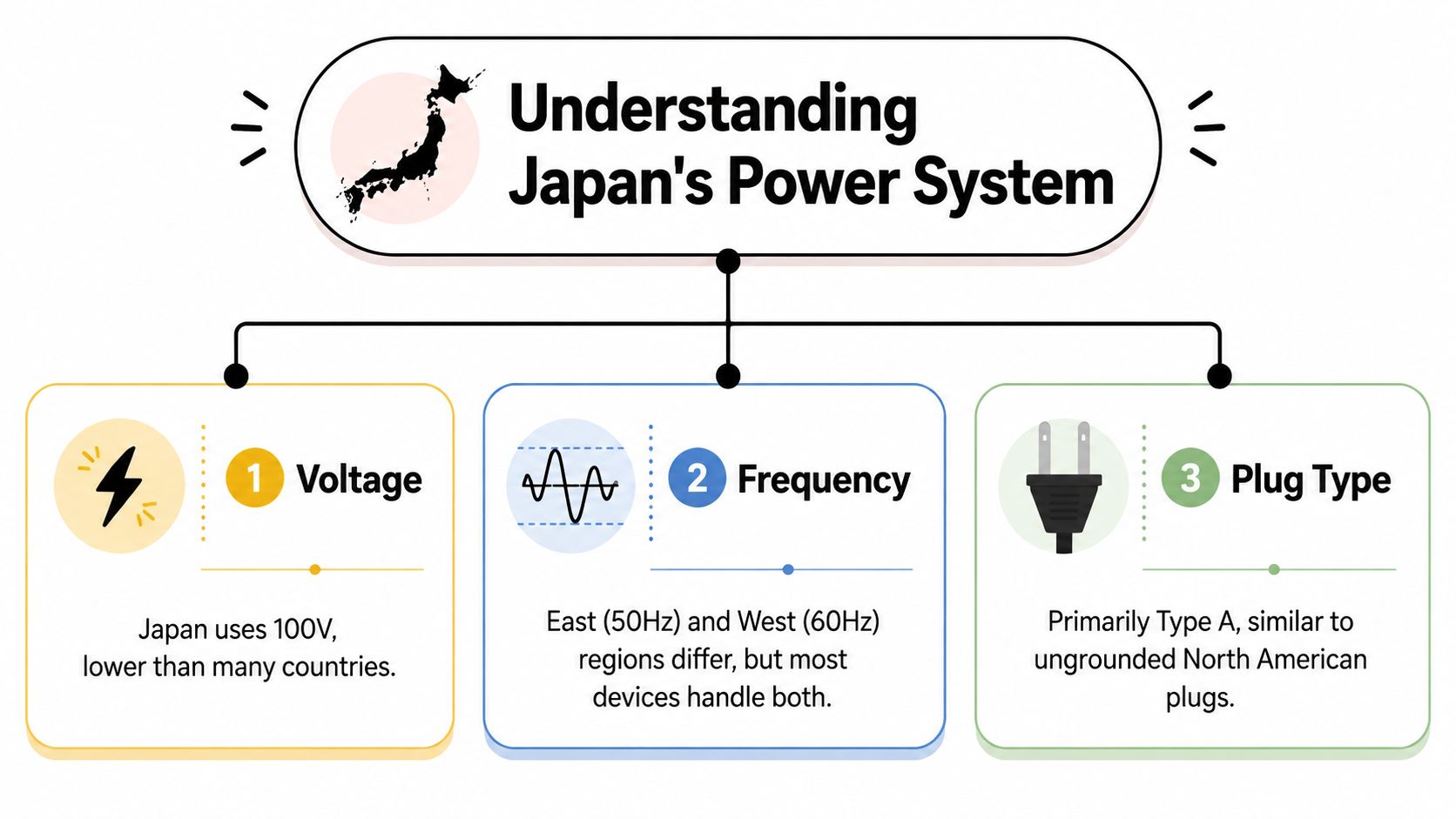
Start with the wall. Japan mainly uses Type A outlets, the same two flat parallel slots U.S. travelers see at home. In practice, that means many American phone chargers, laptop chargers, and camera chargers plug straight in with no adapter at all. This Japan travel adapter guide notes that Type A is the standard outlet style in Japanese homes and hotels.
The trouble starts with three-prong plugs. A grounded U.S. plug often will not fit a standard Japanese outlet, even if the device itself can handle Japan's electricity just fine. That is why plug shape is only the first checkpoint.
If your trip includes multiple stops before Japan, this Korea to Japan travel route guide can help you sort the logistics before you sort your charging kit.
Now the part that decides whether your device is safe to use. Japan runs on 100 volts. That is a bit lower than the 120 volts common in the U.S. For most modern chargers, that difference is no big deal because they are built for a wide input range. For older appliances and heat tools, it can absolutely matter.
Japan also uses two power frequencies depending on the region:
- Eastern Japan: 50Hz
- Western Japan: 60Hz
Modern electronics usually handle both frequencies without complaint. Older motor-driven devices, clocks, and specialty gear are more likely to care. So if you are packing a phone charger, you are probably fine. If you are packing an old curling iron, electric shaver, or some niche gadget from the garage, check the label before it goes in your bag.
Here is the practical takeaway. For many U.S. travelers, Japan is not an adapter problem first. It is a device compatibility problem first. If the plug has two flat prongs and the charger supports a wide voltage range, you may need nothing. If the plug has three prongs or the device only supports U.S. voltage, you need to solve that before wheels up.
Adapter vs Converter The Critical Difference
Travelers often make dumb, expensive mistakes. An adapter is not a converter.
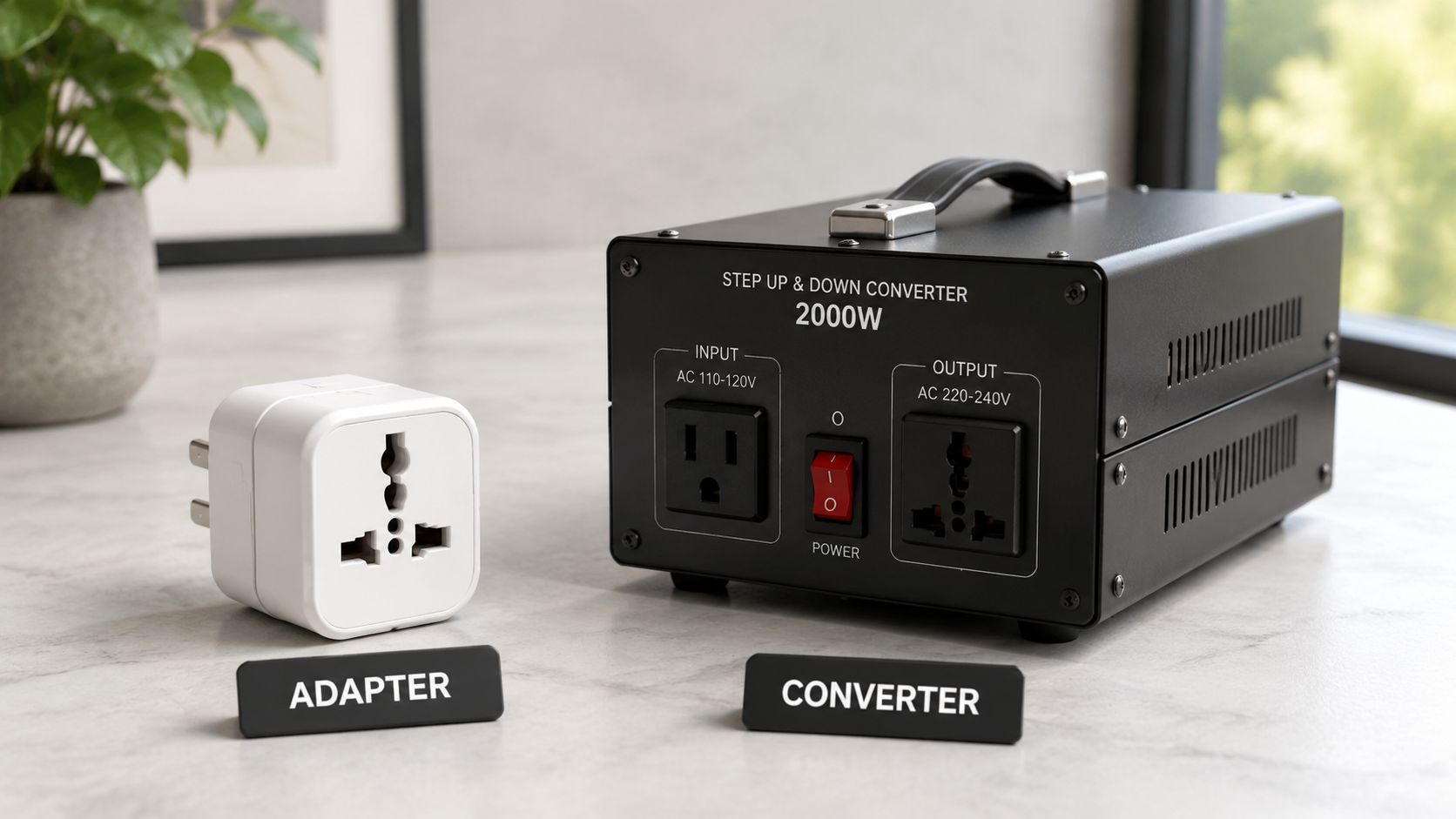
An adapter changes the plug shape. That's it. It helps your device physically connect to the wall.
A converter changes the electrical voltage. That's the heavier tool you only need if your appliance can't handle Japan's power on its own.
According to KYT Chargers' Japan adapter checklist, the practical rule is simple: an adapter only changes the plug interface, not the voltage, and travelers with grounded three-prong devices often need a Type B-to-Type A adapter.
Adapter vs converter at a glance
| Feature | Travel Adapter | Voltage Converter |
|---|---|---|
| Main job | Changes plug shape | Changes voltage |
| Best for | Plug compatibility | Single-voltage appliances |
| Use with phone charger | Usually yes | Usually unnecessary |
| Use with old hair dryer | Not enough by itself | May be required if the device isn't rated for 100V |
| Typical size | Small and packable | Bulkier and heavier |
A plain-English rule for your rucksack:
- Adapter: gets the plug into the wall
- Converter: makes the electricity suitable for devices that need different voltage
Need a visual explainer? This quick walkthrough helps clear the fog:
If your appliance says only 120V and you plug it into Japan with just an adapter, you're gambling with gear you probably don't want to replace on vacation.
How to Check if Your Devices Will Work
Stop guessing. Pick up each device and inspect it.
You're looking for the tiny print labeled INPUT. It's usually on the charger brick, near the plug, or on the underside of the device. Your job is to find out whether your gear can accept Japan's power as-is.
What the label should say
If you see something like 100-240V and 50/60Hz, that device is built for travel. It can usually handle Japan's system without a voltage converter.
That's why modern phone chargers, laptop chargers, camera battery chargers, and USB-powered gadgets are usually easy wins. Japan's two-frequency setup also isn't a major obstacle for most current chargers. This YouTube explainer on Japan's outlet setup notes that Japan uses both 50Hz and 60Hz, and that approximately 98% of Japanese outlets are Type A.
What should make you stop
If the label only shows a single voltage such as 120V, don't assume it'll be fine. That's the moment to either bring a proper converter or leave the item at home.
Run this inspection on these items first:
Phone charger
Usually the easiest pass. Most modern ones are travel-friendly.Laptop power brick
Check the brick, not just the wall plug. A three-prong plug may still need a physical adapter even if the voltage range is fine.Camera battery charger
Usually safe if it lists broad input voltage.Hair dryer, curling iron, trimmer, steamer
These are the danger zone. Check every single one.
A fast field test
Use this no-nonsense checklist before you pack:
- If it says 100-240V: good candidate for Japan
- If it says 50/60Hz: frequency won't be your problem
- If it has two flat U.S. prongs: it may fit directly
- If it has three prongs: plan for a grounding workaround
- If it's a heat appliance with single-voltage input: leave it home unless you know exactly what support it needs
Most charging problems on the road come from people not reading the label. The label tells the truth. Your assumptions don't.
Choosing the Right Adapter for Your Mission
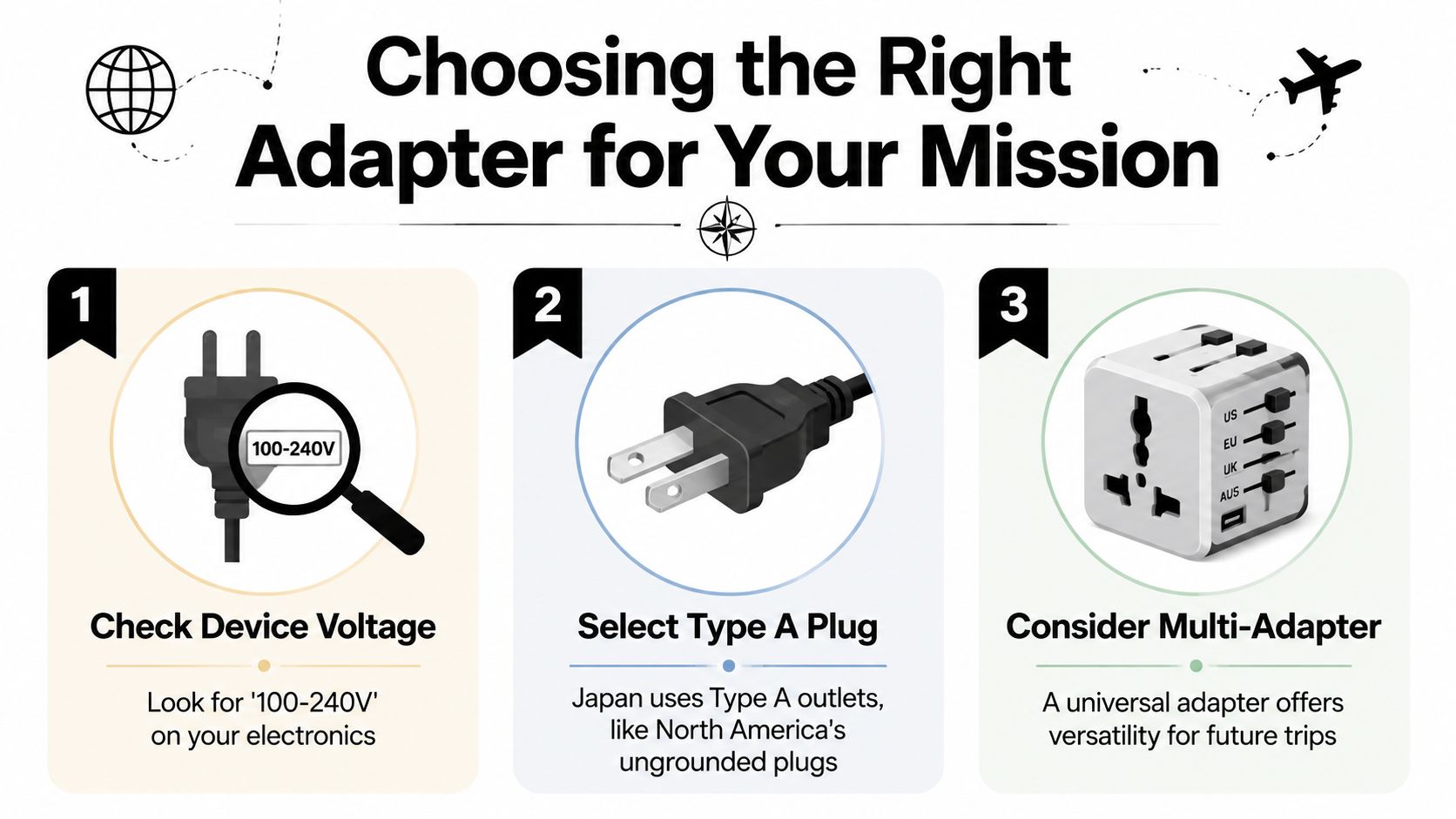
Once you've checked your gear, buying the right adapter for Japan gets easy.
If you're a U.S. traveler carrying mostly two-prong dual-voltage chargers, you may not need a traditional adapter at all. That's the part many articles bury. For plenty of Americans, the better purchase is a compact charging setup that solves outlet scarcity, not outlet incompatibility.
What I'd actually pack
My recommendation is straightforward:
- For U.S. travelers with two-prong chargers: pack a compact multi-port USB charger if your charger block supports your devices and fits your setup
- For travelers with three-prong plugs: bring a simple plug adapter that handles the grounding mismatch
- For non-U.S. travelers: bring a reliable Type A travel adapter
- For single-voltage appliances: don't rely on a basic adapter and hope for the best
Features worth paying for
Don't get seduced by gimmicks. Look for function.
- Compact body: You don't need a brick the size of a field radio.
- Firm fit: Loose adapters are junk.
- USB charging support: Useful if you're charging a phone, power bank, earbuds, and watch from limited outlets.
- Universal design: Smart if Japan is one stop on a longer trip.
A cheap adapter that fits poorly is a nuisance every night. A small, sturdy one earns its keep.
My opinionated buying rule
If your trip is only Japan and you know your device mix, buy for that mission. If you travel internationally often, get a decent universal adapter and be done with it.
Don't overpack electrical gear. Japan is not the place to haul a bag full of questionable single-voltage appliances you barely use at home.
Sgt Travel's Final Power and Packing Briefing
You do not want to discover your mistake at 11 p.m. in a Tokyo hotel room with a dead phone, one wall outlet, and a hair tool that smells like it's about to surrender.
Here's the final call. Stop obsessing over plug shape first. Your real decision starts with the device. If the charger or appliance can handle Japan's power, you're in business. If it can't, a plug adapter will not save it.
Run this check before you zip the bag:
- Read the INPUT label on every charger and appliance
- Use the label, not your memory
- If it shows a wide voltage range, your phone and laptop chargers are usually fine
- If it has a three-prong plug, solve the fit problem with the right adapter
- If it is single-voltage, keep it out of your bag unless you also have the right converter
- Leave bulky heat tools at home unless you have confirmed they are compatible
For the rest of your bag, tighten up your loadout with this international carry-on packing guide.

My rule is simple. Dual-voltage device plus a plug that fits. Use it. Dual-voltage device plus a plug that does not fit. Add an adapter. Single-voltage device with the wrong power requirements. Stop and reconsider before you cook it halfway through your trip.
If you want the rest of your trip planned with the same no-nonsense mindset, enlist with Sgt. Travel Deals Army. It's a veteran-owned platform built to help travelers compare smarter and book better. Once you're in, use STD Army Deals to hunt hotels, flights, car rentals, activities, and more for your Japan run.