
TL;DR: Yes, you can take a rental car to Mexico, but it’s not as simple as driving to another US state. Only certain rental companies allow it from specific locations, and you absolutely must buy separate Mexican car insurance. Think of it as a special operation. It requires planning, the right paperwork, and knowing the rules of engagement.
You’re probably sitting there with tabs open, comparing rates, maybe already plotting beach stops, taco runs, or a family road trip south of the border. Then the buzzkill question hits: can you take a rental car to mexico or are you about to get shut down at the border like a rookie who skipped the briefing?
Good question. And the short version is this: sometimes yes, often no, and almost never without hoops.
A lot of travelers assume a rental car works the same way it does when crossing state lines. Wrong. Mexico changes the playbook. Rental company permission, Mexican insurance, and border paperwork all matter. Miss one piece and your road trip can turn into an expensive parking lot exercise.
So You Want to Road Trip to Mexico? Here's the Intel
The dream is solid. Grab the keys at a U.S. airport, point the hood south, and roll into Mexico with your playlist, snacks, and confidence fully loaded. I like that energy.
But this mission needs more than enthusiasm.

Some companies allow cross-border travel only from select border-state locations. Some ban it outright. Some say yes only if you have a corporate account or special authorization. That’s why casual assumptions get people in trouble.
The three things that decide the mission
If you remember nothing else, remember these:
- Company permission: If the rental company didn’t approve the Mexico trip, you’re dead in the water.
- Mexican insurance: Your U.S. setup doesn’t carry the operation by itself.
- Border documents: Depending on where you’re going and how long you’re staying, you may need extra permits.
That’s the fundamental answer behind can you take a rental car to mexico. It isn’t about whether the car can physically cross. Of course it can. It’s about whether the company, the law, and the paperwork all line up.
Field rule: Never trust “I think it’s allowed.” Get the approval in writing from the rental branch.
The good news is this isn’t impossible. It’s just picky. If you’re organized, patient, and willing to follow orders, you can do it right.
Why travelers get blindsided
Travelers often fail because they book based on price first and rules second. Bad move. A cheap rental that can’t legally cross the border is not a deal. It’s a trap with cup holders.
Others assume their credit card will save them. Also a bad move. Mexico has its own legal requirements, and rental companies care about those requirements a lot more than your confident speech at the counter.
So yes, the mission is doable. But don’t freelance this one. Check the company policy, prepare your docs, and know your route before you ever leave the lot.
Your Rental Company's Cross-Border Rules
At this point, the operation either gets a green light or a hard no.
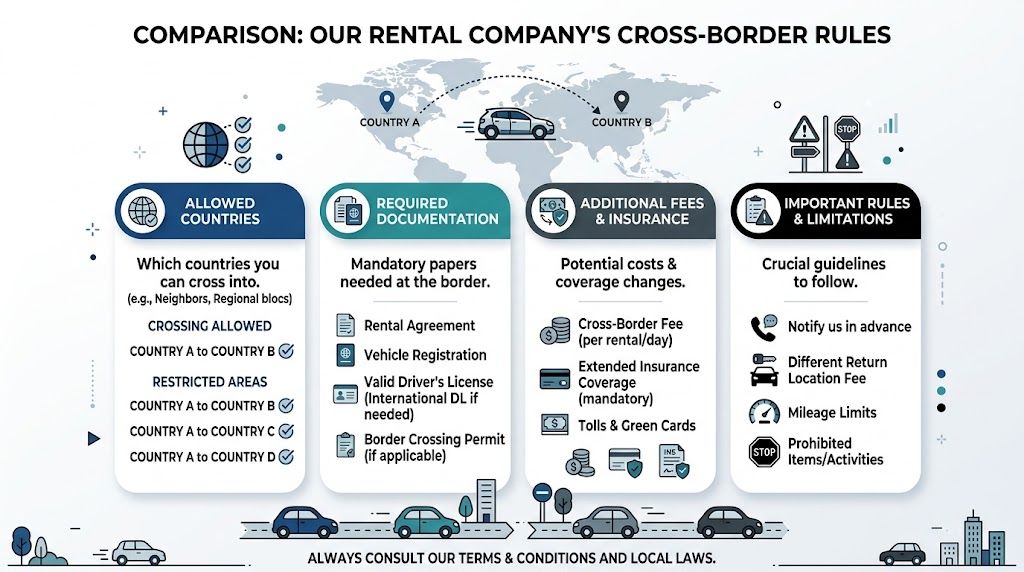
Major rental companies do not use one simple policy. They all write their own rules, and those rules can be wildly different. According to Avis cross-border rental guidance, Avis may allow travel from select Texas or Arizona locations if you have a corporate AWD number and buy their specific Mexican insurance, while Enterprise explicitly prohibits it entirely. Hertz and its affiliates also ban taking U.S. cars to their Mexican locations due to local laws.
The fast answer by company
Here’s your field manual version.
| Rental Company | Allows Travel to Mexico? | Key Restrictions & Requirements |
|---|---|---|
| Avis | Sometimes | Only from select locations, tied to border states, requires corporate AWD number, advance notice, special Mexican liability insurance, and return to the U.S. |
| Budget | Sometimes | Conditional approval from select border-state locations, usually requires U.S. residency, corporate status, and Mexican liability insurance. Return to the U.S. required. |
| Enterprise | No | U.S.-rented vehicles cannot be driven into Mexico. |
| Hertz | Generally no for U.S. rentals returning to Mexican locations | Cross-border use is heavily restricted and U.S. vehicles cannot be returned to Mexican locations. |
| Dollar | No for return into Mexican locations | Restricted due to local law issues. |
| Thrifty | No for return into Mexican locations | Restricted due to local law issues. |
That table should save you a pile of time and at least one headache-induced snack purchase.
The two camps you need to know
Hard no companies
Enterprise is the cleanest example. They prohibit taking U.S. rental vehicles into Mexico. No debate. No clever workaround. No “but I’m only going for the day.”
If a company sits in the hard-no camp, stop trying to negotiate with reality. Pick a different strategy.
Conditional go companies
Avis and Budget fall into the “possible, but don’t get cocky” camp. You may be able to cross, but only from approved locations and only if you meet their requirements. That can include corporate credentials, advance notice, and their approved Mexican coverage.
This is why the pickup location matters as much as the brand name. One branch near the border may handle Mexico-approved rentals. Another branch with the same logo may shut you down immediately.
Some companies don’t just ask where you’re driving. They care where you picked up the car, how you’re covered, and whether the branch gave explicit approval.
Why the rules are so strict
This isn’t rental-car bureaucracy for fun. It comes down to liability, recovery, and insurance jurisdiction. Once a U.S.-rented car goes into Mexico, the risk profile changes and the company wants tighter control.
That’s also why so few travelers get approved compared with the total number of people renting near the border. Practical restrictions narrow the field fast.
Questions to ask before you book
Call the branch. Don’t just read the homepage and salute yourself.
Ask these:
- Can this exact vehicle be driven into Mexico from this exact location?
- What written authorization do I need at pickup?
- What insurance must I buy through you?
- Can I drive only near the border, or farther inland?
- Must the vehicle return to the U.S.?
If the agent sounds fuzzy, ask again or call another branch.
For price shopping before you make those calls, compare options through S.T.D. Army car rental rates. Then verify the Mexico rules directly with the rental location before you hand over your card.
My recommendation
If the company says anything less than a crisp yes with written steps, treat it as a no. That’s the smart play. Confusion at the rental counter is annoying. Confusion at the border is a full-blown self-inflicted disaster.
Unlocking the Border with Mexican Auto Insurance
This is the part people try to wiggle out of. Don’t.
Mexican law mandates third-party liability insurance for all vehicles. Failure to comply can result in fines up to 20,000 MXN (about $1,000 USD) or vehicle impoundment, and rental agencies often reject U.S.-based insurance and require their approved policy on-site, as explained in this guide to renting a car in Mexico.
What TPL actually means
Third-Party Liability, often shortened to TPL, covers damage or injury you cause to other people. It’s the legal baseline. It is not the glamorous part of trip planning, but it’s the ticket that keeps your operation legal.
It functions as a passport for the car. Without it, the vehicle isn’t properly cleared for the mission.
What not to assume
Don’t assume your regular U.S. auto policy solves this.
Don’t assume your travel credit card solves this either.
Don’t assume showing proof from home will impress the rental counter. It won’t.
Rental companies that allow Mexico travel usually require you to buy their approved Mexican liability policy. That’s how they control compliance and keep the paperwork tied to the vehicle.
What this does to your budget
This requirement can inflate your total trip cost. That’s one reason some travelers decide the easier move is to rent inside Mexico instead of crossing with a U.S. rental.
Plan for the insurance cost before you book the “cheap” car. If you don’t, the desk agent is going to educate you in the least fun way possible.
Practical rule: If the rate looks suspiciously low, it probably doesn’t include everything you need for Mexico.
What to do at the counter
Use this simple checklist:
- Ask for the Mexico authorization paperwork: Don’t leave without it.
- Confirm the insurance is specifically valid in Mexico: The words matter.
- Read the return rule: Many approved rentals must come back to the U.S.
- Keep proof handy: Don’t bury it in your luggage like a chaos goblin.
If the agent can’t clearly explain what coverage applies after crossing, stop the process and get a supervisor.
My opinion on this
This is not the place to be cheap, stubborn, or “pretty sure.” Insurance is the lock on the gate. If you don’t have the exact approved coverage, you’re not running a road trip. You’re running a gamble.
Essential Documents for Your Mexico Mission
You’ve got company approval. You’ve got insurance handled. Good. Now stack your paperwork like a grown-up and not like someone stuffing receipts into a glove box.
The required documents depend on your route and how long you’ll stay. For travel beyond the 20-25km border zone or for stays longer than 72 hours, you’ll need an FMM tourist permit for around $30 and a Temporary Vehicle Importation Permit (TIP) for around $50. These can be obtained digitally, and having them ready in advance is tied to 98% smoother entry according to Hertz Mexico conditions and permit guidance.
Your checklist before you roll
Carry these in one folder. Physical copies. Digital backups too.
- Passport: Keep it current and accessible.
- Valid driver’s license: Your home-country license is generally what you’ll use.
- Rental agreement: It needs to reflect your legal rental details.
- Written authorization for Mexico travel: If the company approved the crossing, keep that proof handy.
- Proof of Mexican insurance: Border and roadside issues are not the time to go digging through email.
- FMM permit: Needed for certain stays and travel beyond the basic border zone.
- TIP permit: Required if you’re taking the vehicle farther into the interior beyond the exempt area.
FMM versus TIP
These two get mixed up constantly. They are not the same thing.
FMM
This is your tourist permit. It’s about you entering and staying under the proper travel rules.
TIP
This is about the vehicle. It tells authorities the foreign-plated car is temporarily in the country under the right process.
One handles the traveler. One handles the car. Keep both straight.
When you need extra prep
If your route stays close to the border for a short visit, the paperwork burden may be lighter. If you’re pushing farther inland or staying longer, the permit game gets serious fast.
That’s why route planning matters before pickup, not after. A casual “we’ll figure it out on the way” strategy is how people wind up burning hours at the border.
For a smart budget check before the trip, review what rental holds can look like at S.T.D. Army’s car rental deposit guide. Then make sure your card can handle both the rental side and your travel spending without choking halfway through the mission.
Keep every critical document together. Border staff don’t care that your confirmation email is buried under screenshots of taco recommendations.
My recommendation
Get the permits before travel whenever possible. Show up organized, calm, and boring. Border crossings reward boring. Chaos is for people who enjoy unnecessary suffering.
Your Step-by-Step Border Crossing Game Plan
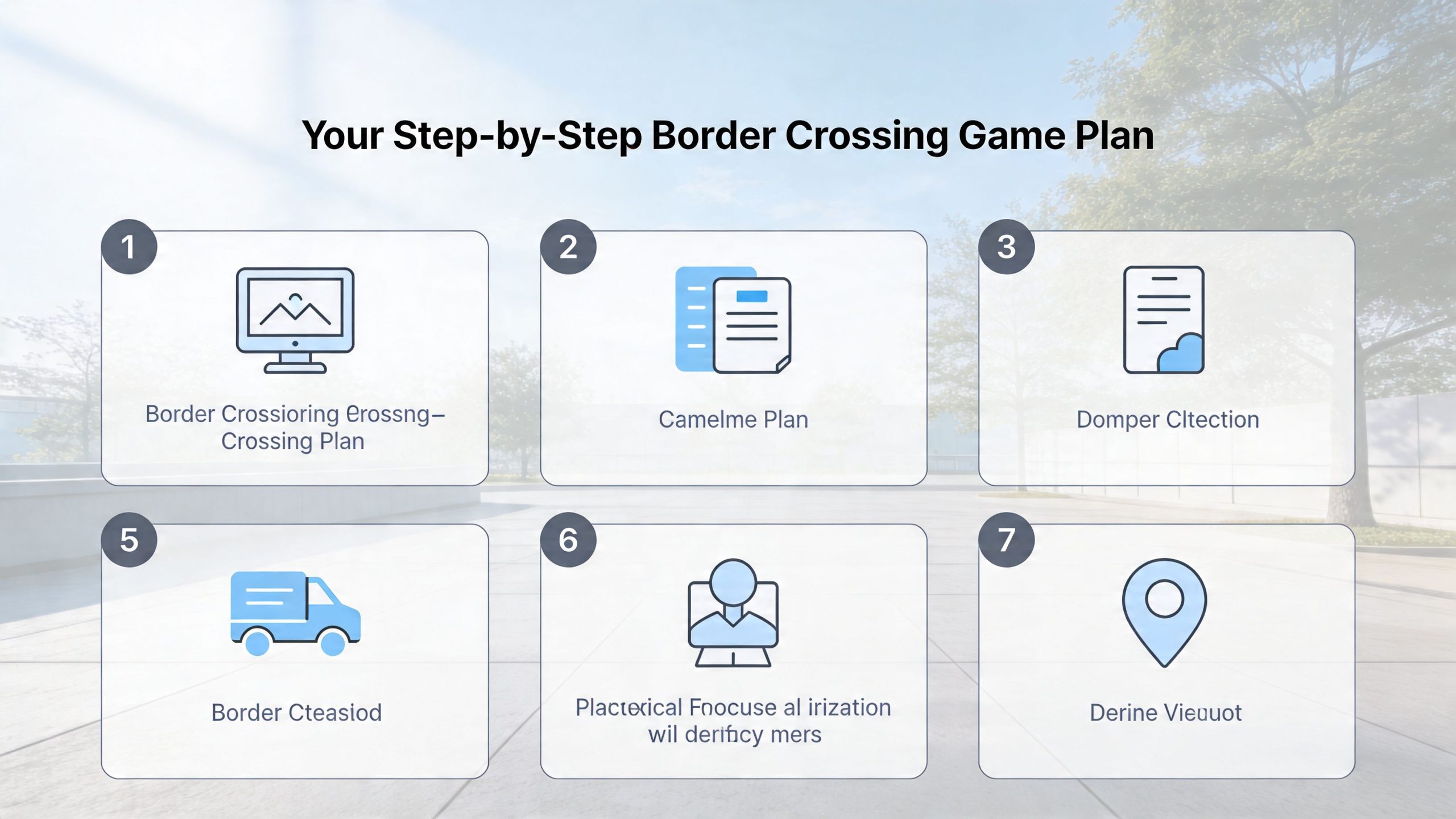
This is the moment recruits get sweaty palms. Relax. Border crossings aren’t magic. They’re a process. Follow the steps and don’t improvise like you’re in an action movie.
Without proper company authorization and Mexican insurance, you could face full personal liability up to $50,000 USD per incident under Mexican law, according to Budget’s guidance on crossing into Mexico with a rental car. That’s why the procedure matters.
Step 1
Do a final document check before leaving your hotel, airport area, or rental lot.
You want passport, license, rental agreement, written Mexico authorization, insurance proof, and any permits you already secured. If one item is missing, fix it before you drive toward the checkpoint.
Step 2
Approach the border calmly and follow posted directions.
Don’t speed in like you’re late for a hostage exchange. Keep your documents reachable, your answers short, and your vehicle clean enough that nobody thinks you live in it.
Step 3
Tell the truth.
If an officer asks where you’re headed, answer directly. If they ask about the rental, say it’s an authorized rental and have the paperwork ready. This is not the time for long stories, jokes, or dramatic over-explaining.
Short answers win. Border officers want clarity, not your life story.
Step 4
Handle the personal entry process first if required.
If your route or stay means you need that traveler permit, get it handled properly. Don’t assume somebody waved you through, so everything else is magically covered.
Step 5
Handle the vehicle paperwork if you’re going beyond the exempt area.
Having your permit ready in advance makes life much easier. Nobody enjoys parking, waiting, and sorting forms while hungry passengers glare from the back seat.
Step 6
Expect inspection or questions and stay polite.
A quick look at the vehicle, a few routine questions, or a request to verify documents is normal. Stay respectful. Frustration never speeds up border admin. It only makes you memorable for the wrong reasons.
Step 7
Keep your documents accessible after entry.
Don’t celebrate by burying everything under beach towels and gas station snacks. If you get stopped later, you’ll want the folder ready.
A few field tips that save pain
- Drive during daylight: It makes navigation and paperwork stops easier.
- Fuel early: Rural stretches can be less convenient.
- Use toll roads when they make sense: They’re often the smoother option.
- Stay patient: Border operations move at border speed, not your speed.
A helpful way to get familiar with the flow is to watch a real crossing video on YouTube before the trip. Search for a current walkthrough of your exact border crossing and vehicle lane setup. Seeing the layout in advance can knock the stress way down.
When to Rent a Car Directly in Mexico Instead
Sometimes the smartest move is not to force the border crossing at all.
If your U.S. rental company says no, gives you a maze of conditions, or makes you jump through flaming hoops for a short trip, renting directly in Mexico is often the cleaner play. I’m a big fan of simple plans that work.
Why Plan B is often the better plan
When you rent in Mexico, you skip the U.S. cross-border fight entirely. No branch-level permission drama. No wondering whether the car is approved for the mission. No arguing with a counter agent who suddenly “needs to check with a manager.”
You still need to follow Mexico’s rules, but the rental itself is already built for driving there. That’s a huge operational advantage.
What the Mexico-side rental usually requires
When renting directly in Mexico, foreign policies are invalid and you’ll need local insurance packages. The minimum driver age is often 18, drivers 21 to 24 may face daily surcharges, and the credit card deposit hold can range from $500 to $2,000 USD depending on vehicle class, as noted in the earlier Hertz Mexico source already cited above.
That means the process is straightforward, but you still need enough available credit and the right expectations.
Best situations for renting in Mexico
Rent in Mexico if any of these apply:
- Your U.S. company said no: Don’t waste more time.
- You’re flying into Mexico anyway: Pick up the car there and move on.
- You want to avoid border paperwork stress: Fair. That’s called wisdom.
- You need more flexibility inside Mexico: Domestic rentals are usually the more natural fit.
Tradeoff check
This option isn’t automatically cheaper. Local insurance requirements can raise the final cost. But in many cases, the simplicity is worth it. A smooth trip beats a “deal” that collapses under rules and paperwork.
For bargain hunting, compare providers with this guide to the cheapest car rental companies, then confirm the actual Mexico-side insurance and deposit terms before booking.
My opinion
If you’re trying to drive deep into Mexico, or you don’t have a company with crystal-clear cross-border approval, just rent in Mexico. It’s often the cleaner, saner option. Pride doesn’t earn mission points. Getting where you’re going without administrative nonsense does.
Your Mission Debrief and Final Orders
Here’s the whole operation in one tight briefing.
Yes, can you take a rental car to mexico is a real yes for some travelers. But it only works when three things line up: company permission, approved Mexican insurance, and the right permits for your route.
Miss the company authorization and the trip can die before the border. Skip the insurance and you’re playing with legal and financial fire. Ignore the permits and you’re volunteering for delays you absolutely do not need.
So my final orders are simple:
- Get written permission from the rental company
- Buy the exact Mexican coverage required
- Secure your traveler and vehicle paperwork before the crossing if your route requires it
That’s how you keep the mission clean.
If the company policy feels murky, don’t force it. Rent inside Mexico instead. Clean decisions save money, time, and blood pressure.
And when you’re ready to build the rest of the trip, lock in your hotels and activities through Sgt. Travel Deals Army booking at stdarmydeals.com. If you want more travel intel from a veteran-owned platform, enlist free at www.stdarmy.com. March smart. Travel smarter.
Lingering Questions from the Front Lines
Some questions keep popping up, so let’s hit them fast and clean.
| Question | Answer |
|---|---|
| Can you take a rental car to Mexico from any U.S. rental location? | No. Approval is usually tied to specific companies and specific pickup locations. |
| Does Enterprise allow it? | No. Enterprise explicitly prohibits taking U.S.-rented vehicles into Mexico. |
| Does Avis allow it? | Sometimes. Approval can be available from select locations if you meet specific requirements. |
| Can I just use my U.S. car insurance? | No. Mexican liability coverage is the key requirement for legal driving there. |
| Will my credit card rental protection be enough? | Don’t count on it for the legal liability requirement in Mexico. |
| Do I need extra documents beyond my license and passport? | Often yes, especially if you’re traveling beyond the border zone or staying longer. |
| Do I need to return the rental car to the U.S.? | In many approved cross-border situations, yes. One-way drop-off in Mexico is generally not allowed. |
| Is renting directly in Mexico easier? | In many cases, yes. It often removes the cross-border approval problem entirely. |
| What’s the biggest mistake travelers make? | Booking the cheapest car first and checking the Mexico rules later. That’s backwards. |
| What should I do if the policy sounds vague on the phone? | Treat vague as a warning sign. Get written confirmation or choose another plan. |
The final answer is still the same. Can you take a rental car to Mexico? Yes, sometimes. But “sometimes” only becomes “successfully” when you follow the rules like your vacation depends on it. Because it does.
Want more straight-shooting travel intel, better booking options, and a veteran-owned community that loves a good deal? Enlist with Sgt. Travel Deals Army.