
Alright, troop, let's get you ready for your next adventure! You just scored a killer flight deal on www.stdarmydeals.com, and the countdown to your next mission—I mean, vacation—is officially on. But let's get real for a second. Life has a funny way of throwing a wrench in the works, and those perfect plans can get scrambled fast. That's where flight ticket insurance comes in. Think of it as your personal backup, ready to protect that cash you worked so hard for.
Why Flight Insurance Is a Traveler's Best Friend
Welcome, soldier! Don't think of flight ticket insurance as some complicated add-on. It's your essential travel safety net! It’s built to pay you back for your non-refundable flight costs if you have to scrap or cut short your trip for a reason the policy covers.
Here at Sgt. Travel Deals Army (www.stdarmy.com), our mission is to make sure you travel smart and have a blast doing it. This guide is your new field manual, and we're going to demystify everything you need to know to protect your travel investment. We'll break down how this powerful protection works and why it's more crucial than ever in today's unpredictable travel landscape.
Your Ultimate Guide to Confident Booking
Navigating the world of travel protection can feel like trying to read a map in the dark, but we're here to flip the lights on! Consider this your go-to resource for understanding the ins and outs of flight insurance. The goal is to get you focused less on the "what-ifs" and more on the incredible adventure waiting for you. We want you to book with total confidence!
Flight ticket insurance provides awesome peace of mind, ensuring that a sudden illness, a family emergency, or severe weather won't just ruin your trip—it won't drain your wallet either.
The demand for this kind of protection has absolutely exploded. The global travel insurance market, which includes this critical flight coverage, swelled to a massive USD 27.05 billion in 2024. Why the jump? It’s driven by a travel boom and smart travelers like you realizing how important it is to protect their trips, especially when flight delays can mess up 20-30% of international flights during peak seasons. Learn more about these travel insurance market trends.
So, pull up a chair and let's dive into how you can make flight ticket insurance work for you on your next big adventure!
Understanding Your Flight Insurance Coverage
Alright, so what exactly are you buying when you click "add insurance" on that incredible deal you just snagged on www.stdarmydeals.com? Think of flight insurance less like a single product and more like a specialized toolkit. Each tool is designed to fix a very specific travel nightmare.
It's not just one blanket benefit. It's a bundle of different coverages, and knowing what's in the box is the key to traveling with real confidence.
The Big Three: Cancellation, Interruption, and Delay
At the heart of any decent flight insurance policy are three core protections. These are the heavy hitters that guard against the most common trip-ruining scenarios. Getting the difference between them is crucial for feeling secure.
Trip Cancellation: This is your pre-mission safety net. Picture this: your kid spikes a fever the day before your big family getaway. Trip Cancellation is what can get you your money back for those non-refundable plane tickets when you have to scrap the whole thing for a covered reason.
Trip Interruption: This one kicks in after you’ve already taken off. A sudden family emergency back home means you have to cut your trip short and book a flight back, like, now. This coverage helps pay for that crazy-expensive last-minute ticket and can even reimburse you for the parts of your trip you didn't get to use.
Travel Delay: Ever been stranded at the gate because a blizzard decided to shut down the entire airport? This coverage is your best friend in that moment. It can reimburse you for stuff you absolutely need while you're stuck, like meals, a hotel room for the night, and a cab to get there.
These three scenarios are, without a doubt, the most common travel headaches. In the massive U.S. market, trip cancellation and interruption claims alone make up over 40% of all travel insurance payouts. That tells you just how vital this specific protection is for travelers!
To give you a clearer picture, let's break down what each type of coverage handles in a real-world situation.
Flight Ticket Insurance Coverage At a Glance
| Coverage Type | What It Covers | Real-World Example |
|---|---|---|
| Trip Cancellation | Reimburses your non-refundable costs if you have to cancel before you leave for a covered reason. | Your military leave gets unexpectedly revoked a week before your planned vacation. |
| Trip Interruption | Reimburses unused trip costs and covers extra transportation fees if you have to end your trip early. | A hurricane changes course and is now heading directly for your resort, forcing an evacuation. |
| Travel Delay | Covers necessary expenses like meals and lodging when your flight is delayed for a significant time. | A mechanical issue on the plane grounds you overnight, and you need a hotel room near the airport. |
| Baggage Loss/Delay | Reimburses you for essential items if your bags are delayed, or pays a set amount if they're lost for good. | The airline sends your luggage to Denver, but you’re in Miami. You get reimbursed for buying a swimsuit and toiletries. |
| Emergency Medical | Covers medical bills for unexpected illness or injury that happens during your trip. | You get a nasty case of food poisoning in a foreign country and need to see a doctor. |
This table is a quick reference, but always remember to read the fine print of your specific policy. The details matter, and we want you to be fully prepared!
Essential Extras for Your Journey
Beyond the big three, a solid policy will often include other critical protections that cover you and your stuff while you're on the move. These are the details that turn a good policy into a great one.
A great policy doesn't just protect your ticket cost; it protects your entire travel experience from start to finish. It’s the difference between a minor hassle and a major financial headache.
You'll often find these benefits tucked inside:
Baggage Loss/Delay: When the airline sends your suitcase on its own little side-trip to another city, this coverage steps in. It can reimburse you for essentials you have to buy while you wait, or up to a specific dollar limit if your bag is gone forever.
Emergency Medical: This is a non-negotiable for international travel. It can cover the costs if you get sick or have an accident and need a doctor. Some of the best policies even cover emergency medical evacuation, which can literally save you from a six-figure bill.
Understanding these pieces helps you see the true value you're getting. For even more ways to protect your trip, take a look at our guide on the best credit cards for travel rewards, as many premium cards offer their own built-in travel protections.
Common Exclusions Hidden in the Fine Print
Alright, let's chat! Just like any good mission briefing, knowing what your flight ticket insurance doesn't cover is just as important as knowing what it does. I know, reading the fine print feels like a total drag, but it's the one thing that will save you from a massive headache and a denied claim down the road.
Let's cut through the jargon and look at what they usually leave out.
The hard truth is that insurance is built for stuff you genuinely didn't see coming. If a problem was predictable or something you could control, you're probably out of luck. Think of it as a safety net for a sudden catastrophe, not an "undo" button for when you have second thoughts.
Pre-Existing Medical Conditions
This is the big one. Most basic policies will slam the door shut on cancellations or interruptions caused by a pre-existing medical condition. What does that mean? Typically, it’s any illness or injury you got treatment for, were diagnosed with, or started new meds for within a certain window (usually 60 to 180 days) before you bought the insurance.
But here’s a pro tip: many third-party providers offer a Pre-Existing Condition Exclusion Waiver. You have to be quick, though. You usually need to buy your policy within 10-21 days of making your first trip payment to get this upgrade. For anyone managing an ongoing health issue, this can be an absolute lifesaver!
Foreseeable Events and Known Perils
Insurance is for surprises, period. If you book a flight to Florida a day after a category 4 hurricane has already been named and is barreling toward the coast, don't expect your policy to cover a cancellation. That storm is what they call a "foreseeable event."
An insurance policy is your defense against the unexpected. If an issue is already making headlines or is a known risk when you buy your ticket, it's almost always excluded from coverage.
This same logic applies to other stuff you could see coming, like an airline strike that's already been announced on the news. If the problem existed before you were covered, you're not protected from it. This is exactly why our team at www.stdarmy.com will always tell you to lock in your protection as soon as you book.
Common Sense Exclusions
Finally, there are the claims that just don't pass the smell test. These are the things that are squarely on you, and insurance companies have heard them all before.
- Simply changing your mind: Got cold feet about the trip or had a fight with your travel buddy? Sorry, but that's not a covered reason.
- Missing a flight due to your own error: Oversleeping, getting stuck in rush-hour traffic you should have planned for, or mixing up your flight times won't get you a payout.
- Engaging in high-risk activities: If you get injured while BASE jumping or wrestling alligators, your standard policy probably won't cover it unless you paid extra for an adventure sports add-on.
Getting a handle on these limits is key to using insurance the right way. For more on how these policies work, our guide on the typical hotel cancellation policy is a great read, since a lot of the same principles are at play.
How Do I Actually Buy Flight Insurance?
Alright, so you're convinced. You want that peace of mind. Fantastic! When it comes to snagging flight ticket insurance, timing is everything. Pulling the trigger early doesn't just give you more choices; it guarantees you get the best, most comprehensive protection for your trip.
Here's the golden rule, and you’ll want to remember this: purchase your flight insurance either when you book your flight or within 10-21 days of that first payment. If you wait too long, you can kiss certain benefits goodbye, especially critical stuff like waivers for pre-existing medical conditions. It’s like calling "shotgun" for a road trip—you’ve gotta claim it early to get the best seat!
Where to Get Your Policy
You’ve got a few places to go, but one route is usually the smoothest for savvy travelers like us.
Directly from the Airline: This is that little pop-up box you see right before you hit "Confirm Purchase." It’s easy, sure, but the policies are often pretty bare-bones. They might only cover issues tied to that specific airline’s flight, leaving you exposed elsewhere.
Through a Third-Party Provider: These are the specialized insurance companies. They typically offer much more robust and flexible plans. The downside? You have to open another tab, shop around on a different website, and add another step to your booking marathon.
Via Your Booking Platform: Now we're talking. This is the sweet spot. When you book through a site like our own www.stdarmydeals.com, you get the best of both worlds. The insurance options are baked right into the checkout process, making it dead simple to compare solid deals from different providers and lock in protection all at once.
The smartest way to lock in great flight ticket insurance is to make it part of your booking routine. Using an integrated platform gives you total transparency and convenience, so you never forget this mission-critical step.
This isn't just a hunch; the numbers back it up. There's been a whopping 46% surge in what U.S. travelers are spending on insurance since 2019. Why? Because technology embedded at checkout makes it almost too easy to add protection. Digital channels, including veteran-owned platforms like www.stdarmy.com, now command a 33.45% market share in the U.S. It just goes to show that we all love the convenience of one-stop shopping. You can dig into the full research on travel insurance market growth if you're a numbers geek like me.
The Power of Integrated Booking
So why is bundling your flight and insurance booking together such a game-changer? For starters, it saves you a massive headache. No more juggling different websites and trying to match up policy details. Everything is right there, in one place. You can see the cost and coverage right next to your flight info, making the decision crystal clear.
This all-in-one approach is exactly what we're about here at S.T.D. Army. We want you to find an incredible deal on www.stdarmydeals.com and protect it without any friction. Securing your flight ticket insurance right at the point of sale is the smartest, simplest way to make sure your mission—your vacation—is covered from every possible angle.
Is Flight Insurance Worth the Cost?
Alright, soldier, let's get down to brass tacks. You see that little "add insurance" box when you're booking a flight, and the big question always pops up: do you really need it?
The honest answer is… it depends! Deciding if it's a smart buy is all about weighing the cost of the policy against the cost of your trip and your own personal gut feeling on risk.
Generally, a policy will run you about 4% to 10% of your total non-refundable trip cost. A few things can move that number up or down, like your destination, how long you'll be gone, and even your age. Think of it like this: that cheap, short hop to visit family might not justify the extra expense. But that $5,000 family trip to Europe you’ve been planning for a year? That’s a whole different ball game.
Your Personal Risk Assessment
So, how do you decide what's right for you? It’s time for a quick personal mission brief. Run through these questions to see where you land on the flight insurance spectrum.
- What’s your total investment? If losing the cost of your non-refundable tickets would be a major financial hit, insurance is a smart play. Simple as that.
- Are you traveling internationally? For trips abroad, where a medical emergency can get wildly expensive, the medical coverage alone often makes the policy worth its weight in gold.
- What time of year are you flying? Heading to the Caribbean during hurricane season or Aspen in the middle of a blizzard-prone winter? Your risk of weather messing up your plans is way higher.
- Do you have any health concerns? If you or a travel buddy has a condition that could flare up, getting insurance with a pre-existing condition waiver is absolutely mission-critical.
This decision tree can help you visualize the key choices when figuring out where to buy your flight ticket insurance.
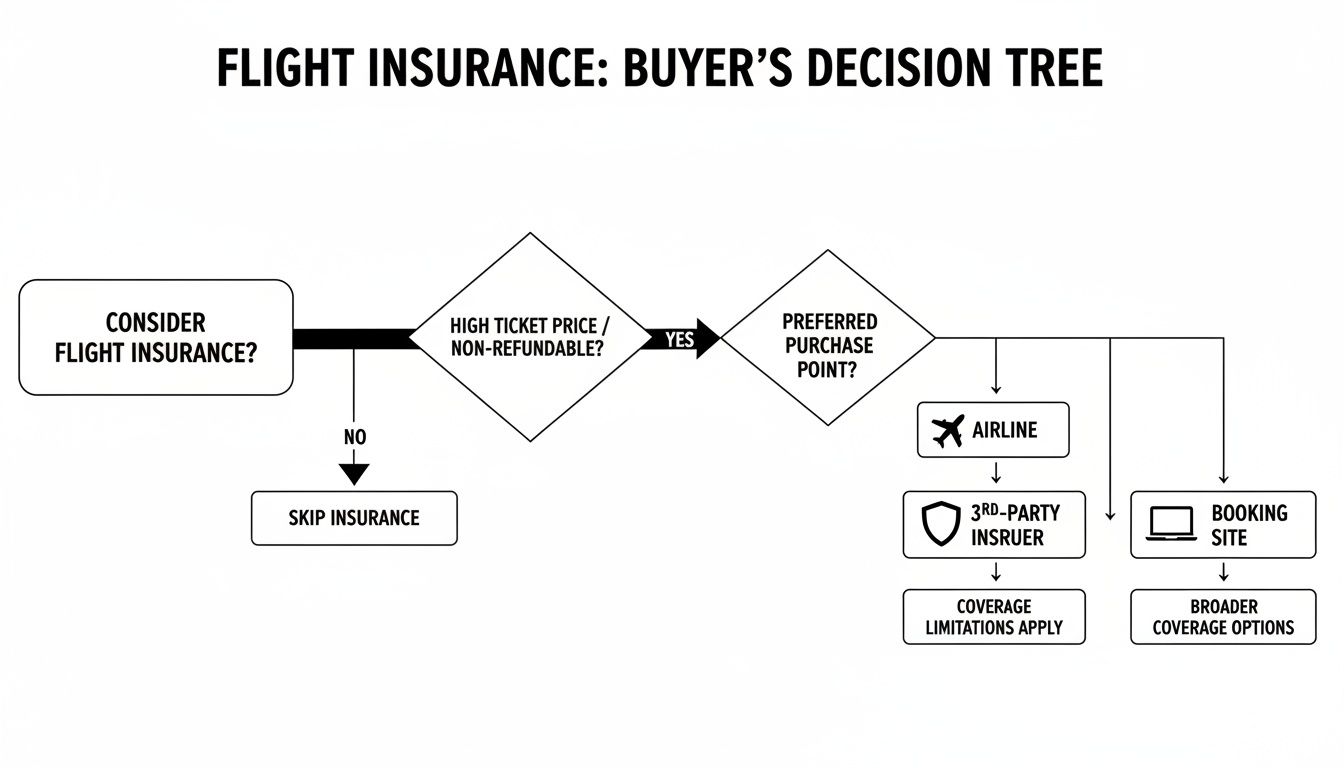
As you can see, booking sites like www.stdarmydeals.com often hit that sweet spot, giving you the easy "click-to-add" of the airlines but with the more solid coverage you'd get from a third-party provider.
Tailored Advice for Every Traveler
Different missions require different gear, and the same goes for travelers. What makes sense for a solo backpacker just won't cut it for a family of four.
The real value of flight insurance isn't just about money; it's about buying the freedom to be excited for your trip instead of worrying about what could go wrong.
Let’s break it down for different members of the S.T.D. Army:
- For the Budget-Conscious Adventurer: If your tickets were dirt cheap and you’re flexible, you might skip it. But if you’ve been squirreling away cash for months for a big trip, a small insurance premium is a wise move to protect that hard-earned savings.
- For the Frequent Flyer: You're in the air a lot, which means your odds of hitting a snag are just naturally higher. An annual travel insurance plan might be a lot cheaper than buying a new policy for every single trip.
- For Families: With kids in the mix, the chances of a last-minute ear infection or flu derailing your plans go way, way up. For family vacations, flight insurance is practically a must-have for your sanity.
- For Our Veteran Community: Listen up! Before you buy anything, always check the benefits on your military-affiliated credit cards (like from USAA or Navy Federal). Many of them offer solid trip protection as a built-in perk, which could save you some cash.
Ultimately, you’re the commanding officer of your trip. By understanding the factors at play, you can make a sharp, informed decision. And for more tips on saving money, learn about the best time to book flights in our other guide.
How to File a Claim Step by Step

Alright, soldier, the unexpected happened. Your trip hit a snag, and now you need to use that flight ticket insurance you smartly purchased. Don't sweat it! Filing a claim might seem like navigating a minefield, but with a clear plan, it's a totally manageable mission.
Think of it this way: your paperwork is the proof that backs up your story. The more organized you are, the smoother the entire process will be. Here at S.T.D. Army, we’re all about having a solid strategy, so let's walk through it together, step-by-step.
Your Claims Action Plan
When a covered event messes with your travel plans, your first move should be to get in touch with your insurance provider. Don't wait! Most policies have a specific timeframe for you to report an incident. Acting fast shows you’re on top of it.
Here’s your four-step plan for a successful claim:
Contact Your Provider Immediately: The second a covered issue pops up—like a flight cancellation or a medical emergency—call their 24/7 assistance line. They’ll give you the intel on exactly what your policy covers and what paperwork you'll need to start gathering.
Gather Your Documentation: This is the most critical step. You'll need to collect everything related to your claim. This includes your original flight itinerary, all receipts for extra expenses (like that unexpected hotel or meal), communications from the airline, and any relevant medical notes from a doctor.
Fill Out the Claim Form Completely: Be thorough and honest. Double-check every single detail before you hit submit. Any missing information can cause serious delays in getting your claim processed and approved.
Follow Up Regularly: Once you've sent everything in, don't just sit back and wait. Make a note of your claim number and check in with the provider every so often to track its progress. A friendly follow-up call can keep your claim from getting lost in the shuffle.
Remember, a successful insurance claim is built on clear communication and solid documentation. Keep every receipt and record every interaction—it’s your best ammunition for getting the reimbursement you deserve.
Filing a claim is all about being prepared. By following these steps, you’ll be in the best possible position for a quick and stress-free resolution. You’ve got this!
Got Questions? We've Got Answers!
Still on the fence about flight insurance? No sweat. Let's run through a final briefing on the most common questions our S.T.D. Army community throws our way.
What's the Real Difference Between Flight and Travel Insurance?
Think of it this way: flight ticket insurance is your specialist—a sniper rifle focused on one target. Its mission is to protect the money you spent on your plane ticket if you have to cancel for a covered reason.
Comprehensive travel insurance? That's the whole platoon. It covers your flight, sure, but it also has your back with medical emergencies, lost luggage, trip delays, and a whole lot more. For a quick weekend trip to visit family, flight insurance might be all the backup you need. But for that big two-week international mission you've been planning? A comprehensive plan gives you a much wider safety net.
Doesn't My Credit Card Already Cover My Flight?
Good question! A lot of those fancy travel credit cards do offer some trip protection, and that's a great perk. But here's the catch: the coverage is often pretty basic, with lower payout limits and a lot more red tape than a dedicated policy.
Before you rely on it, you absolutely need to call your card company and get the specific details. A dedicated plan you grab through a site like www.stdarmydeals.com usually provides stronger, primary coverage. That means less hassle and a smoother claims process if things go sideways.
Can I Buy Flight Insurance After I Already Booked?
You bet, but timing is everything. It's best to lock in your policy within 10 to 21 days of making your first payment for the trip.
Why the rush? Buying early often unlocks key benefits, like waivers for pre-existing medical conditions, which can be a total game-changer. If you wait too long, your options start to shrink. At Sgt. Travel Deals Army, we tell our troops to make it part of the booking drill—that way, you're covered from the get-go.
Ready to book your next adventure with total peace of mind? The Sgt. Travel Deals Army is your command center for incredible deals on flights and the protection to back them up. Enlist for free and find your next mission