
You know the feeling. You’ve picked the destination, checked your dates, maybe even started daydreaming about the room with the view. Then the hotel rates hit you like a surprise inspection. One quick search turns into ten tabs, wildly different prices, mystery fees, and a sinking suspicion that everybody else knows a trick you don’t.
Good. That means you’re ready for training.
I’m going to give you the no-nonsense version of how to save money on hotels. Not fluffy “travel hacks.” Real tactics. Timing. rebooking. points. smarter comparisons. veteran-specific perks that most travel sites barely mention. If you follow orders, you stop paying lazy prices.
A lot of travelers lose money because they book once, trust the first rate they see, and move on. That’s civilian behavior. Deal hunters do recon, lock in flexible options, watch the price, and strike when the rate drops. That’s how one traveler cut four weeks of peak-season hotel costs from $4,939.32 cash to $866.94 out of pocket, saving $4,072.38, or 82%, by mixing points with opportunistic bookings, as detailed by Near the Elevators.
That’s the mindset. Not luck. Not magic. Discipline.
Your Mission Briefing to Beat High Hotel Prices
Last week’s version of you probably opened a booking site, saw a room price that looked painful, and thought, “I guess that’s just what hotels cost now.” Wrong answer. Hotels don’t price rooms based on your feelings. They price them based on demand, timing, unsold inventory, and how closely you’re paying attention.
That’s where your travel drill sergeant comes in.
Think of this guide as your field manual. You’re not trying to shave off a couple bucks with random coupon hunting. You’re learning how to stop overpaying in the first place. The difference matters. A traveler who books early without a plan can get stuck with a mediocre rate. A traveler who books smart can hold a flexible room, monitor price changes, use rewards where cash prices get ugly, and switch tactics when the market moves.
Battle-tested rule: Don’t treat hotel booking like a one-time task. Treat it like an ongoing operation until check-in.
That shift alone changes everything.
You also need the right attitude. Be flexible when you can. Be skeptical of the first “deal” you see. Read cancellation terms like they matter, because they do. Compare total cost, not just the flashy nightly rate. And if you’re a veteran, service member, or military family, stop ignoring benefits you already earned.
The hotel market isn’t unbeatable. It’s just noisy. Once you know where the savings hide, the whole game gets simpler.
Master Your Mission Timing and Flexibility
You spot a decent hotel on Tuesday. By Friday, the price drops. By Sunday, it jumps again because a concert rolled into town. That is how hotel pricing works. It moves fast, it reacts to demand, and it punishes travelers who treat booking like a one-and-done chore.
Timing matters. Flexibility matters more.

Analysts at Skyscanner found that domestic U.S. hotel rates can run about 21% cheaper within the same week of travel, and international stays can also get cheaper close to check-in. Their data also showed that the “responsible” middle window, around 3 to 4 weeks out, is often not the bargain travelers expect.
Use that intel correctly. Do not wait blindly and hope for a miracle. In busy cities with lots of hotel inventory, late booking can work in your favor because properties compete to fill unsold rooms. In small towns, beach markets, national park gateways, and event weekends, hesitation gets expensive fast.
Here is the smart move. Book a cancellable backup as soon as you find an acceptable rate. Then keep checking. If the price falls, switch. If it rises, you already have cover.
Run this drill every time:
- Secure a refundable room first: Give yourself a safe position before rates move.
- Check prices in the final week: Unsold inventory often gets marked down late.
- Stay flexible on the exact hotel: Needing one neighborhood is workable. Needing one exact property usually costs you.
- Shift your stay by one day if you can: A Tuesday arrival or Sunday checkout can change the math.
- Read the cancellation cutoff: “Flexible” only helps if you know the deadline.
Month choice matters too, but broad seasonal trends are only a starting point. Shoulder-season travel usually gives you the best shot at lower rates without sacrificing the whole trip. Go right before peak demand or right after it. You still get the destination. You stop paying the full tourist premium.
That is also where Sgt. Travel Deals Army gives you an edge that generic travel guides miss. Use a hotel price comparison website strategy that checks rates across multiple sources to confirm whether a late drop is real, then use Sgt. Travel Deals Army to verify the savings and support a veteran-owned travel community while you book smarter.
Keep your plan loose in the places that do not matter. Be firm on the parts that do. If the mission is “good hotel in a safe area,” you have room to maneuver. If the mission is “this exact hotel on this exact night,” expect to pay for that rigidity.
NerdWallet’s 2026 Summer Travel Report found that 89% of travelers are taking steps to cut costs, and 33% are choosing lodging based on price over amenities. Your competition is real. Calm travelers with flexible dates, backup reservations, and a fast recheck routine win more often than travelers who book once and disappear.
Assemble Your Arsenal of Booking Tools
Don’t trust one website. That’s rookie work.
Every booking platform shows you a slice of the field, not the whole battlefield. Some are good for broad searches. Some are better for alerts. Some make cancellation terms easy to compare. And some are useful because they show a discounted rate next to the standard price so you can quickly judge whether a deal is real.
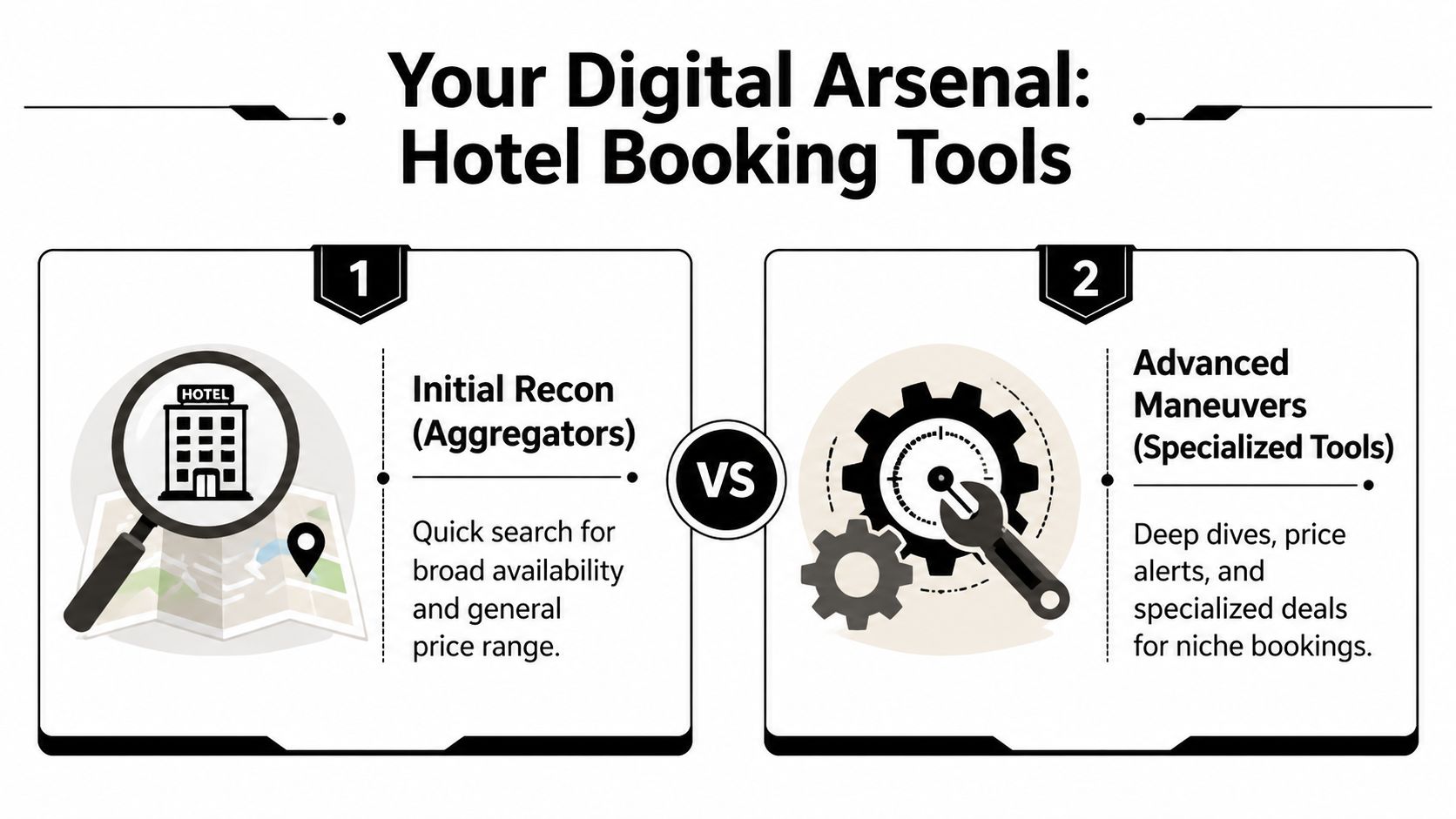
Start with broad recon
Use major hotel search tools to answer basic questions fast.
What’s available in the area? Which properties have flexible cancellation? Are the cheapest options decent, or are they cheap for a bad reason? What happens to the rate if you move your stay by one night?
That first pass is not where you commit. It’s where you gather intel.
A strong search routine looks like this:
- Search the destination and exact dates.
- Pull up map view.
- Filter by cancellation policy first, then by guest rating and location.
- Compare room types carefully. “City view,” “standard,” and “economy” can have wildly different value.
- Check total price at the final screen, not just the nightly teaser.
Compare like a professional, not like a tourist
A bad comparison is worse than no comparison. If one site shows breakfast included and another doesn’t, that’s not the same booking. If one rate is refundable and the other isn’t, that’s not the same booking either.
Use this quick comparison standard:
- Room type matters: Match the same bed setup and room class.
- Policy matters more: Refundable versus prepaid changes the actual value.
- Fees matter: Resort fees, local taxes, and service charges can flip a “deal” into dead weight.
- Payment timing matters: Some rates charge immediately, others closer to arrival.
- Perks matter: Free breakfast, parking, and late checkout can tilt the math.
If you want a clearer breakdown of how these platforms differ, review this guide to hotel price comparison websites.
Cheap-looking rates win clicks. Total cost wins the battle.
Use specialized tools for side-by-side checks
Once you’ve got your baseline, move to sharper tools.
The booking site at Sgt. Travel Deals Army displays hotel options with side-by-side pricing context so travelers can compare the normal price, the discounted price, and the savings amount in one place. That’s useful because it shortens the verification process. Instead of guessing whether a discount is meaningful, you can inspect the spread quickly and keep moving.
That doesn’t mean you stop cross-checking. It means you’ve got another instrument in the kit, especially if you want a veteran-owned option in the mix.
Here’s a practical field routine:
| Phase | Tool type | What you’re trying to learn |
|---|---|---|
| Recon | Major aggregators | Overall availability and neighborhood price range |
| Validation | Hotel direct site and final checkout screens | Whether the rate, perks, and policy actually match |
| Precision check | Specialized comparison tools | Whether a discount is materially better for your exact stay |
Watch somebody do it live
If you learn faster by seeing the process in action, a hotel booking comparison video can help. Search YouTube for live hotel price comparison walkthroughs before you book. Watching someone compare policies, room types, and total checkout costs in real time can save you from sloppy mistakes.
That matters because the biggest hotel booking error isn’t usually choosing the “wrong” website. It’s choosing too fast.
Unleash the Power of Loyalty Programs and Points
You find a decent hotel on Tuesday. By Friday, the same room is charging peak-season nonsense. That is when rewards stop being a nice extra and start acting like a field-tested money-saving weapon.
Travelers who ignore points pay cash when they do not have to. Fix that now. Join the hotel programs you are likely to use, build balances on purpose, and check every stay two ways: cash price and points price. Then verify whether the savings are real before you pull the trigger. Mainstream guides usually stop at “earn points.” You need a better system. Use points strategically, and use a verification tool like veteran-owned Sgt. Travel Deals Army to sanity-check whether the rate you are seeing is a win.

One strong example proves the point. A traveler documented cutting four weeks of peak-season hotel costs from $4,939.32 cash to $866.94 out of pocket by combining redemptions with strategic point purchases, saving $4,072.38, or 82%. The same report also notes that 32% of 2026 summer travelers plan to use credit card points and miles to save, according to Near the Elevators.
Start with a simple rewards plan
Keep this clean and disciplined:
- Join the hotel programs you will use: Free membership gets you access to member pricing and future redemptions.
- Focus on one or two hotel ecosystems first: Scattered points are weak. Concentrated points are useful.
- Compare points and cash every time: Some nights are cheap enough to pay cash. Some nights are perfect for points.
- Save points for painful dates: Holidays, events, and peak-season stretches often give you the best value.
- Protect your savings: Do not carry credit card debt just to chase rewards.
If you need help choosing the card side of the plan, start with this guide to the best credit cards for travel rewards.
Use points where cash rates hurt the most
Rewards work best when hotel pricing gets aggressive. That usually means holiday weekends, convention dates, school breaks, and last-minute high-demand stays.
The documented example above worked because the traveler used points with intent. They converted 189,000 Wyndham Rewards points, bought 400,000 IHG One Rewards points during a sale, and used those balances on expensive stays. One Holiday Inn Express booking in that breakdown came in 40% below the cash price.
That is how you should treat points. Not as a cute bonus. As stored buying power.
Field order: If the cash rate makes you stop and stare, check the points rate before you book.
Keep rewards from turning into clutter
A lot of travelers make this harder than it needs to be. Do less, better.
Pick one or two programs. Learn how those programs price award nights. Track your login details and expiration rules. Use points to replace expensive nights, not cheap ones. Then verify the final math against the rates you can see elsewhere so you know the redemption is doing real work.
A quick visual explainer can make the basics easier if you’re new to the topic.
Why points are a powerful tool
Hotel prices swing fast. Points give you options when cash rates spike.
You can pay cash on the cheaper nights, use points on the overpriced nights, and protect your budget without dropping to a worse property. You can also use member perks, award availability, and your verified rate checks together to avoid overpaying. That is the smarter play.
If your mission is to save money on hotels without settling for a sad downgrade, loyalty programs and points belong in your kit.
Deploy Advanced Tactics for Maximum Savings
You booked a decent rate. Then two days later, the same room drops. Then the Friday night in the middle of your trip jumps while the other nights stay flat. That is how hotels win. They count on you to book once, stop checking, and pay whatever happens next.
Don’t give them that win.
Your advanced playbook has three jobs. Rebook when the rate drops. Split a stay when one or two nights get overpriced. Verify every “deal” against the full total so a fake discount does not slip past you. If you want a fast second opinion before you switch plans, use veteran hotel deal checks from Sgt. Travel Deals Army to compare what you found against a platform built for value hunters and a military-connected community.

Run the rebooking drill
Book the flexible rate first. Then keep hunting after you book.
Analysts cited in SmarterTravel’s hotel savings guide found repeat rebooking can cut the cost of a stay, especially when travelers check the same property more than once before arrival. Rates move because hotels adjust to demand, local events, and occupancy gaps. Your job is to catch the drop before check-in.
Use this sequence:
- Book a cancellable room early when the trip matters.
- Set reminders to check the exact same room every few days.
- Compare the room type, cancellation terms, and total price.
- Rebook as soon as the lower rate is live.
- Cancel the old reservation only after the new confirmation hits your inbox.
Simple. Disciplined. Effective.
Check the real total before you celebrate
Nightly price is bait. Total trip cost is the target.
Taxes, resort fees, parking, and city charges can turn a cheaper-looking booking into a worse deal. Compare the final checkout screen, not the number hotels flash at the start. If the replacement room has stricter payment terms, no breakfast, or a worse cancellation deadline, count that too.
Use this checkpoint every time you switch:
- Match the total stay cost, not just the nightly rate
- Scan for parking, resort, destination, and cleaning fees
- Confirm whether payment is due now or later
- Check that the room class and bed type are the same
- Read the cancellation cutoff before you hit book
A lower headline rate means nothing if the final bill climbs.
Split the stay when the math says move
One overpriced night can wreck the whole booking. Cut it out.
Hotels often charge much more on a weekend night, during a convention, or right before a holiday. If the rest of the trip is reasonably priced, break the reservation into parts and move once. That gives you control over the expensive nights instead of swallowing an averaged rate across the full stay.
Use a split stay in these situations:
| Situation | Better move |
|---|---|
| One or two nights spike hard | Switch hotels after the expensive night |
| You land late and only need sleep | Book a cheaper first night, then move |
| The last nights price badly in cash | Use points or a different property for the back end |
| Your plans may change | Keep shorter reservations so you can adjust |
This works especially well for solo travelers, couples, and work trips where one quick move can save real money. Families with a pile of gear may decide the hassle is not worth it. Make the call based on dollars, not habit.
Keep the maneuver tight
Advanced tactics fall apart when your notes are a mess.
Track the hotel name, booked rate, cancellation deadline, and any rebooked rate in one place. Pack so your essentials stay accessible on move day. Ask both hotels about luggage storage before you commit to a split stay. Stay in the same area when you switch, or you can burn your room savings on rides and wasted time.
That is the whole mission. Stay flexible, watch the pricing, and verify the total before you move. Hotels change rates all the time. You should act like it.
Special Ops Savings for Service Members and Vets
You book a hotel near your destination for $219 a night, then find out at check-in that a military rate, base lodging, or veteran discount could have cut that bill hard. That mistake is common, and it is avoidable.
If you serve, served, or travel as part of a military family, stop booking like a civilian traveler with fewer options. Military lodging, service-member rates, and veteran verification programs can beat public pricing by a wide margin. CBS News notes that military travelers often miss savings through on-base lodging and ID.me-verified hotel discounts, even though those options can undercut standard hotel rates by a lot in the right market. Read the full roundup here: CBS News hotel-saving strategies.
Start with the channels tied to your service. Then compare them against the open market. That is the right order.
Use the benefits civilians cannot touch
Check military lodging first, especially if your trip is flexible on location or you just need a clean, practical place to sleep. After that, search chain hotel military rates and verified veteran discounts through programs like ID.me. Only then should you stack those numbers against the regular booking sites.
Keep the process tight:
- Check base or military lodging first for eligible trips
- Search hotel military and veteran rates directly on chain sites
- Verify discount access through ID.me when required
- Compare the final total against public rates, including taxes and fees
- Use the cheapest option that still fits the mission
That last step matters. A military rate is not automatically the winner. But if you fail to check it, you are giving up an advantage you already earned.
Use a veteran-owned platform as your spotter
Mainstream travel sites rarely build their tools around military travelers. That is why veteran-focused resources matter.
If you want booking paths built around service-member and veteran savings, start with this guide to cheap hotels for veterans. Then use Sgt. Travel Deals Army as your verification tool. It gives you a clean way to compare offers, confirm whether a so-called discount is real, and support a veteran-owned community while you save.
Good travel strategy is not just about finding a lower number. It is about knowing which channels deserve your attention first.
Use every benefit you earned. Check military options before public rates. Verify the savings. Support your own when the numbers make sense. That is how you win this fight.
Mission Accomplished Your Debrief and Next Steps
You’ve got your orders.
Book with timing on your side. Compare rates like a skeptic. Use flexible reservations as placeholders, not commitments carved in stone. Check points when cash prices turn stupid. Rebook when the numbers improve. Split stays when one hotel starts gouging you on key nights. And if you served, use the military-specific advantages that too many travelers still ignore.
That’s how to save money on hotels without settling for bad properties, bad locations, or bad decisions.
The next trip is your first real test. Don’t drift back into lazy booking habits. Open multiple options. Check the total. Read the cancellation terms. Stay calm when prices move. The traveler who wins isn’t the one with the fanciest app. It’s the one who follows the plan.
Head to the resources that help you compare smarter, then put the training to work. Mission ready. Dismissed.
Ready to put this into action? Enlist with Sgt. Travel Deals Army for free, then run your next hotel search through STD Army Deals and compare the numbers for yourself.
1 thought on “How To Save Money On Hotels: Expert Guide”