

You've probably got a hotel search open right now with a familiar mess on screen. One tab says one price. Another tab says something lower. A third site looks cheaper until checkout. Then your phone shows a totally different rate and now you're wondering whether discount hotel booking sites are saving you money or wasting your time.
That confusion is normal. It's also exactly why so many travelers book the wrong “deal.”
The good news is that bargain hunting isn't random. If you know how these sites work, and how to judge risk-adjusted value, you can stop chasing fake bargains and start booking smarter. The hunt is already mobile-first. Travel and hospitality websites received 70.5% of online traffic from mobile devices in 2024, and big hotel search players actively highlight properties under US$50 and US$100 for deal hunters, according to Kayak's hotel search trends and listings.
Your Mission to Find an Amazing Hotel Deal
Hotel shopping now feels like speed dating with browser tabs. You swipe through options, compare photos, squint at cancellation terms, and try to decide whether the “limited time deal” is a deal or just a dressed-up restriction.
That's where many get burned. They compare the headline rate and stop there.
Why the search feels chaotic
Discount hotel booking sites are built for fast comparison, not always for clarity. They know you're scanning quickly, usually on a phone, and they know a lower sticker price grabs attention first. That's not evil. It's just how the market works.
What trips people up is that the cheapest-looking room may come with the worst trade-offs. You might lose flexibility, loyalty perks, room choice, or easy customer support. If your trip is locked in, that may be fine. If your plans are shaky, a “cheap” room can become the expensive mistake.
Practical rule: Never judge a hotel deal from the search results page alone.
What a smart traveler does instead
A savvy traveler checks three things before getting excited:
- Final checkout cost after taxes and fees
- Cancellation terms in plain English
- What's missing compared with booking direct or through another path
That shift changes everything. You stop asking, “Which site is cheapest?” and start asking, “Which booking gives me the best overall value for this specific trip?”
That's the mindset you want. Not bargain fever. Not tab overload. Just a clear process.
How Discount Sites Uncover Hidden Deals
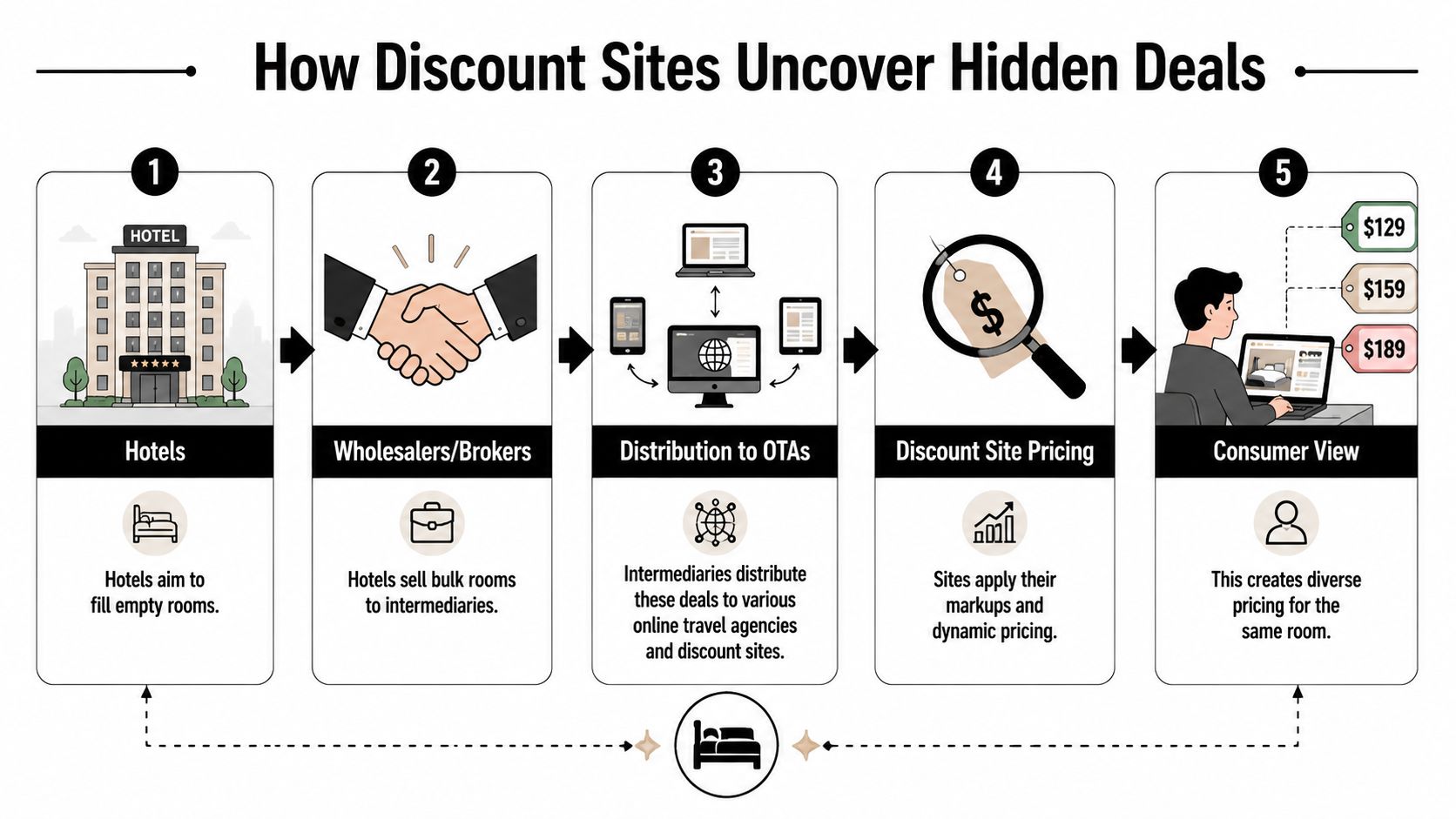
Think of hotel pricing like a stock market for rooms. The same hotel can push inventory through several channels at once, and each channel can show a different rate for what looks like the same stay.
That's why discount hotel booking sites can uncover deals that don't show up everywhere else. They aren't pulling from one neat central shelf.
Where the deals come from
Hotels don't sell every room the same way. Some inventory is sold directly, some is distributed through wholesalers, some through global distribution systems, and some through online travel agencies. SiteMinder's 2025 data shows that hotel websites had the highest average booking value at US$516, followed by wholesalers at US$445, global distribution systems at US$392, and online travel agencies at US$312, according to SiteMinder's hotel booking trends report.
That matters because different channels have different pricing structures. A discount site can surface value by tapping a different source than the one you checked five minutes ago.
Why the same room shows different prices
Price dispersion is baked into the system. Aggregators often source inventory from multiple paths, including hotels, wholesalers, and online travel agencies, so the same room can show different rates depending on where you search. Meta-search tools help because they gather those offers into one view and can track price changes over time, as explained in MoneySavingExpert's guide to cheap hotels.
Here's the simple version:
| Booking path | What usually happens |
|---|---|
| Direct hotel website | Often clearer terms, sometimes better room control |
| Wholesaler-fed listing | Can unlock hidden pricing not obvious elsewhere |
| OTA listing | Easy comparison, but terms may vary sharply |
| Meta-search tool | Shows multiple sellers side by side |
If you want a deeper comparison strategy, this guide on hotel price comparison websites is worth a look.
The two deal types worth knowing
Some discounts come from unsold inventory. Hotels would rather fill a room late than let it sit empty, so certain platforms specialize in last-minute offers.
Others come from opaque bookings. That's where you get a lower rate because the site hides the hotel name until after purchase. You trade certainty for savings. Sometimes that's a great move. Sometimes it's a fast path to regret if location, room quality, or cancellation flexibility matters to you.
The Real Pros and Cons of Booking for Less
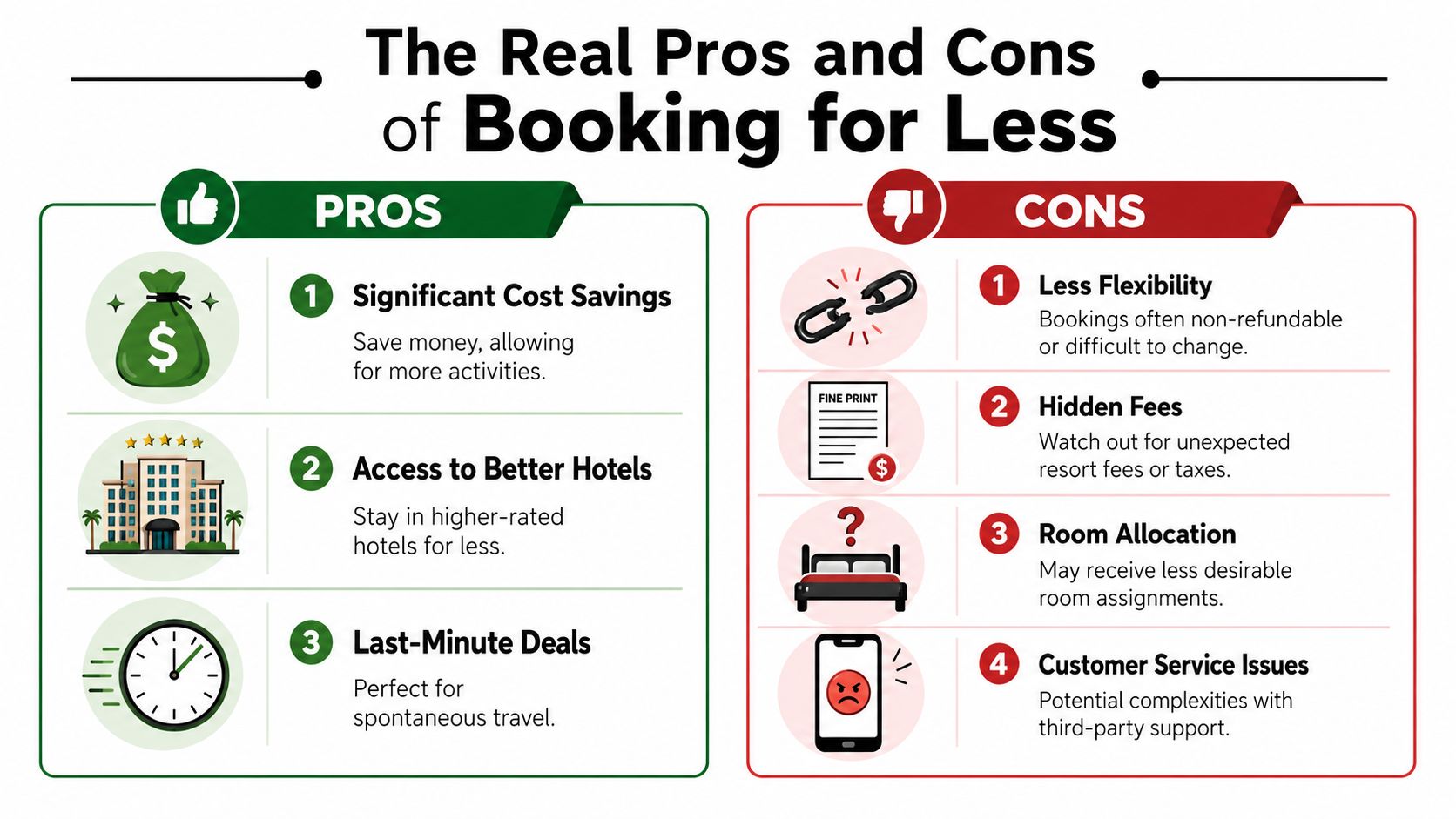
Cheap hotel bookings feel like a win because sometimes they are. If your dates are firm and your standards are flexible, discount hotel booking sites can save serious money. But the best deal hunter doesn't just celebrate the low rate. They check what they had to give up to get it.
What's genuinely great about these sites
The upside is obvious. You can often pay less than you would through a standard booking path, especially when a platform is trying to move unsold rooms or package inventory creatively.
Last-minute mobile platforms can be especially useful. One travel expert cited HotelTonight as helping budget travelers save more than 20% on hotel bookings, while Priceline-style opaque products can advertise discounts of up to 60% by hiding the hotel name until after purchase, according to this travel expert roundup.
A few situations where these sites shine:
- Spontaneous trips: You're booking close to check-in and just need a good room fast.
- Price-first travel: You care more about budget than brand loyalty.
- Short stays: A basic overnight stop doesn't justify paying extra for perks you won't use.
Where travelers get ambushed
The catch is rarely the room itself. It's the fine print.
Some rates are hard to change, impossible to refund, or detached from loyalty benefits you'd get elsewhere. You might also end up with a less desirable room assignment because the site sold a discounted inventory bucket, not the exact room experience you pictured.
Here's a clean side-by-side view:
| Big advantage | Common trade-off |
|---|---|
| Lower rate | Less flexibility |
| Great last-minute inventory | Fewer choices in room type |
| Easy comparison | More checkout scrutiny required |
| Opaque savings | More booking risk |
A quick video can help sharpen your instincts before you book:
Some savings are worth grabbing. Some are just prepaid inconvenience.
My blunt advice
Use discount sites aggressively for simple trips. Be much more careful for family travel, special occasions, long stays, or anything where a bad room and a bad policy would ruin the whole plan.
That's the dividing line. Not “is it cheap?” but “can this booking go wrong in a way that matters?”
Smarter Tactics to Maximize Your Savings
Most travelers search once, tweak a date or two, and book whatever looks decent. That's lazy money.
If you want better results from discount hotel booking sites, work the search like a deal hunter, not a tourist in a hurry.
Build a tighter search routine
Start with flexibility. Even a small shift in timing can move you into a different pricing bucket. If your destination gives you room to play with arrival day or stay length, test several combinations before you decide anything.
Then compare through a meta-search tool before you commit to a booking platform. You want the wide view first, then the detailed inspection.
Try this routine:
- Search broad first with flexible dates if the tool allows it.
- Check at least two booking paths for the same room and policy.
- Switch devices if needed. Mobile and desktop can surface deals differently in practice.
- Open the final booking page before declaring a winner.
Test whether your location changes the price
One of the more interesting tactics floating around travel circles is checking if your digital location affects what you see. Travel hack videos increasingly discuss using a VPN to see whether hotel rates change based on the country you appear to be searching from, suggesting pricing isn't always globally uniform. This angle is discussed in this YouTube travel hack video about location-based hotel pricing.
That doesn't mean every search will change. It does mean you shouldn't assume one universal price exists everywhere online.
Here are the best practical tests:
- Use incognito mode: It's a quick way to remove some clutter from repeat searches.
- Try a VPN location change: Test another country and compare the final booking page.
- Compare currency displays carefully: Sometimes the difference is real. Sometimes it's just presentation.
For more practical search ideas, browse these tactics on how to find cheap hotel deals.
Don't confuse clever with reckless
A good tactic saves money without increasing chaos. If a workaround creates confusion about taxes, currency, support, or booking terms, slow down. The point isn't to outsmart the internet for sport. The point is to book a better stay at a better real-world value.
A Framework for Verifying True Deal Value
Here's the part most travelers skip. They compare rates, feel victorious, and click book. That's backwards.
The smartest way to use discount hotel booking sites is to verify true deal value, not just price. A cheap rate with ugly restrictions can cost more in stress, lost benefits, and change penalties than a slightly higher booking with better terms.
Hotel industry coverage has pointed directly at this blind spot. Travelers often focus on the headline rate and ignore the total risk-adjusted value, including cancellation rules, blackout dates, and price-match conditions, as discussed in HotelTechReport's analysis of hotel booking sites.
The six-point verification check
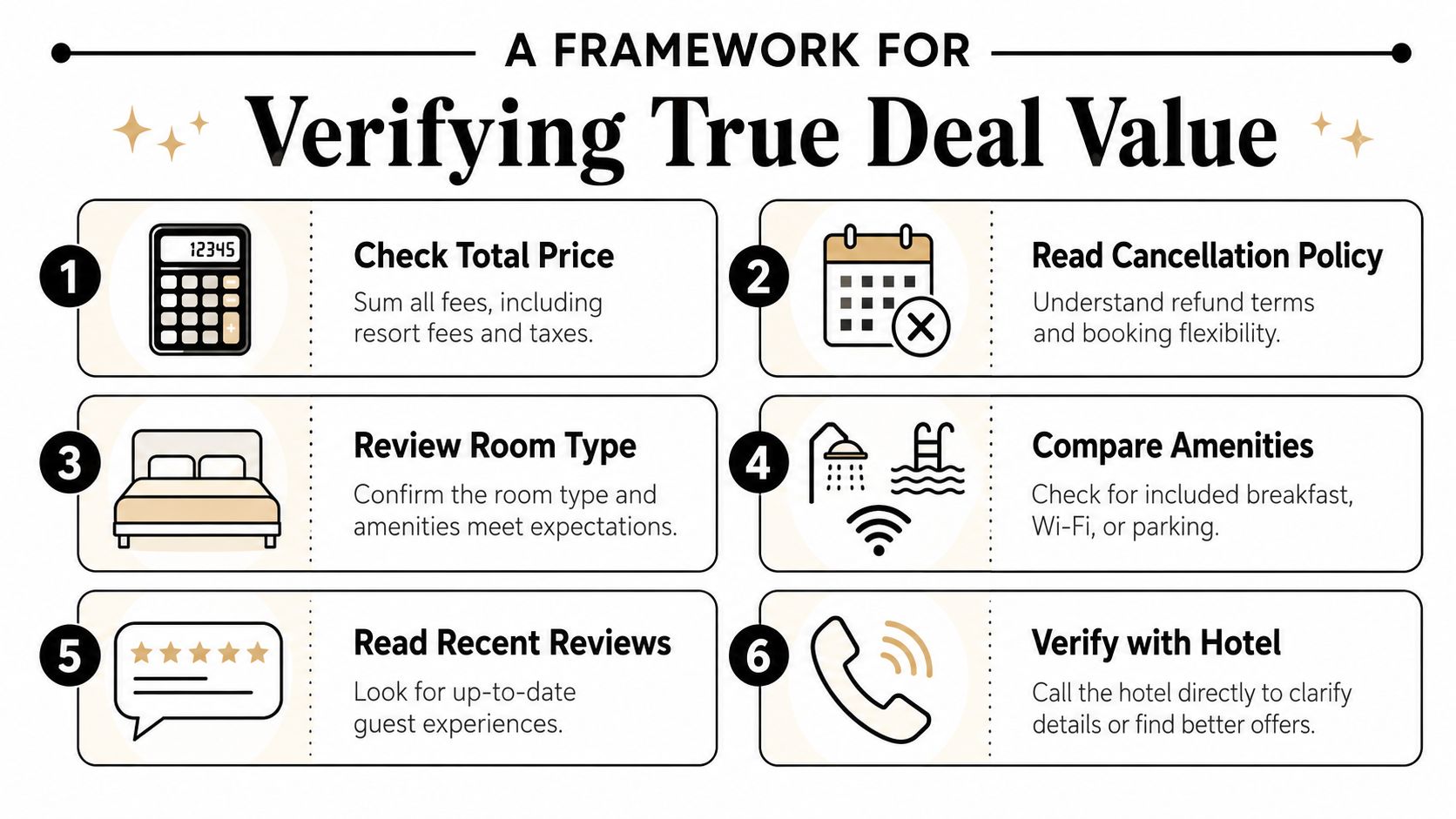
Run every tempting deal through this filter before you pay:
- Total price first: Don't stop at the search result. Go all the way to the last checkout screen.
- Cancellation reality: “Free cancellation” means nothing if the window is tighter than your plans.
- Room type clarity: A discount on a room you don't want isn't a bargain.
- Included amenities: Breakfast, Wi-Fi, parking, and resort access can change the equation fast.
- Recent reviews: Old praise won't help if the property slipped lately.
- Direct hotel confirmation: If anything looks fuzzy, call the hotel and ask.
A simple way to think about risk-adjusted value
Ask yourself four blunt questions:
| Question | Why it matters |
|---|---|
| Can I cancel this if plans change? | Flexibility has value |
| Am I giving up loyalty perks? | A lower rate may erase benefits |
| Is this the room I'd actually accept? | Cheap doesn't help if the stay disappoints |
| Is support easy if something goes wrong? | Third-party friction can ruin savings |
Bottom line: The best hotel deal is the one that still looks good after checkout, after policy review, and after you've considered what you're giving up.
If you book longer stays, this roundup on weekly hotel rates can help you compare value with a longer lens.
My rule for pulling the trigger
If a deal is only attractive because the number is low, keep looking. If it still looks strong after you inspect the rules, that's a real deal.
Introducing the Sgt Travel Deals Army Platform
You find a hotel rate that looks great, then the doubts start. Is the room type worse? Are the rules tighter? Did the cheap rate strip out the perks you would have kept elsewhere? That is exactly why a member-focused platform can earn a spot in your booking process.

Why a member model stands out
Sgt. Travel Deals Army takes a smarter angle than the usual giant booking sites. It is veteran-owned, built around member access, and focused on cleaner comparisons instead of baiting you with a headline rate and leaving you to sort out the fine print later.
The booking engine at STD Army Deals fits the way smart travelers book. You can compare options without the usual clutter, then judge whether the rate still holds up once you factor in restrictions, fees, and trade-offs. That is the true test. Price matters, but risk-adjusted value matters more.
How to use it well
Do not treat it like a magic shortcut. Treat it like a better filter.
Run your search, compare what you find against the big public sites, and check whether the offer keeps its value after you review the actual booking terms. If a member rate saves money without piling on extra risk, keep it. If the savings disappear once you inspect the details, pass.
A platform like this earns its keep for a few simple reasons:
- It cuts down the noise: Less ad-heavy clutter makes it easier to focus on the deal itself.
- It helps you verify value: You can compare rates with a sharper eye for policy, perks, and total cost.
- It supports a veteran-owned business: If the pricing is strong, that is a solid bonus.
My take
I like tools that make it easier to spot a real deal before checkout, not after. That is the appeal here.
If you want one more tab that shows a low number, you already have plenty of options. If you want a member-focused platform that helps you judge whether a hotel deal is worth booking, Sgt. Travel Deals Army is a smart one to test on your next search.
Your Mission to Find Better Deals Is Complete
A good hotel deal survives scrutiny.
That is the standard to keep. A low nightly rate means nothing if resort fees show up late, the cancellation policy traps you, or booking through a third party costs you breakfast, points, or elite perks you would have received direct. Cheap on the first screen is not the same as good value.
Use a simple rule before you book. If the savings disappear once you add fees, restrictions, and lost benefits, skip it. If the deal still wins after that check, book it and move on.
Keep this checklist in your head:
- Compare the total price, not the teaser rate
- Read the cancellation terms before checkout
- Check for resort, parking, and service fees
- Count the perks you lose by booking away from the hotel
- Choose the option with the best risk-adjusted value
That mindset will save you more money than chasing every flashy discount site in Google.
And if you want a cleaner booking path, use the member-focused platform mentioned earlier as one of your comparison tools. Run it against the big public sites. Keep the rate only if it holds up under pressure. Smart travelers do not chase cheap headlines. They book the deal that stays good after the fine print.