

You're probably doing the family vacation math right now. Flights. Meals. Snacks. Pool drinks. A bigger room because nobody sleeps well packed into one box. Then somebody says, “Let's just do an all inclusive.” That sounds easy until you realize some resorts mean “mostly included,” some are built for couples who tolerate kids, and some are specifically designed for families.
My advice is simple. If you want less friction, more predictability, and fewer wallet ambushes during the trip, an all inclusive resort for families can be a strong play. But you've got to book with discipline. The sticker price is not the mission. The actual target is total value for your specific crew.
Your Mission Briefing Planning the Ultimate Family Escape
Planning a family trip can feel like running supply lines through chaos. One kid wants waterslides. One needs a nap schedule. One only eats plain pasta, fries, and fruit. You want one vacation where you're not making twenty decisions before lunch.
That's why all-inclusive resorts moved into the mainstream. Their basic appeal is dead simple. They bundle lodging, food, drinks, and activities into one prepaid package, which cuts down the number of in-trip expenses you need to manage. In family travel, that convenience matters a lot more than glossy marketing copy.

A useful reality check comes from Club Med's look at why all-inclusive family resorts appeal to families. It notes prices ranging from $850 per night to more than $1,900 per night for a family of four, depending on the property and level of luxury. That spread tells you two things. First, this isn't a niche product anymore. Second, “all inclusive” doesn't automatically mean “good deal.”
Why families keep coming back
Parents don't love all-inclusives because they're flashy. Parents love them because they reduce friction.
- Meals are simpler: You're not hunting for breakfast every morning or arguing over restaurant tabs.
- Activities are on-site: Kids can move from pool to club to show without constant transportation planning.
- Budgeting gets cleaner: You know more of the trip cost before you leave home.
Field intel: The right resort doesn't just save money. It saves energy, and that's usually the scarcer resource on a family trip.
What a good mission looks like
Your ideal resort should do three jobs at once:
| What you need | What the resort should deliver |
|---|---|
| Predictable spending | Clear inclusions and fewer surprise charges |
| Easier parenting | Child-friendly spaces, programs, and room setups |
| Actual rest | Enough built-in entertainment that you're not the activities director |
If you approach the search that way, you stop chasing pretty photos and start booking smarter.
Decoding the All-Inclusive Promise
“All inclusive” is not a magic phrase. Treat it like a vacation starter pack, not a blank check. If you don't know where the package ends, the bill at checkout can sting.
Most family all-inclusives include the room, standard meals, snacks, and a lineup of on-site activities. That's the base package. It's built to keep the day moving without constant payment decisions.
What's usually in the base package
Think practical, not luxurious. You're generally paying for the stuff your family will use repeatedly from morning to night.
- Lodging: Your room or suite is part of the package.
- Dining access: Buffets, casual spots, and some restaurants are usually included.
- Standard beverages: Soft drinks and basic drink options are often covered.
- On-site fun: Pools, beach access, scheduled activities, and evening entertainment are commonly included.
If you want a good plain-English breakdown of how the model works, read how all-inclusive resorts work.
What commonly costs extra
Families get sloppy. You assume “all inclusive” means all costs. It rarely does.
Premium liquor, spa treatments, motorized water sports, and off-resort excursions are often extra charges. Sometimes the upgrade starts with room category. Sometimes it's the restaurant with the better menu. Sometimes it's the “special experience” your kids spot on day one and refuse to forget.
Don't book a resort until you know which parts of your vacation are covered by the package and which parts sit behind a paywall.
Your pre-booking questions
Before you lock anything in, ask these questions directly:
- Which restaurants require reservations or surcharges?
- Are kids' clubs included, supervised, and available for your children's ages?
- Which room category fits your family without cramming?
- Are airport transfers included or separate?
- Which activities are free, and which are premium add-ons?
That quick recon can spare you a lot of “I thought this was included” frustration later.
Must-Have Amenities for Your Family Squad
Amenities aren't fluff. They're logistics. A family resort either supports your daily rhythm or fights it.
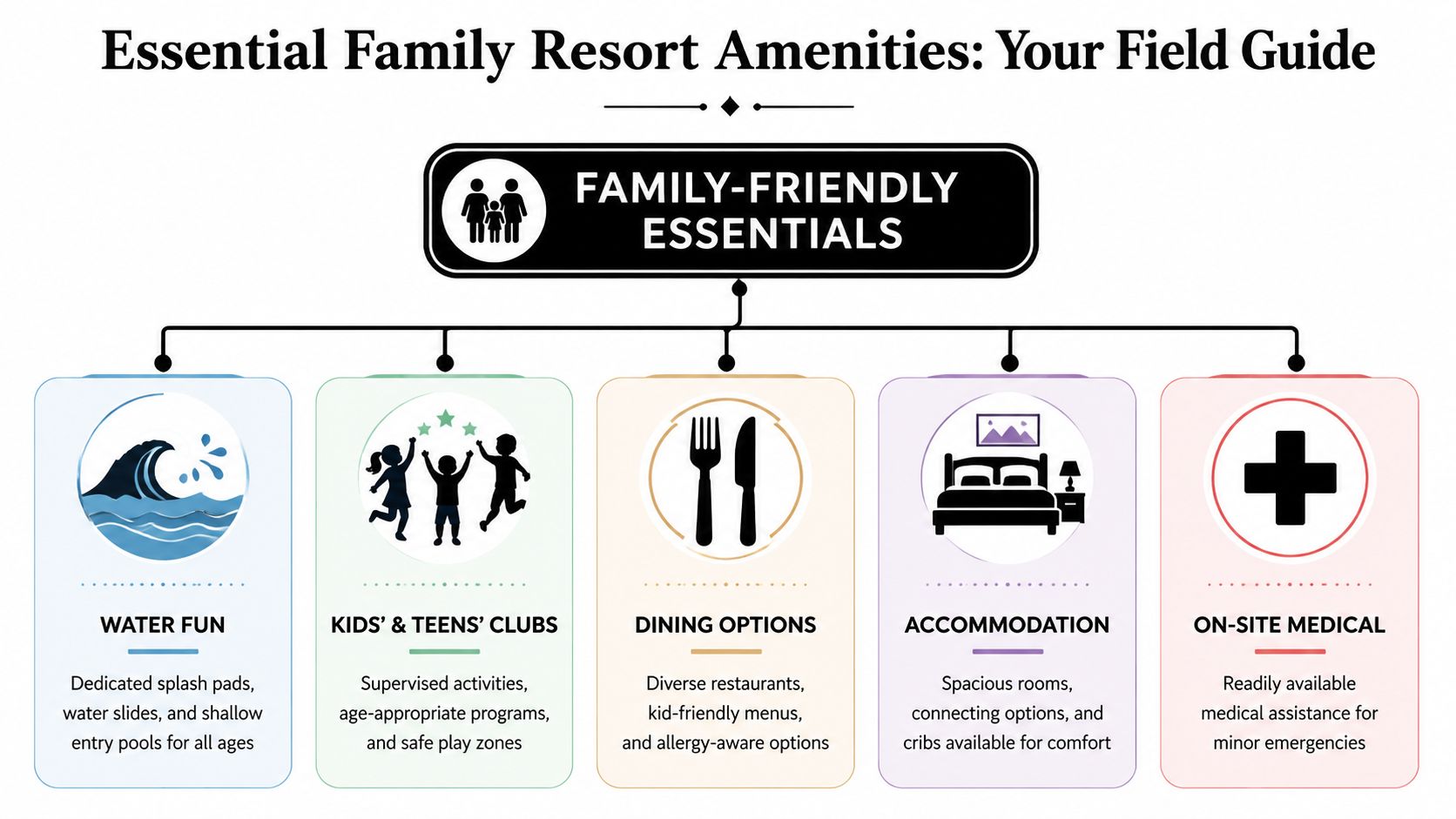
The biggest mistake I see is parents choosing a resort based on beach photos and forgetting the family hardware. You need infrastructure. A shallow splash zone matters. A separate sleeping space matters. A kids' club that's properly staffed and active matters.
The room is your command center
Room design is one of the most overlooked parts of booking an all inclusive resort for families. A property's room design either makes your life easier or turns bedtime into a hostage situation.
Good Housekeeping's roundup of family all-inclusive resorts highlights a key differentiator: resorts with true family rooms that sleep five or more, such as those at Club Med Cancun, are built around family logistics. That reduces the need for multiple rooms and makes supervision easier.
If you have early sleepers, nap schedules, or siblings with wildly different energy levels, don't settle for “two beds and good luck.”
The amenities worth caring about
Here's the gear that changes your trip:
- Water setups for different ages: You want more than one pool vibe. Little kids need shallow entries or splash areas. Bigger kids want slides and movement.
- Real kids' and teen spaces: Not a token room with beanbags. You want structured, age-specific programming.
- Dining variety: Buffets help with picky eaters. Multiple venues help when everyone is tired of the same meal format.
- Family-scale accommodations: Suites, separate sleeping zones, and connecting options can save the whole vacation.
- On-site medical support: You hope you never need it. You'll still sleep better knowing it's there.
Here's a quick visual walk-through of resort features many families look for before booking:
My blunt recommendation
If your children are young, prioritize room layout and pool design over fancy dining. If your kids are older, prioritize programming and independence-friendly spaces over décor. A beautiful resort that doesn't match your family's rhythm is a bad booking.
Practical rule: Book for how your family actually behaves on vacation, not how you wish they behaved.
Age-Appropriate Activities and Entertainment
A resort can have a great pool and still bomb your vacation if the programming is weak. Kids get bored fast. Teens get cynical faster. You need activities that fit your family's age mix, not a vague promise of “fun for everyone.”
One Smiley Monkey's family-resort guidance notes that modern family all-inclusives compete on specialized programming, with dozens of recreational activities, supervised kids' and teen clubs, and nightly shows as standard features. That's exactly the right lens to use. Don't just ask whether a resort has activities. Ask who those activities are built for.
Toddlers and preschoolers
Little kids need simple wins. Splash areas, short activity windows, easy snack access, and calm transitions matter more than packed schedules.
Look for:
- Shallow water zones
- Short supervised play sessions
- Nightly entertainment that isn't too late or too loud
- Easy stroller movement around the property
If your crew skews young, use this extra recon on Caribbean resorts for kids.
School-age kids
This age group usually thrives at all-inclusive resorts because they can bounce between structured and unstructured fun. They want motion. They want options. They also want enough novelty that every day doesn't feel identical.
A strong resort for this group should offer:
- sports and games during the day
- kids' club activities with some real energy
- evening shows the whole family can watch together
- pools or water features that feel like a reward, not just a place to cool off
Teens
This is the hard one. Teen clubs can be excellent or painfully lame. If the “teen lounge” is just a dim room with old furniture, your teenager is going to vanish back to the phone.
Use this side-by-side gut check:
| Age group | What works | What flops |
|---|---|---|
| Toddlers | splash areas, short activities, simple meals | long waits, loud late-night entertainment |
| Kids | games, clubs, shows, water fun | repetitive schedules, no freedom |
| Teens | social spaces, sports, independence, late options | childish programming, forced participation |
Don't let brochures fool you. Ask whether the activity calendar matches your children's ages.
Choosing Your Destination and Dining Wisely
Destination choice changes the whole mission. It affects flight time, paperwork, daily pace, and what your family will realistically eat without complaints.
Many families automatically start with Mexico or the Caribbean. Fair enough. Those regions are loaded with beach-focused all-inclusives, and the format is especially mature there. But that doesn't make them the default answer for every family.
When a U.S. resort makes more sense
Traveling Mamas points out that U.S.-based all-inclusives in places like Florida, Vermont, and Colorado can offer a strong alternative, especially when they package park tickets or similar add-ons and remove passport hassles. For families with younger kids or shorter trip windows, that convenience can be the deciding factor.
That's strong intel. If your children melt down during long travel days, don't force an “exotic” destination just because it sounds more vacation-like.
Match the destination to your dining reality
Food can make a family trip smooth or miserable. Be honest about your crew.
If your family likes trying new dishes, a Caribbean or Mexico trip can feel more immersive. If your kids are strongly committed to familiar basics, your resort's buffet quality and kid-friendly staples matter more than destination romance.
Use this simple comparison:
- Younger kids or tighter schedules: A U.S. option may be easier to manage from start to finish.
- Beach-first family with longer travel tolerance: Mexico or the Caribbean often gives you the classic all-inclusive rhythm.
- Picky eaters: Favor resorts with multiple dining venues and flexible buffet access.
- Dietary restrictions: Contact the property before booking and ask how they handle allergies and special meals.
The smartest destination is the one your family can enjoy without spending half the trip recovering from the travel day.
My recommendation on food strategy
Don't over-romanticize dining. For family travel, reliability beats novelty most nights. You want at least one easy breakfast setup, one dependable lunch option near the pool, and enough variety at dinner that nobody feels trapped.
That sounds unglamorous. It's also how family vacations stay pleasant.
The Smart Way to Budget and Book Your Trip
You find a resort rate that looks perfect, then the actual bill shows up. Bigger room. Airport transfer. Extra restaurant fees. Suddenly your “deal” is the expensive option.
That's the trap.
For family travel, the sticker price means very little. What matters is the full mission cost for the trip you will take. A flashy rate on the booking page does not help if it only applies to a room your crew will outgrow by bedtime or excludes the extras you know you'll end up paying for.

Where families get ambushed on cost
Resorts love a clean headline number. Your wallet gets the messy version.
Watch for these budget killers:
- Transfers: Airport transportation may cost extra, especially for larger families.
- Room reality: The cheapest room often works poorly for families once you check bed setup and square footage.
- Upcharges on food and fun: Specialty restaurants, premium snacks, off-menu treats, and certain activities can raise your total fast.
- Taxes and resort fees: These can change the ranking between two resorts that looked close at first glance.
- Daily family spending: Mocktails, arcade cards, tips, sunscreen, and small requests from the kids stack up quickly.
Marching orders. Build your budget from the final checkout number backward, not from the teaser rate forward.
A smarter booking drill
Keep it simple and ruthless.
- Price the exact room you would book. If your family needs a suite or a better layout, use that number.
- Add the predictable extras. Transfers, tips, paid dining, and any activity your kids will absolutely ask for belong in the math.
- Judge value by total trip fit. A slightly higher rate can be the better buy if it covers more and prevents nickel-and-dime charges.
If you want a faster way to compare offers, use all-inclusive resort discounts for families to check side-by-side pricing and spot whether a lower headline rate is weaker value.
My booking rule
Book the resort that stays honest after the math.
If one property looks cheap until you add the room you need, skip it. If another includes the setup your family will use without constant add-ons, that's your better deal. Good booking intel is not about chasing the lowest starting price. It is about avoiding hidden costs and buying the trip that fits your family the first time.
Your Ultimate Resort Comparison Checklist
You're at the point where every resort starts to sound the same. Great food. Great pools. Great family fun. That marketing fog is exactly where families overspend.
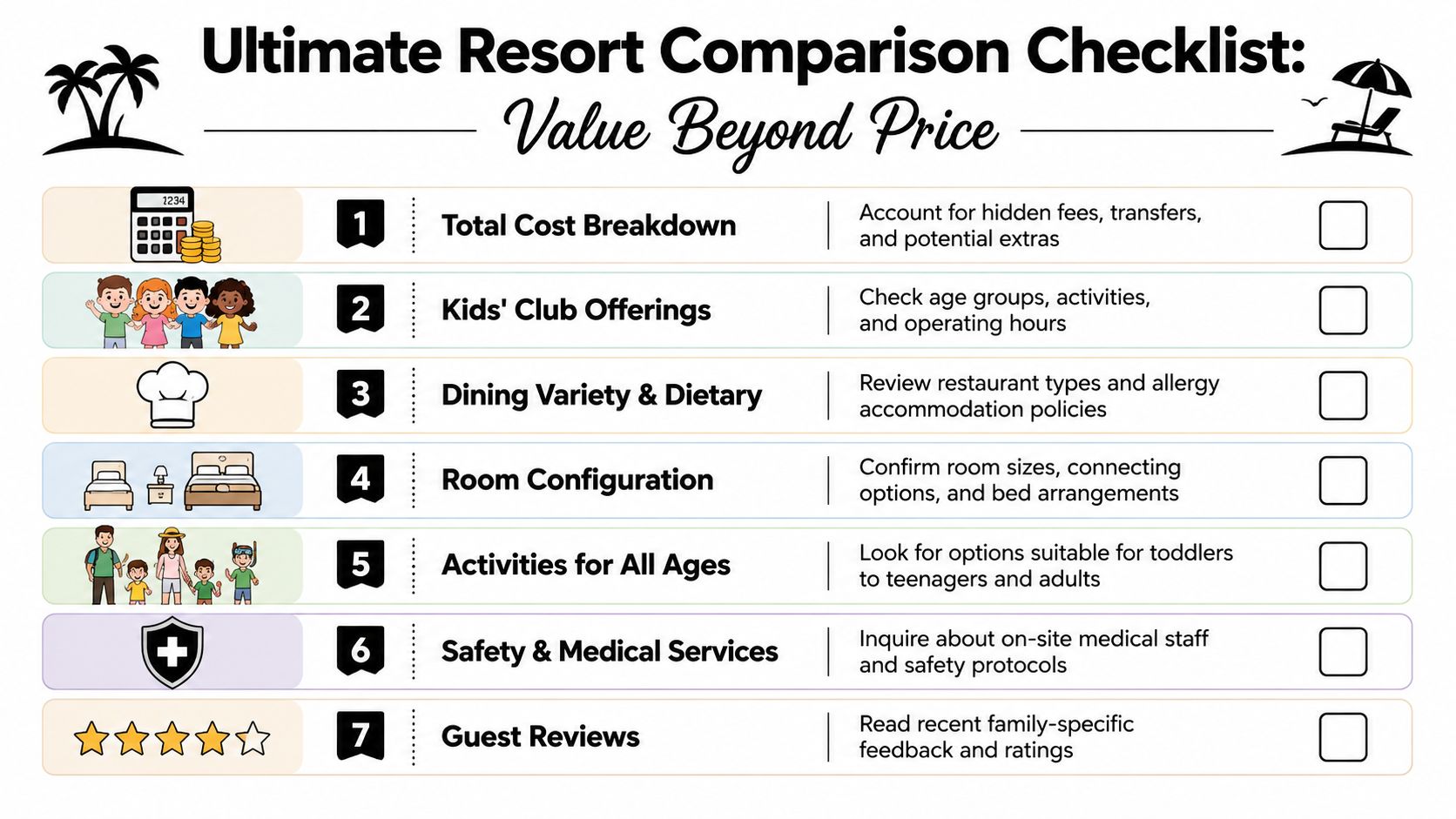
Your final call needs one standard. Pick the resort with the clearest real-world value after you account for what your family will use, what you will probably pay extra for, and how much hassle the property creates once you arrive. Sticker price is weak intel. Total trip reality wins.
Your go or no-go checklist
Run every finalist through this filter before you book:
- Total trip cost: Write down the full working number, including the extras your family is likely to buy or need.
- Room fit: Check bed layout, privacy, noise, and whether everyone can sleep without nightly chaos.
- Water setup: Confirm there is a real match for your kids' ages, not just one nice pool photo.
- Kids' club quality: Look at hours, supervision, age bands, and whether the activities feel organized or like babysitting.
- Teen credibility: Give older kids a space they will use, or you will hear about it all week.
- Dining reliability: Make sure the resort can handle picky eaters, quick lunches, and special diets without turning every meal into a project.
- Medical and safety basics: Know what happens if someone gets sick, scraped up, or sunburned badly.
How to make the final call
Use friction as your tiebreaker.
A resort that saves you fifty bucks but creates sleep problems, food battles, and add-on charges is not the better deal. A resort that costs a little more up front but covers your family's real needs usually protects your budget better once the trip starts.
That is your marching order. Choose the property that keeps the vacation easy, keeps surprise spending under control, and fits your crew the first time.
If you want a straightforward way to compare options with price visibility instead of brochure fluff, Sgt. Travel Deals Army gives you a practical starting point. You can also check broader booking options through STDArmyDeals.com. Enlist, compare hard, and book with the full cost in view.