

You're probably doing what a lot of troops, veterans, and military families do before a trip. You open three hotel tabs, punch in your dates, click the “government/military” box, and assume you've found the smart rate. Then the doubts start. Is this for leave or official orders? Will they take a veteran ID? Is this discount real, or is it just a fancy label on the regular price?
That confusion is where people get smoked at check-in.
Some travelers book a government rate for a family weekend and find out at the desk that the hotel wanted orders, not just proof of service. Others skip the military option entirely because the booking page reads like it was written by a sleep-deprived admin clerk. The result is the same. Money left on the table, or a surprise rate change when you're standing there with luggage and zero patience.
This guide is your field manual for Hotel Military Rates. Not the fluffy version. The useful version. We're separating the rates that work for personal travel from the rates meant only for official duty, and that one distinction can save you a pile of frustration.
Your Mission to Save on Hotels Starts Now
A soldier books a hotel for a long weekend. He sees “government/military rate,” clicks it fast, and thinks the mission is complete. At check-in, the clerk asks for official orders. He doesn't have them, because this trip is for family, not duty. Suddenly the cheap rate disappears, and the whole plan takes incoming.
That scenario happens because hotel rate labels are sloppy, not because travelers are careless.

The problem most guides gloss over
Most articles mash everything together under “military discount.” Bad move. In practice, there are different rate types, different ID rules, and different reasons a front desk will reject one booking and approve another.
You've earned better intel than that.
What you need is a clean plan:
- Identify the right rate type for your mission
- Know what proof to carry before you show up
- Compare the discount against other public deals so you don't overpay
- Book the right way so the front desk doesn't have to fix your mess
Practical rule: If you can't explain why you qualify for the rate in one sentence, don't book it yet.
The goal is simple
Use Hotel Military Rates the way they're intended. If you're traveling for vacation, family visits, reunions, or a quick reset, you want a leisure military rate. If you're traveling on official duty, that's a different lane.
That split is the whole game.
Get it right, and hotel discounts become straightforward. Get it wrong, and the discount can vanish right when you need it most. Sgt. Travel says treat booking like gear prep. Check it before you step off, not after you've hit the objective.
Decoding Hotel Military and Government Rates
A “military rate” isn't one piece of gear. It's more like having one rucksack for field training and another for inspection day. They both count as equipment, but you'd be a fool to use the wrong one for the wrong mission.
The two rate types that matter are leisure military rates and government or per diem rates.
Leisure rates for personal travel
A leisure rate is the one most readers prefer. It's built for non-official travel like vacations, family visits, weddings, graduations, or a weekend away. Hilton states that hotel military leisure offers such as the Hilton Military Family Rate are for non-official travel, require valid U.S. or Canadian military ID at check-in, and usually run about 10% to 25% below rack rates, depending on the property and dates, as shown in Hilton's military leisure rate terms.
That same source also makes another point crystal clear. These leisure rates are not for DoD TDY or PCS travel.
Government and per diem rates for official duty
Government or per diem rates are a separate lane. These rates exist for official travel, and they line up with government lodging rules, reimbursement limits, and travel authorization. The Department of Defense explains in DoD Instruction 1015.11 that official lodging rates are tied to the minimum amount required to cover official travel lodging costs, and they often require a CAC or travel orders.
That means if you're not traveling on official business, this isn't your rate.
Book a leisure military rate for personal trips. Book a per diem rate only when your orders justify it.
Why the distinction matters at the desk
Front desk staff don't care what you meant to click. They care whether your booking matches your documentation. If the reservation says government or per diem and you can't produce the required proof for official travel, you may lose that rate on the spot.
Keep it simple:
- Vacation or family trip: Leisure military rate
- TDY or PCS: Government or per diem rate
- Not sure: Call the hotel and ask which military option is for personal travel
That one habit will save you grief.
Are You Eligible for a Military Hotel Discount
Good news. Eligibility for Hotel Military Rates is often broader than people think. Bad news. You still need proof at check-in, and “I served” without the right document won't always cut it.
Start with your ID, not your assumptions.
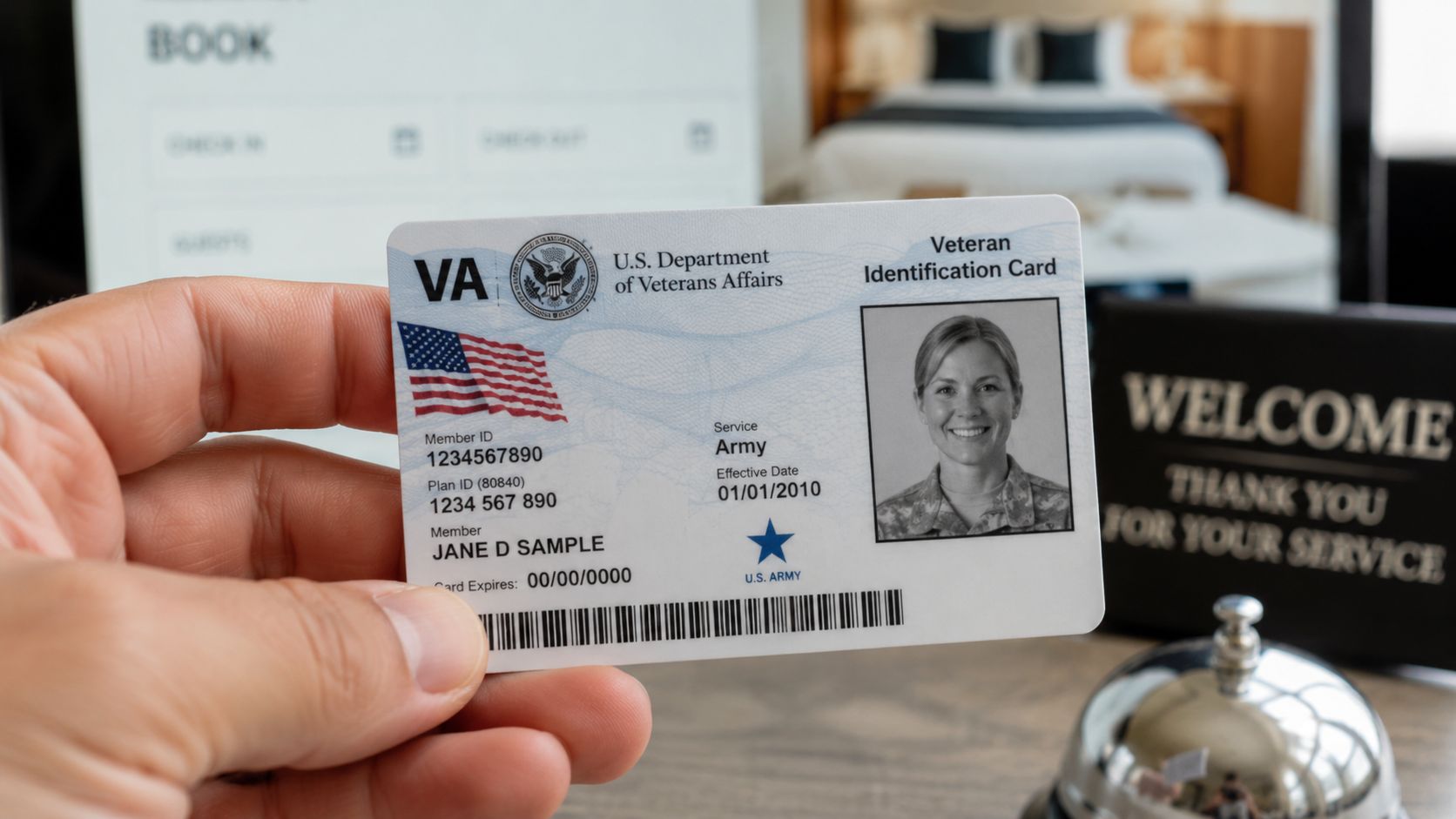
Who usually qualifies
Hotels commonly extend military discounts to several groups. Policies vary by brand and property, but this is the usual roll call:
- Active-duty service members: CAC is your strongest play.
- Retired military: Retiree ID is usually the cleanest proof.
- Veterans: Acceptance varies more, so verify before booking.
- National Guard and Reservists: Commonly included, but check the rate terms.
- Military family members: Some chains include spouses and dependents under leisure offers.
If you're hunting more options for personal stays, this roundup of cheap hotels for veterans is a useful starting point.
What to bring to check-in
Smart travelers separate themselves from the chaos merchants.
Bring the proof that matches your status:
- Active duty: CAC
- Retired military: Retiree ID card
- Veterans: VA ID card, veteran designation on a driver's license, or DD-214 copy
- Dependents: Dependent ID card
Don't assume a screenshot of an old document or a story about your service will do the job. Some hotels are flexible. Some are by-the-book. Plan for by-the-book.
The best booking in the world still fails if your check-in proof doesn't match the rate.
Why veterans should verify before they click
Veterans run into more friction than active-duty travelers because not every hotel defines “military” the same way in public-facing rate pages. Some brands are veteran-friendly on leisure rates. Others focus much more tightly on current service members or official government travelers.
That's why a quick phone call matters. Ask one direct question: “Is this military rate valid for veterans on personal travel, and what ID do you require at check-in?”
That one sentence can save a lot of nonsense later.
A quick walkthrough can help if you want to hear the process broken down in plain English:
My recommendation
Don't play guessing games. If you're active duty, retired, veteran, Guard, Reserve, or an eligible family member, assume nothing and verify everything. Hotels usually want to help, but the reservation system only works if you choose the right lane and bring the right proof.
That's not red tape. That's basic pre-combat checks for your wallet.
Top Hotel Chains Offering Military Rates
Most major chains offer some form of Hotel Military Rates, but the details aren't identical. One brand uses a fixed discount. Another uses a promo code. Another gives a discount range that depends on dates and property. If you don't compare them side by side, you'll miss the better play.
According to AARP's roundup of military hotel discounts at major chains, Wyndham Hotels & Resorts offers 12% to 15% off, Hyatt offers 10% to 15% off, IHG guarantees at least 5% off its Best Flex Rate across more than 6,000 destinations, Caesars Entertainment offers up to 30% off, Red Roof Inn offers 10% off to veterans nationwide with 20% for Veterans Advantage members, and Super 8 offers a fixed 15% discount to active, retired, and veteran military members and their families in the U.S. and Canada.
Hotel Military Discount Policies 2026 Overview
| Hotel Chain | Typical Discount | Eligible Groups (Commonly) |
|---|---|---|
| Wyndham Hotels & Resorts | 12% to 15% | Military personnel, often including veterans at participating locations |
| Super 8 | 15% | Active, retired, and veteran military members and their families |
| Hyatt | 10% to 15% | Veterans and immediate family members at participating locations |
| IHG | At least 5% off Best Flex Rate, often higher | Military travelers at participating brands |
| Caesars Entertainment | Up to 30% | Military guests at participating properties |
| Red Roof Inn | 10%, or 20% for Veterans Advantage members | Veterans and eligible members |
| Best Western | Percentage discount available | Military travelers commonly eligible |
| Choice Hotels | Percentage discount available | Military travelers commonly eligible |
| Hilton | Percentage discount available | Military travelers commonly eligible |
| Marriott Bonvoy | Percentage discount available | Military travelers commonly eligible |
| La Quinta | Percentage discount available | Military travelers commonly eligible |
| Motel 6 | Percentage discount available | Military travelers commonly eligible |
What the table actually tells you
Don't stare at discount percentages like they're rank insignia. A bigger number doesn't always mean a better final price. A hotel with a smaller military discount can still beat a nearby property if its base rate is lower.
That means your job is to compare:
- The discounted rate
- The standard refundable rate
- Any prepaid or promo rate
- Parking, resort, or other required fees
Chain-by-chain reality check
Some brands make the offer clearer than others. Wyndham, Hyatt, IHG, Caesars, Red Roof, and Super 8 give you more concrete guidance. Other major chains offer military pricing, but the exact discount may depend on the property and booking channel.
The best chain isn't the one with the flashiest military page. It's the one that gives you the lowest total cost for the trip you're actually taking.
My opinion. Start with the brands that spell out their discounts clearly, then compare the final out-the-door number. That's the adult move.
Your Step-by-Step Booking Guide
Booking Hotel Military Rates shouldn't feel like clearing a minefield. Keep it disciplined. Three steps. No nonsense.
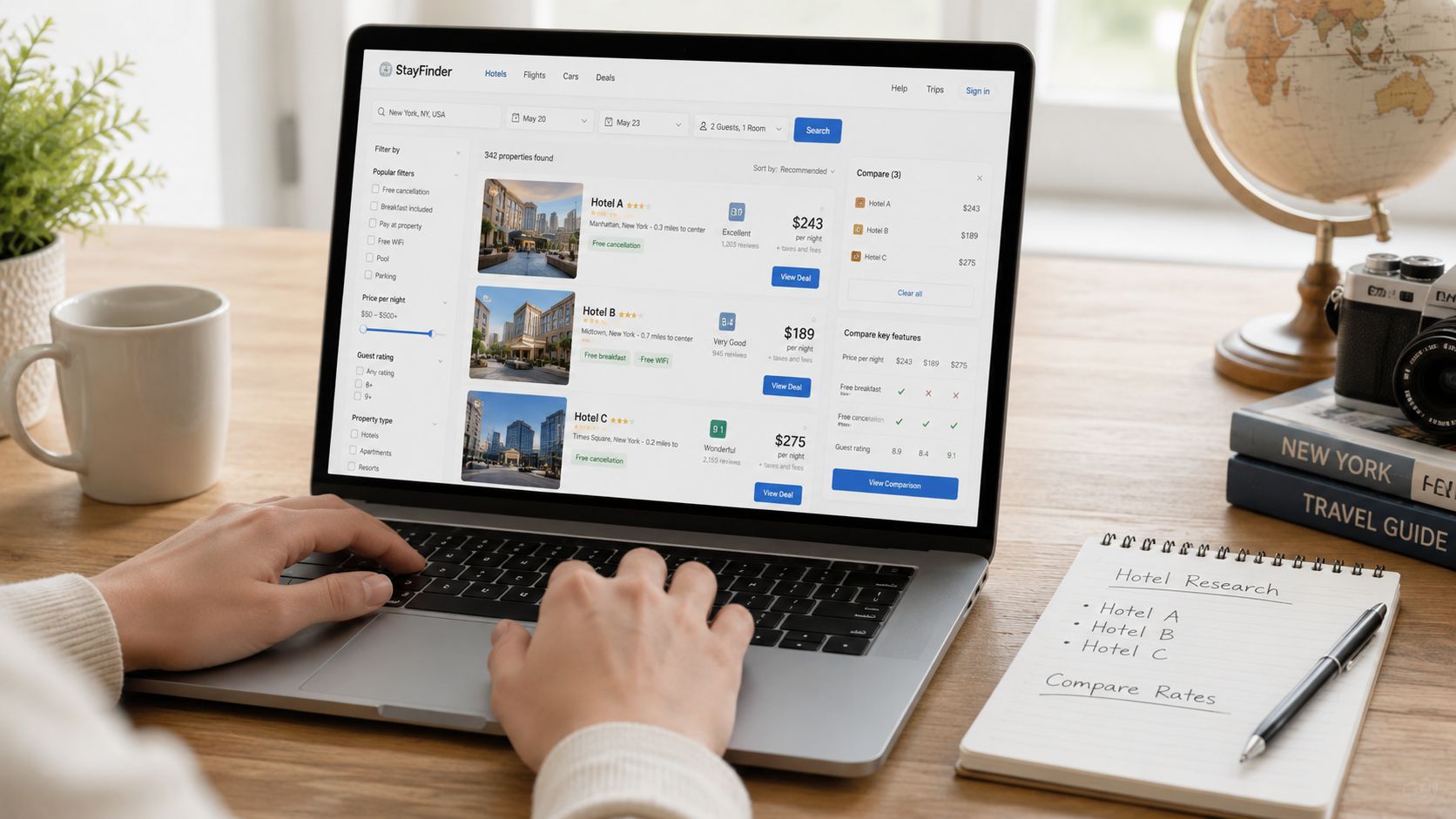
Step one. Do your recon
Don't book the first “military” label you see. Search several properties in your target area and compare rate types. Check the military rate against refundable public rates and any member promotions.
If you want a better process, review these practical tips on how to get better hotel rates. The key is simple. Compare before you commit.
Your recon checklist:
- Confirm the trip type: Personal travel means leisure military rate
- Read the rate name closely: “Government” and “military” are not always the same thing
- Check cancellation terms: A cheap nonrefundable rate can become an expensive mistake
- Look at total trip cost: Room rate alone isn't the full battlefield
Step two. Book the right rate on purpose
When booking online, don't click rate boxes on autopilot. If the site gives you a “Government & Military” filter, drill into the details and confirm whether the option is for leisure travel or official duty. If there's a separate military appreciation, military family, or veteran rate, that's often the better lane for personal travel.
If you book by phone, say this plainly: “I'm traveling for leisure and want the military or veteran rate for personal travel.”
That sentence does two jobs. It keeps the agent from parking you in a per diem lane, and it creates less confusion when you arrive.
Step three. Prep for check-in like a pro
The booking isn't done until you pass the front desk. Have your ID ready before the clerk asks. Match your documentation to the reservation. If the booking is under a military family or dependent rate, bring the right dependent ID.
Use this final pre-check:
- Reservation confirmation saved
- Correct rate type confirmed
- Military, retiree, VA, veteran, or dependent ID packed
- Hotel contacted if any eligibility question remains
Field note: Front desk surprises usually start with a booking made too fast, not a clerk trying to be difficult.
Where Sgt. Travel's practical advice comes in
The smartest travelers treat hotel booking like route planning. They don't just look for a discount. They look for the right discount, on the right terms, for the right mission. That mindset saves more headaches than any promo code ever will.
If you stay disciplined on those three steps, your odds of a smooth check-in go way up.
Common Mistakes That Cost You Money
The biggest mistake is also the dumbest one, and it's not always the traveler's fault. People book a government rate for personal travel because the hotel website doesn't explain the difference clearly enough.
That's where check-in turns into a contact sport.
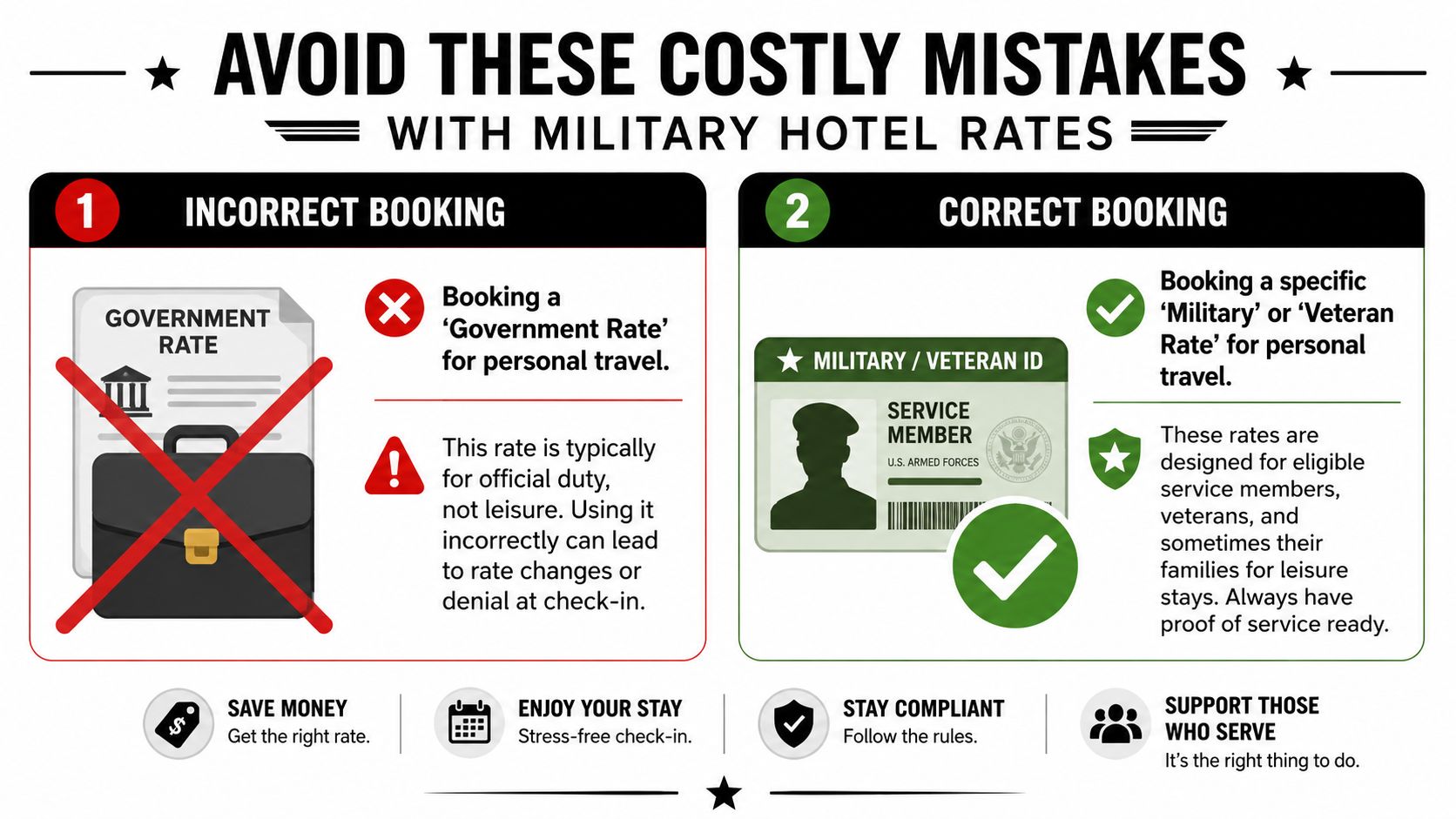
The costliest trap
A 2025 analysis of 12,000 hotel terms found that 40% of chains do not distinguish per diem and leisure rates in their public FAQs, which leads veterans to book the wrong rate type and face denial of service. The same source notes that ID.me verification is becoming mandatory for leisure rates at chains like Wyndham and IHG.
That's a strong warning order. Don't trust vague labels.
Other mistakes that trip people up
- Assuming military is always the cheapest: Sometimes a public promotion beats the military rate.
- Skipping the rate rules: If the details mention official travel, orders, or government ID requirements, stop and reassess.
- Not preparing verification: Hotels are tightening ID checks on some leisure offers.
- Forgetting property-level differences: A chain may advertise a program, but a specific location can still have limited availability or different terms.
What happens if you book the wrong rate
Hotels don't have to honor a per diem-style government rate just because someone clicked it. A front desk industry discussion on Reddit notes that hotels are not legally required to comply with per diem rates for travelers without valid orders, and those travelers may need to pay standard pricing out of pocket, as described in this front desk discussion on military discounts and government rates.
That's the ugly ending you're trying to avoid.
Booking the wrong military rate is like bringing parade shoes to a ruck march. Technically you showed up. Practically you're in trouble.
The fix
Use one rule that never fails. If your trip is personal, search for a military leisure, military family, military appreciation, or veteran rate. If the page talks about official business, per diem, travel orders, or reimbursement, back out unless you're traveling on duty.
Simple beats sorry.
Let Sgt Travel Deals Army Be Your Recon Team
You already know the trap. Book a rate with the wrong label, roll up to check-in, and suddenly your “deal” falls apart under fire. The fix is simple. Use a platform that helps you separate military leisure discounts from official-duty and per diem rates before you commit.
Sgt. Travel Deals Army keeps that mission front and center. The brand is veteran-owned, free to join, and built for travelers who want fewer guess-and-check searches and more clear options in one place. You can use its military travel deals hub to compare hotels, resorts, flights, car rentals, and activities without bouncing between a dozen tabs like a private who lost the map.
That matters because the cheapest mistake in travel is the one you avoid before checkout.
Use the platform as your pre-mission checklist. Confirm whether a rate is meant for personal travel or official travel. Compare the final total, not the marketing label. Save your short list, book with your eyes open, and walk into the lobby ready with the right ID instead of hoping the front desk cuts you slack.
Sgt. Travel Deals Army speaks the language, respects the budget, and helps you book smarter. Good recon wins battles. Good rate screening saves cash.