

You've got the tabs open right now. One browser window has school calendars. Another has airline prices that looked decent yesterday and now look rude. One kid wants a window seat. One needs a nap schedule. You're trying to figure out whether the “cheap” fare is cheap, or whether the airline is about to nickel-and-dime your whole squad into budget defeat.
That's normal. Family airfare feels chaotic because airlines price for confusion, not kindness.
I'm Sgt. Travel for this briefing, and the mission is simple: stop shopping like a solo traveler and start booking like a family unit. Cheap flights for families come from timing, discipline, and a little tactical patience. You need a plan for dates, tools, kid fares, baggage, and seating before you ever hit the purchase button.
Your Mission to Find Cheap Family Flights
A family of four usually starts the same way. Mom or Dad spots a destination, gets excited, and then sees the total airfare jump once everyone is added to the reservation. That's when the retreat begins. “Maybe next year.” “Maybe we'll drive somewhere.” “Maybe prices will drop.”
That hesitation is where families lose.

Stop Shopping One Seat at a Time
Airlines don't care that you're traveling with toddlers, a car seat, snacks, and a spouse who'd like to arrive with their sanity intact. They price inventory seat by seat. Families feel the pain faster because every fare jump multiplies across the whole booking.
That means your mission isn't just “find a low fare.” Your mission is to protect the total trip budget while keeping the logistics manageable.
Here's the drill-sergeant truth. A family booking needs to answer five questions immediately:
- When are we willing to fly: A one-day shift can change the whole picture.
- How many bags do we really need: Families overpack by instinct.
- Do we need assigned seats: Sometimes yes, sometimes no.
- Can we handle a connection: A layover with kids is either a money saver or a morale killer.
- Are we comparing total trip cost: Base fare alone is rookie math.
Practical rule: If you're booking for multiple people, every small mistake gets multiplied. Every smart move does too.
Run the Family Trip Like a Mission
Families who win at airfare usually do the boring things early. They check date flexibility before requesting time off. They compare morning and evening departures. They know whether they'll bring strollers, checked bags, or just backpacks. They don't get hypnotized by the first low headline fare they see.
They also use a command center instead of random searching. Keep your planning disciplined, and keep your deal tools in one place. Veteran-owned platforms like Sgt. Travel Deals Army matter because they're built for travelers who want a clearer booking process, not more noise. When it's time to compare actual options, Sgt. Travel Deals gives you another lane to check instead of relying on the same public searches as everyone else.
Your Objective
You're not trying to beat the entire airline industry. You're trying to book smart enough that your family gets on the plane without blowing the vacation budget before takeoff.
That's winnable.
Master the Calendar Your Airfare Attack Plan
Saturday night. The kids are finally asleep. You open your laptop, check flights, and get hit with a family total that looks like a car payment. That is what happens when you let the calendar run the mission instead of commanding it.
Your job is simple. Pick the right booking window, compare a few date options, and buy before family inventory gets squeezed.
According to National Geographic's coverage of Expedia's 2025 Air Hacks Report, families booking domestic flights one to three months in advance can save up to 25% compared to last-minute bookings, and the lowest average U.S. domestic flight prices occurred 39 days before departure. The same report, as covered there, says international family trips should usually be booked two to eight months ahead, with late August offering a strong mix of affordability and smaller crowds.
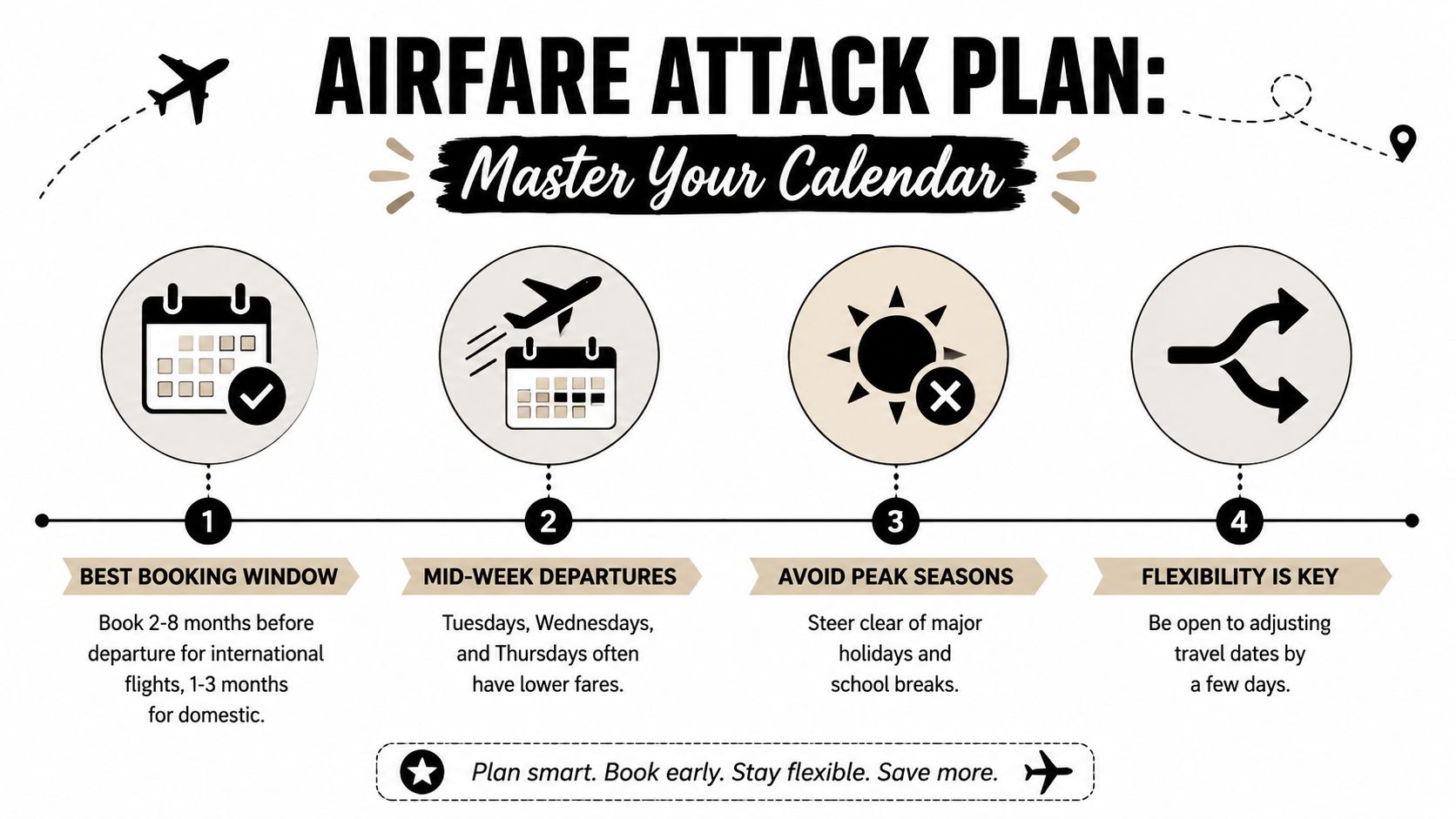
Your booking windows
Do not overcomplicate this.
| Trip type | Booking move |
|---|---|
| Domestic family flights | Aim for one to three months out |
| International family flights | Aim for two to eight months out |
| Summer family travel | Target late August when possible |
If you want a sharper planning framework, use this guide on the best time to book flights.
The late-booking trap
Families get punished faster than solo travelers. Airlines may still show a decent headline fare, but the cheap seat count disappears first. You are not hunting for one bargain. You need a block of seats that works for parents, kids, and all the gear that comes with them.
Here is the Sgt. Travel rule. Once your trip enters the last few weeks, stop waiting for a miracle. Prices often rise, seat maps get ugly, and your odds of sitting together drop with them.
That last point matters. A family of four can watch an acceptable trip turn into a bad one in a hurry because the remaining low fares are split across different flights, different cabins, or middle seats scattered across the plane.
Use a calendar like a planner, not a gambler
Run this drill:
- Start with a date range. One exact departure date is how families trap themselves.
- Test the shoulders of your trip. Leave a day earlier, return a day later, and compare the total.
- Check late August for summer travel. If your school schedule allows it, this is one of the strongest family moves on the board.
- Book while the mission is still calm. Calm means better fare choices, better seat choices, and fewer ugly compromises.
Late August is especially useful for family units. You still get warm-weather travel, but you often miss the peak summer crush. That means a better shot at lower fares and a less chaotic airport experience with kids, strollers, and tired parents.
Generic flight guides stop at “be flexible.” I want you to go one step further. Build a short booking window, put your target dates on the calendar, and check member deal platforms like Sgt. Travel Deals Army alongside public tools. That gives your family a cleaner shot at good fares before the crowd piles in.
Deploying the Right Tools for Airfare Recon
Public tools are your scouts. Member platforms are your special equipment. Use both.
Start with broad visibility, then move to comparison. Families get in trouble when they either trust one search engine too much or bounce between too many tabs and lose track of what they saw.

Use Google Flights like a recon map
Google Flights has a free Explore function that lets families enter a departure city and view deals across dates and destinations. It's especially useful for flexible travelers comparing price patterns without paying for premium tools, as described in this write-up on cheap flights for families using Google Flights Explore.
That tool is excellent for three jobs:
- Budget-first destination hunting: Start with your home airport and see where your money goes farthest.
- Date testing: Move your trip a few days and watch how prices react.
- Quick reality checks: If your dream route looks overpriced, Explore can show whether the issue is the destination, the dates, or both.
For more no-cost planning help, bookmark these best free travel planning apps.
Public search versus member platforms
Here's the clean comparison.
| Tool type | Best use | Limitation |
|---|---|---|
| Public airfare search tools | Broad research, flexible date scanning, destination discovery | Everyone sees similar inventory paths |
| Member deal platforms | Side-by-side price comparison and alternate booking options | Best used after you already know your target route |
Families need both. Public tools tell you where the terrain is favorable. A member platform gives you another angle when it's time to buy.
One more piece of video intel for the troops:
My recommended workflow
Don't improvise. Run this sequence.
- Step one: Search wide with Google Flights Explore.
- Step two: Narrow to two or three date combinations that your family can handle.
- Step three: Compare final booking options across public sites and a member-only option such as Sgt. Travel Deals.
- Step four: Screenshot the best combinations before you get distracted by dinner, homework, or life.
That's how you keep the mission under control.
Special Ops Savings for Your Family Unit
Family flight strategy changes once kids enter the picture. A solo traveler can survive a sloppy connection, random seat assignment, or cramped carry-on setup. A parent traveling with children pays for every weak decision in noise, stress, and airport meltdowns.
Infants and young kids
Most major airlines let infants under 2 fly free on a parent's lap on domestic flights, but that doesn't mean it's automatically the best move. If the flight is short and your child naps well on you, lap infant status can work. If the flight is long, turbulent, or scheduled right through nap time, buying a seat may be the sanity option even if it costs more.
That's not a statistic. That's operational reality.
For older kids, don't assume meaningful child discounts are waiting for you. According to Alternative Airlines' breakdown of free and discounted child fares, most airlines only reduce child ticket prices by 20% to 35% once the child is over age 2. Frontier stands out because it offers a Kids Fly Free program for children 14 or under with a paid Discount Den fare, and that membership costs $60 annually.
When Frontier is worth a hard look
Frontier's family offer can be useful, but read the fine print like a grown-up, not an optimist. Eligible flights can be limited, and the free-child benefit isn't a blank check across every route and date.
Families should think in scenarios:
- One child, one adult: Nice perk, but run the full math.
- Several kids on one reservation: Now the savings potential gets serious.
- Need max flexibility or bundled comfort: A legacy carrier may still win once fees and convenience are added.
A cheap child fare that creates a miserable travel day isn't always the best family move.
Seating and connections
Here's my opinion. For very young kids, nonstop flights are often worth paying more for if the difference is reasonable and the connection would land during meal time, bedtime, or the middle of a chaotic airport rush. For older kids who travel well, a connection can be acceptable if it protects the budget.
Seating follows the same logic. If your children are little, sitting together matters. If your kids are older and confident, you may decide random seat assignment is an acceptable gamble. The key is deciding before checkout, not panicking after the confirmation email lands.
Cheap flights for families aren't just about ticket price. They're about choosing the version of “cheap” your household can survive.
Dodging Financial Landmines Baggage and Beyond
The base fare is bait. The total trip cost is the truth.
Families get burned because they celebrate too early. They find a low advertised fare, high-five in the kitchen, and then get wrecked by baggage, seat assignments, carry-on rules, and airport extras. Low-cost carriers can absolutely help your budget, but only if you price the mission accurately.
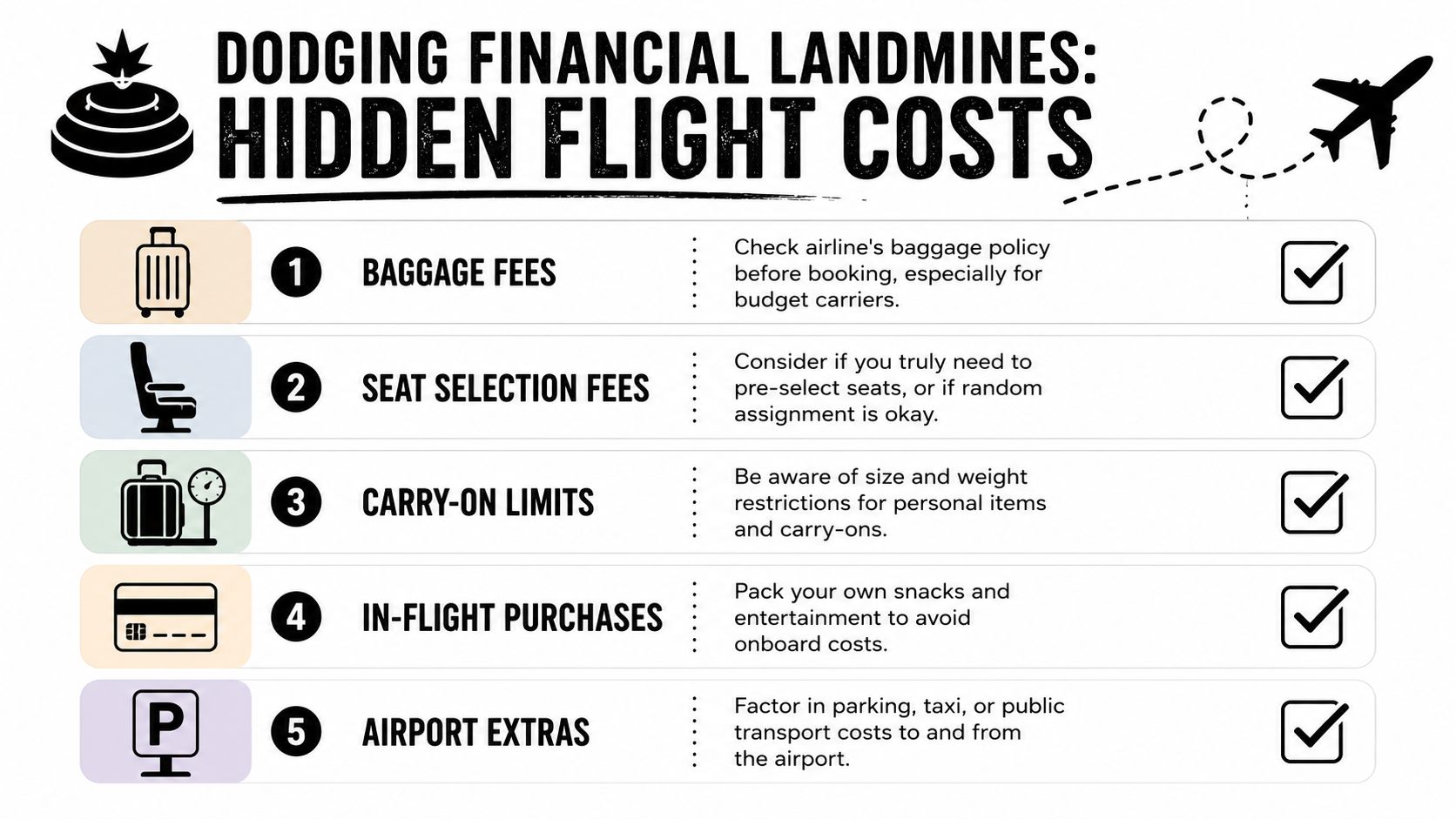
The trap families fall into
A key mistake is psychological. Families delay booking because they're chasing the “perfect” deal, then they rush later and focus only on the fare they can see first. That's exactly backwards.
The warning is straightforward in this report on peak-season booking shifts and hidden family travel costs. Extra fees from low-cost carriers can inflate the total family cost by 20% to 30%.
Run the total-cost checklist
Use this before you book any “deal” fare:
- Baggage plan: Decide whether the whole family can share checked luggage or travel lighter.
- Seat strategy: Determine whether you need paid seat selection for every passenger.
- Carry-on compliance: Check bag size rules before booking. This guide to international carry-on rules helps you avoid ugly surprises.
- Airport transport: Add parking, rideshare, or train cost to the airport.
- Food and kid extras: Bring snacks and entertainment so you don't buy every little thing under pressure.
What smart families do instead
They compare two final totals, not two teaser fares. Sometimes the “more expensive” ticket already includes the pieces your family would have paid for anyway. Sometimes the ultra-low-cost option still wins, but only after you strip the trip down and pack with discipline.
Here's a quick comparison lens:
| Fare type | Looks cheap first | Often cheaper in the end when |
|---|---|---|
| Ultra-low-cost carrier | Yes | You pack light and skip extras |
| Bundled or legacy fare | Sometimes no | You need bags, seats, and smoother logistics |
Field note: If you can't explain your total trip cost in one minute, you're not ready to book.
That's how families avoid getting ambushed by “cheap” airfare.
Your Family Vacation Is a Go Mission Accomplished
It's 9:40 p.m. The kids are finally down. You open three flight tabs, see four different prices, and start wondering if this trip is slipping away. Knock that off. Cheap flights for families do not come from luck. They come from a repeatable mission plan.
Here's the winning formula. Start early, test a few date options, price the trip for the family you have, and book before late fare jumps hit. As noted earlier, waiting too long usually costs more. So does chasing a teaser fare that falls apart once you add bags, seats, and the basics your crew needs.
The final briefing
Your job is simple. Build a booking rhythm and stick to it.
- Scout early: Search before your target dates get crowded.
- Cut weak options fast: Keep only flights that fit your schedule, sleep needs, and budget.
- Book with discipline: Don't drift into the last stretch and hope prices bail you out.
- Check family logistics one last time: Seating, baggage, stroller needs, connection length, and airport transfer costs all count.
That is how Sgt. Travel handles airfare. Calm, fast, and with the full mission in view.
What actually gets families across the finish line
Families who save the most usually do boring things well. They stay flexible by a day or two when possible. They use search tools for recon, then verify the full checkout price before they commit. They pick flights that work for naps, school schedules, and baggage reality, not just the lowest number on the screen.
They also stop treating booking like a solo traveler puzzle. A family unit has different rules. An infant can change seat choices. A basic fare can become expensive fast if you need overhead space, checked luggage, or guaranteed seats together. One ugly connection can wreck the first day of the trip.
That's why member-only deal platforms can earn their keep. A veteran-owned community like Sgt. Travel Deals Army helps families spot offers faster, compare options with a clear head, and stay focused on total trip value instead of airfare bait.
Your vacation is still a go.
Pick the dates. Run the checklist. Book like the commander of your family unit. Then use Sgt. Travel Deals to compare flights, hotels, car rentals, and activities side by side so your whole operation stays on budget.