
You're standing in baggage claim, half awake, phone battery limping, and every sign around you screams rental cars in a different direction. One counter promises speed. Another promises savings. Then the clerk starts talking about waivers, liability, holds, fuel, premium classes, and return rules. That's where travelers get ambushed.
I'm Sgt. Travel, and this is the straight talk on car rentals at the airport. No fluff. No corporate nonsense. Just the field-tested playbook for getting a decent car without donating extra cash to convenience fees, bad timing, and counter upsells. If you've got a trip coming up, lock in and pay attention.
Your Mission Should You Choose to Accept It
You land. You shuffle off the plane with everybody else. One hand's dragging luggage, the other's checking reservation emails, and the airport signs send you into a maze of arrows, elevators, trains, and shuttle pickups. That's the usual battlefield.
Most travelers make the same mistake right here. They assume the first car they can reach is the best option. Wrong move, soldier. Fast isn't always smart, and “easy” gets expensive in a hurry.
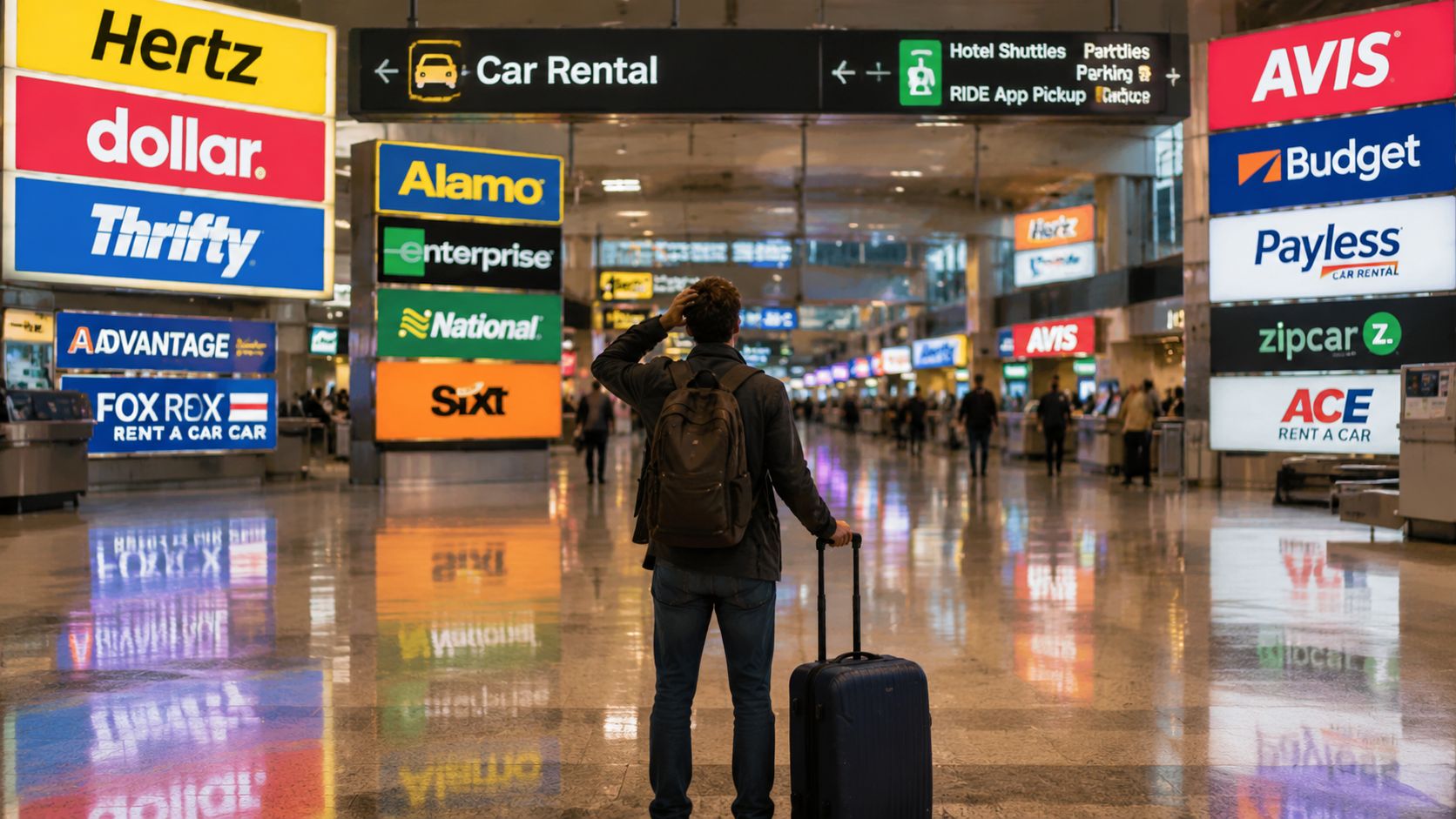
A smarter traveler treats the rental desk like a checkpoint, not a surrender point. You show up with your confirmation ready, your documents lined up, and a plan for what you will and won't pay for. If you haven't done your recon yet, start with this rundown of cheapest car rental companies so you know which names are worth your time before your boots hit the terminal floor.
The real mission
You need three things:
- A car that fits the trip: Don't book a tank for a weekend city run.
- A clean contract: No surprise fees, no mystery coverage, no confusion at return.
- A controlled pickup: You should know where you're going before you start chasing signs.
Practical rule: Convenience is useful. Convenience without price discipline is how travelers get smoked.
Airport rental counters are built to move tired people fast. That's not evil. It's business. But tired people say yes too quickly, skip the inspection, ignore the fee breakdown, and assume they'll sort it out later. Later is when the bill shows up.
Sgt. Travel's opening order
Treat your rental like gear issue before deployment. Read the reservation. Confirm the pickup location. Know whether you're renting on-airport or off-airport. Bring the license, payment method, and confirmation details you'll need. Then walk to the counter like you've done this before.
That's how you win the first round.
The Battlefield On-Airport vs Off-Airport Rentals
Your first strategic choice is simple. Do you rent at the airport, or outside it? This decision shapes your cost, your timing, and your stress level.
At major U.S. airports, approximately 9% to 15% of originating and terminating passengers use a rental car as their primary mode of airport access, and airport rental companies capture 89.1% of the market share at some locations according to the National Academies review of airport ground access and rental activity. Translation: the airport counters dominate because they're easy to reach, not because they're always the smartest deal.
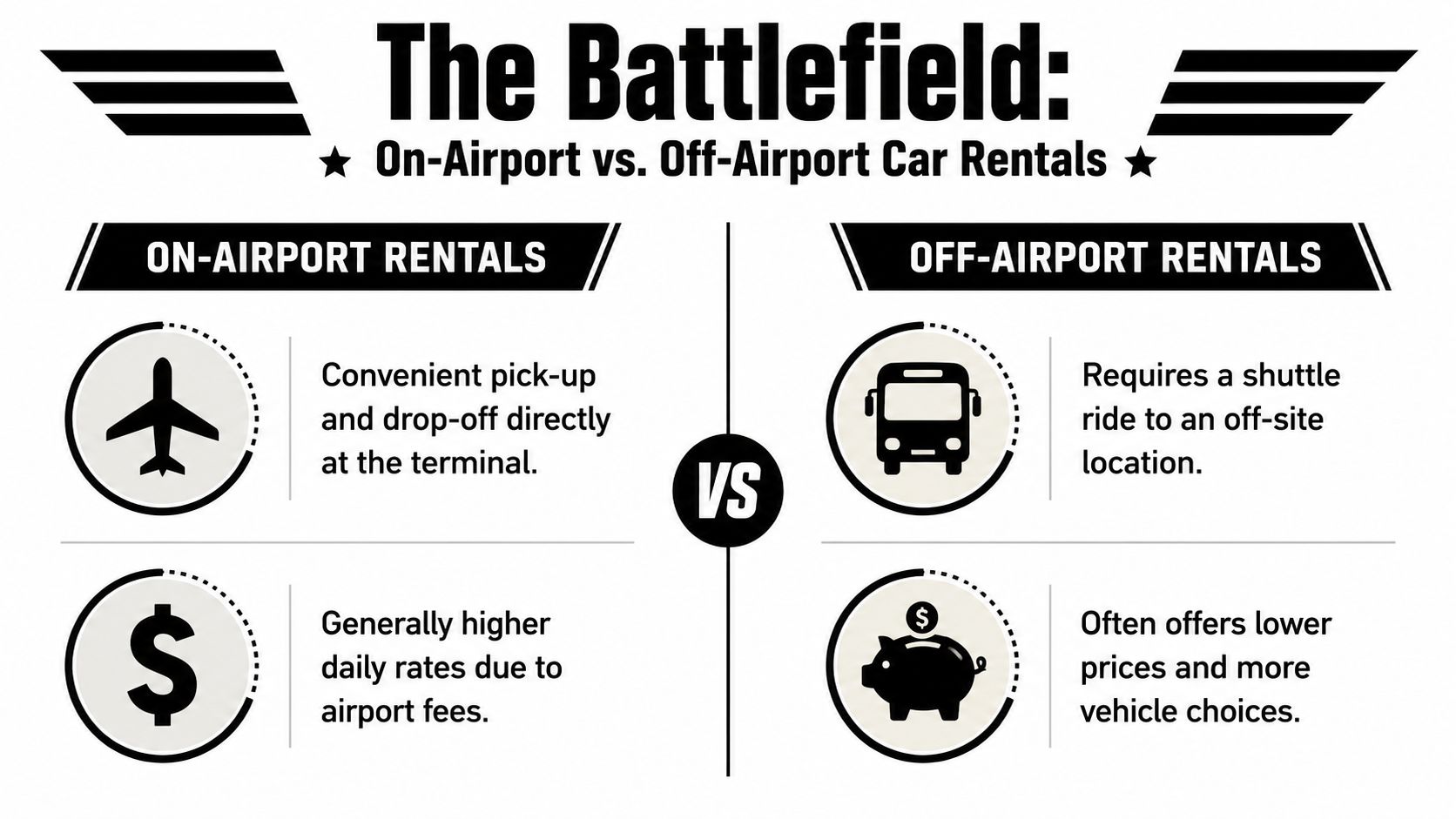
On-airport rentals
These are the brands you see inside the terminal or at the airport rental center. You follow the signs, maybe ride a tram or shuttle, show your license, and grab the car.
That convenience matters when you're arriving late, traveling with kids, carrying extra gear, or trying to make a meeting without any side quests. If time is the mission priority, on-airport wins.
But convenience usually comes with extra cost. You're paying for location, speed, and airport overhead baked into the final bill.
Off-airport rentals
These are the agencies a short distance away from the terminal. They usually run their own shuttle and often compete harder on price.
The catch is obvious. You've got one more transfer to deal with. After a long flight, that shuttle can feel like punishment. Still, if your budget matters more than shaving a little time, off-airport can be the better tactical move.
Don't confuse “farther away” with “worse.” A short shuttle ride can be worth it if the total bill drops enough.
For a quick visual on how the shuttle side of the process usually works, this YouTube walk-through of an airport rental shuttle experience is worth a watch.
Side-by-side comparison
| Feature | On-Airport Rentals | Off-Airport Rentals |
|---|---|---|
| Pickup speed | Usually faster once you reach the counter | Slower because you need a shuttle |
| Location | Inside terminal or airport rental center | A few miles from the airport |
| Convenience | Strongest option for late arrivals and tight schedules | Better for travelers who can trade time for savings |
| Price pressure | Usually higher | Often lower |
| Return process | Easier for same-day flight departures | Needs more timing discipline |
| Best for | Business trips, short stays, tired arrivals | Budget trips, flexible schedules, deal hunters |
My call
If you're landing late, carrying a lot, or traveling on a tight schedule, use the airport location and keep moving. If the trip is price-sensitive, test an off-airport option before you book. Don't pick based on habit. Pick based on mission conditions.
Decoding Fees and Demystifying Insurance
Rental companies often try to fog the battlefield. The rate you see first is rarely the number you pay. The base price is only the opening volley.
You'll see line items that sound harmless. Facility charges. Concession recovery. Taxes. Surcharges. Ignore those labels and focus on the total. That's the number that matters.
Fees that catch tired travelers
Airport rentals often carry extra location-based charges, which is why the terminal counter can look fine at first and ugly by checkout. If the total jumps between search and confirmation, stop and read every line before you commit.
Use this rule. Compare final totals, not headline daily rates.
- Base rate: The advertised rental cost before add-ons.
- Airport-related fees: Charges tied to operating at or near the airport.
- Optional extras: GPS, toll packages, satellite radio, child seats, and prepaid fuel offers.
- Protection products: Waivers and liability add-ons pushed at the desk.
Insurance in plain English
A lot of travelers freeze at the counter because the language sounds more technical than it needs to be.
LDW or CDW usually means a waiver. It's not the same thing as traditional insurance. It's the company saying it may waive certain damage claims against you if the terms are met.
Liability protection is different. That's about damage or injury claims involving other people or property.
For some premium classes, the rules get stricter. At JFK, renters without a ticketed return itinerary must provide verifiable evidence of transferrable collision, non-collision damage, and liability insurance for certain high-end vehicle classes. If they can't, the rental can be denied for those classes. The same location offers Supplemental Liability Protection at $16.20 per day for up to $300,000 in third-party liability coverage, as listed on Enterprise's JFK location policy page.
That matters for travelers who book luxury vehicles, arrive with flexible plans, or assume the counter will sort everything out on the fly. It won't.
How to handle the counter pitch
Before pickup, check your own auto policy and the benefits attached to the card you're using. Don't guess. Verify. If you already have enough protection, say no with confidence.
If you don't have coverage sorted, decide before you arrive whether you'll buy the rental company's protection. The counter is the worst place to start thinking clearly.
For a broader look at how prices shift across locations and booking setups, this guide to car rental rates helps you spot where underlying costs start hiding.
Ask one question at the desk: “What is optional, and what is required for this exact vehicle class?” Then stay quiet and listen.
That single question cuts through a lot of nonsense.
Your Pre-Rental Inspection Checklist
You've got the keys. Good. Don't drive off yet.
The inspection is your shield. Skip it, and you might spend the rest of the trip arguing about a scratch, chipped windshield, torn seat seam, or wheel scuff that was there before you touched the car. This is not paranoia. This is discipline.
The five-minute walk-around
Start outside. Move slowly and film the whole vehicle with your phone in one continuous clip if you can. Then take close photos of any damage.
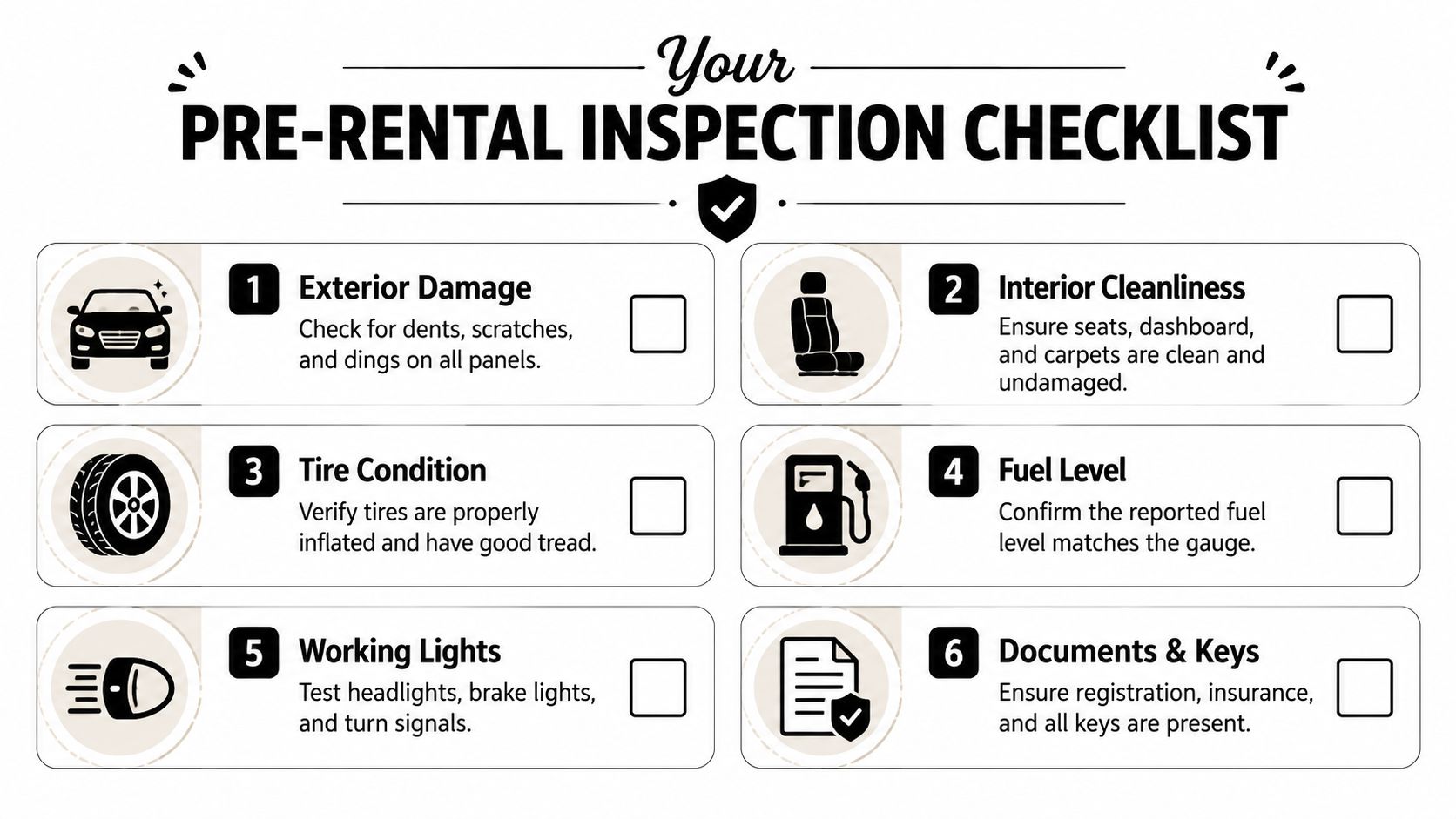
Check these points before you leave the lot:
- Body panels: Look for dents, scratches, paint transfer, cracked trim, and bumper damage.
- Glass: Inspect the windshield and windows for chips or star cracks.
- Wheels and tires: Look for curb rash, low tire pressure, and obvious wear.
- Lights: Turn on headlights, brake lights, and signals if possible.
- Roof and lower edges: Travelers miss these all the time. Don't.
The part people forget
Open the doors and inspect the inside too. A stained seat, torn upholstery panel, missing charger cable, broken screen, or strong odor can become your problem if you leave without noting it.
Then verify the basics:
- Fuel level matches the paperwork
- Registration or required documents are present
- You received the right car class
- The key fob works consistently
A timestamped video beats a vague memory every single time.
Make the agent acknowledge damage
If you spot something, don't just photograph it and hope. Get the company to record it on the rental file or point it out to the lot attendant before departing. You want your evidence and their acknowledgment.
If you want a quick visual demo, this YouTube guide on inspecting a rental car before driving off shows the exact kind of walk-around that keeps you out of billing fights later.
Sgt. Travel's checklist standard
Don't rush because other drivers are waiting. Don't assume “they already know about that scratch.” And don't let the excitement of starting the trip override common sense. Your inspection isn't a formality. It's your defense file.
Executing Pickup and Drop-Off Procedures
This is the ground game. Wheels down, phone on, eyes open.
Once you're off the plane, follow airport signs for ground transportation or rental cars. If your booking is on-airport, the company may have a terminal counter, a consolidated rental center, or a kiosk setup. If your booking is off-airport, you'll usually need the agency shuttle from a designated pickup zone.
Pickup without the chaos
Move in this order:
Find the exact pickup point
Don't assume all rental shuttles stop in the same place. Some airports split them by company or terminal.Have your documents ready
Keep your driver's license, reservation confirmation, and payment card in hand before you reach the desk.Read the final contract
Check the vehicle class, fuel terms, return location, and any optional products added at the counter.
Some travelers can use mobile check-in or automated kiosks to cut the line. If your company offers that option, use it. Less counter time usually means fewer chances to get talked into things you don't need.
If your flight lands early and you're tempted to rush over before your official time, read this practical note on picking up a rental car early so you don't create your own problem at the desk.
Return like a pro
The return is where lazy habits cost money. Don't toss the keys and sprint to security unless the location gives you no other choice.
Do this instead:
- Refuel if your contract requires it
- Remove your trash and personal items
- Photograph the car again at return
- Wait for a check-in when possible
- Get proof that the vehicle was received
A receipt matters. An emailed closeout matters. Final charge confirmation matters. If something is wrong, you want to catch it while you're still standing there, not after you're home trying to remember which scratch was where.
Timing discipline
If you rented off-airport, build extra buffer time for the shuttle on the way back. If you rented on-airport, still leave room for lot traffic and return lane backups. Rental return signs are not always where you want them to be, and circling the airport road system in a hurry is a great way to ruin your final hour.
Close the contract before you leave the scene. That's how you keep a travel day from turning into a customer service campaign.
SGT Travel Deals Army Intel Top Money-Saving Tactics
Travelers often overpay because they book tired, compare badly, or confuse convenience with value. You don't need to be that traveler.

The first cost-cutting move is timing. At JFK, January is the cheapest month to rent with an average daily rate of $56, while July averages $99 per day, which is 39% above the yearly average, according to KAYAK's JFK rental price trends. Same airport. Same basic need. Different timing, different pain.
The savings that matter most
If you remember one thing, remember this: the airport location often costs extra because it can. Travelers often pay 18.3% more for an airport rental, and seven-night airport rentals average $86 more than downtown equivalents. Some off-brand providers outside airport zones can be up to 30% cheaper by avoiding airport concession fees that can run 10% to 15% of the rental rate, based on NerdWallet's rental car pricing analysis.
That's why I tell people to stop blindly defaulting to the terminal counter. If your schedule can absorb a little friction, compare downtown and off-airport branches before you book.
There's a practical airport example too. At Harry Reid, travelers often ask how to avoid steep airport concession fees, and the answer is brutally simple. Pick up away from the airport zone when that option makes sense. The airport's own rental information explains the setup, and it's useful reading if you're planning Nevada travel through Harry Reid rental car access details.
Sgt. Travel's tactical playbook
- Book before you fly: Last-minute airport rentals put you in a weak bargaining position.
- Compare locations, not just brands: The same company can price airport and downtown pickups very differently.
- Use smaller off-airport operators carefully: Savings can be real, but you need to factor in shuttle time and review the pickup process.
- Avoid premium upgrades you didn't plan for: Fancy wheels impress nobody if the fees wreck your trip budget.
If you want a quick pep talk on thinking beyond the first price you see, this short video gets the point across:
My opinion, no sugar coating
The airport counter is a convenience purchase. Treat it like one. Sometimes it's worth paying for. Sometimes it's a lazy tax. Your job is to know which mission you're on before you click book.
Mission Debrief Frequently Asked Questions
Travelers usually ask the same handful of questions when the booking gets real. Good. That means you're thinking ahead.
Can I use a debit card instead of a credit card
Sometimes, yes. But don't assume. Policies vary by company and location, and airport branches can be stricter than neighborhood branches. Check the exact rental location's payment rules before you travel.
What if my flight is delayed and I'm late for pickup
Call the rental company as soon as you know. Don't wait until you land. A no-show can wreck the reservation, especially on busy travel days.
Are drivers under 25 charged extra
Often, yes. The exact rule depends on the company and location. Read the terms before booking so you don't get hit with a surprise at the desk.
Are one-way rentals a good idea
They can be convenient, especially for road trips or point-to-point travel, but they may come with different pricing and limited vehicle availability. Check both round-trip and one-way options before deciding.
Should I prepay for fuel
Usually not, unless you know you'll return the car nearly empty and won't have time to refuel yourself. Most travelers do better by filling up shortly before return.
Do I need to print my reservation
Usually your phone is enough, but I still recommend saving a screenshot. Airport Wi-Fi, dead batteries, and weak signals love to show up at the worst possible time.
Final order from Sgt. Travel
Stay calm. Read the contract. Inspect the car. Keep your receipt. If something feels off at the counter, slow the operation down and ask questions. That's not being difficult. That's being smart.
Sgt. Travel Deals Army is a veteran-owned travel platform built for travelers who want to compare smarter and spend less. If you want backup for hotels, flights, car rentals, resorts, activities, and more, enlist with Sgt. Travel Deals Army and check rates side by side at STD Army Deals. It's free to join, easy to use on mobile or desktop, and a solid option for travelers who like value, transparency, and supporting a veteran-owned business.