

You're probably doing what most travelers do. You open a few tabs, search business class to Europe, see a fare that looks like a mortgage payment, and slam the laptop shut. That's the rookie move.
Listen up, troop. Business class to Europe isn't reserved for CEOs, hedge fund managers, or people who think airport champagne is a personality trait. It's a targetable deal if you stop searching like a tourist and start booking like you're on a mission.
The game is simple. You need timing, tools, flexibility, and the discipline to compare cash fares against miles. That's how you find the cheapest business class tickets to Europe without wandering into fantasy-land pricing or panic-booking the first “sale” you see.
Why Flying Business Class to Europe Is Not Just for CEOs
You know the setup. Overnight flight. Tight economy seat. Knees jammed into a tray table. You land in Europe feeling like you lost a bar fight with the airplane.
That's why business class matters. On a long-haul route, you're not paying only for a bigger seat. You're paying for sleep, function, and the ability to arrive like a human being instead of a wrinkled carry-on bag.
The myth is that business class is always absurdly expensive. Wrong. Price matters, but strategy matters more.
According to KAYAK's business class Europe fare data, the average round-trip business-class fare from the U.S. to Europe is $3,614, while a good deal is closer to $3,072. More useful than the average, 25% of users found fares at $3,176 or less round-trip, and recent cheap examples included London nonstop for $1,120 and Paris with one stop for $2,207.
That's your first mission brief. Don't anchor on the average. Anchor on the deal zone.
What a realistic target looks like
If you're shopping for the cheapest business class tickets to Europe, use these bands:
- Good-deal range: Around the low-$3,000s round-trip is a serious look.
- Strong find: Anything below that benchmark deserves immediate attention.
- Outlier strike: A fare like the London example above is not normal, but it proves the market can break in your favor.
Field rule: Stop asking, “Is business class expensive?” Ask, “What price band am I willing to strike on?”
Why this matters more than people admit
A premium cabin changes the whole trip. You board earlier, settle in faster, and get off the plane ready to move. If you're doing a short Europe trip, that matters even more. Wasting your first day recovering from economy is a bad bargain.
Here's the straight truth. Plenty of travelers can afford one overpriced business-class ticket once. Smarter travelers learn how to buy the same cabin at a much better number, and they repeat the process.
That's the mission. Not luxury for luxury's sake. Better travel, bought with discipline.
Mission Timing Your Search and Booking Window
Timing wins this fight. You can search the right route with the right cabin and still overpay if you pick the wrong month.
Cheapflights reports that August is currently the cheapest month for U.S. business-class flights to Europe, with an average fare of $3,424. May is the most expensive at $4,222. That's a gap of $798, which is roughly 19% lower in August than in May.
That's not a rounding error. That's mission-critical intel.
The month matters more than your hunch
A lot of travelers book around their assumptions. They think spring sounds nice, early summer feels ideal, and holiday periods will “probably be fine.” That's how airlines take your lunch money.
If your schedule has any wiggle room, August deserves a hard look. May deserves scrutiny. June also sits among the pricier months in the same Cheapflights dataset, so don't drift into early summer just because it feels convenient.
Use this as your operational map:
| Travel month approach | What to do |
|---|---|
| August window | Prioritize it if your schedule allows. It's the best documented seasonal value in the current data. |
| May and June travel | Expect tougher pricing. Search, but don't assume you're seeing a deal. |
| Flexible month shoppers | Let the fare decide the trip, not the other way around. |
How to search without boxing yourself in
Don't start with fixed dates if your real goal is price. Start with flexible-date calendars, scan a wider month, and only tighten the trip after you find the fare pattern.
That's the disciplined version of shopping. You're gathering intel first, then making the move.
For a broader timing strategy, take a look at this guide on the best time to book flights. Use it as your planning map, then verify the route in live search.
August gives you the best historical pricing signal in the current business-class Europe data. If you insist on peak-demand timing, don't complain when the fare bites back.
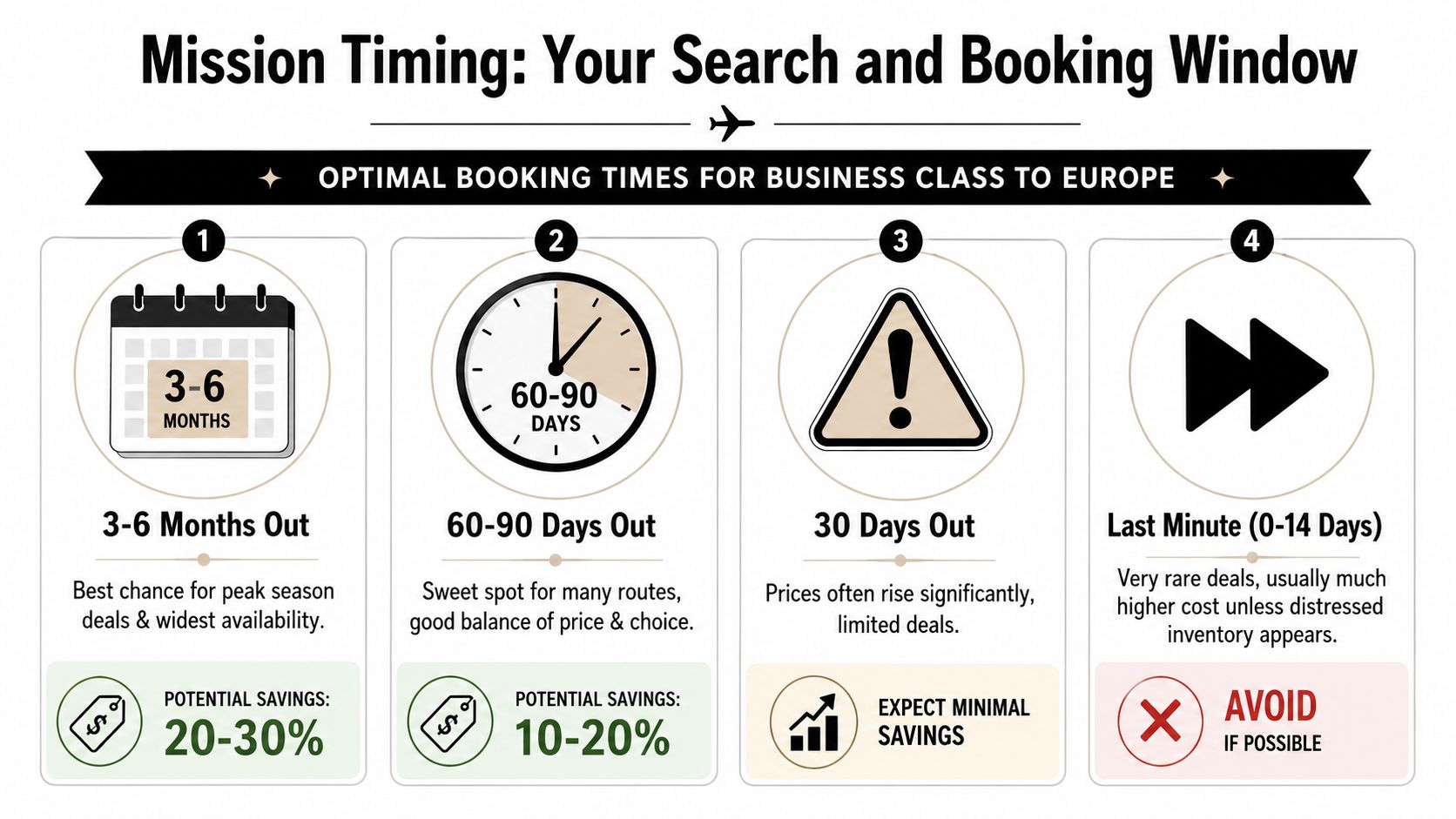
The booking window commandment
The infographic above lays out a useful tactical framework. The key takeaway is simple. Earlier planning usually gives you more choices, while late booking often means paying for urgency.
Treat the booking process like reconnaissance:
- Search early: You want room to compare dates, airports, and carriers.
- Track patterns: Watch the same route over time instead of making a one-search decision.
- Strike when your target appears: Once the fare hits your acceptable range, move.
If you wait for perfection, you'll usually get regret.
Your Arsenal of Search Tools and Alerts
A deal hunter without tools is just a guy refreshing the same airline website and hoping for mercy. That's not a strategy.
You need a search system. Not one site. A system.
The smartest starting point is a flexible-date search with the business-class cabin filter turned on. That matters because Momondo notes through KAYAK's business-class booking guidance that prices vary sharply by departure city, with some Los Angeles fares dropping as low as $560 per person, while other cities price much higher.
That means where you depart can matter as much as when you fly.

Build your search stack
Use more than one tool because each one reveals different weaknesses in airline pricing.
- Google Flights: Best for broad route discovery, calendar scanning, and quick comparison across nearby airports.
- KAYAK and Momondo: Useful for wider market scanning and alternate fare displays.
- Airline websites: Important for checking fare rules, aircraft type, and direct booking options.
- Fare alerts: Your surveillance layer. Let the tools watch prices when you're not.
The nearby-airport drill
This is one of the easiest wins in the whole operation.
If you only search your home airport, you're acting like the airline owes you a deal. It doesn't. Search nearby major hubs, secondary airports, and cities you can reach with a cheap positioning flight or a manageable drive.
Do it in this order:
- Search your home airport first so you know the baseline.
- Open nearby departures and compare the same week.
- Check destination flexibility if Europe itself is the priority more than one exact city.
- Review total trip friction before booking. A cheaper fare that adds chaos may not be worth it.
Set alerts like a grown-up
Fare alerts aren't optional if your dates aren't urgent.
Create them for:
- Your preferred route
- A backup destination
- At least one alternate departure airport
- Both cash and, if relevant, award options
If you want to see the mechanics in action, search YouTube for walkthroughs on Google Flights alerts and flexible-date flight hunting. Video demos are useful because you can watch the filtering process step by step instead of guessing your way through menus.
Search wide first. Narrow later. Travelers who reverse that order usually overpay.
Don't confuse a low fare with a good fare
A headline price means nothing if the schedule is ugly, the connection is risky, or the plane doesn't offer the experience you expected. Before you book, check:
- Aircraft type: Some business products are better than others.
- Layover structure: Long or awkward transfers can erase the comfort advantage.
- Fare rules: Change and cancellation terms matter.
- Seat map quality: Cabin layout can make or break the value.
The cheapest business class tickets to Europe are often found by people who compare airports, not just dates. That's the professional move.
The Ultimate Hack Unlocking Value with Points and Miles
Cash isn't always the best weapon. Sometimes it's the wrong weapon.
If you've got transferable points, airline miles, or access to a transfer bonus, award travel can beat a cash fare so badly that paying cash starts to look lazy. Such situations allow disciplined travelers to distinguish themselves from people who only search the “Book Now” button.
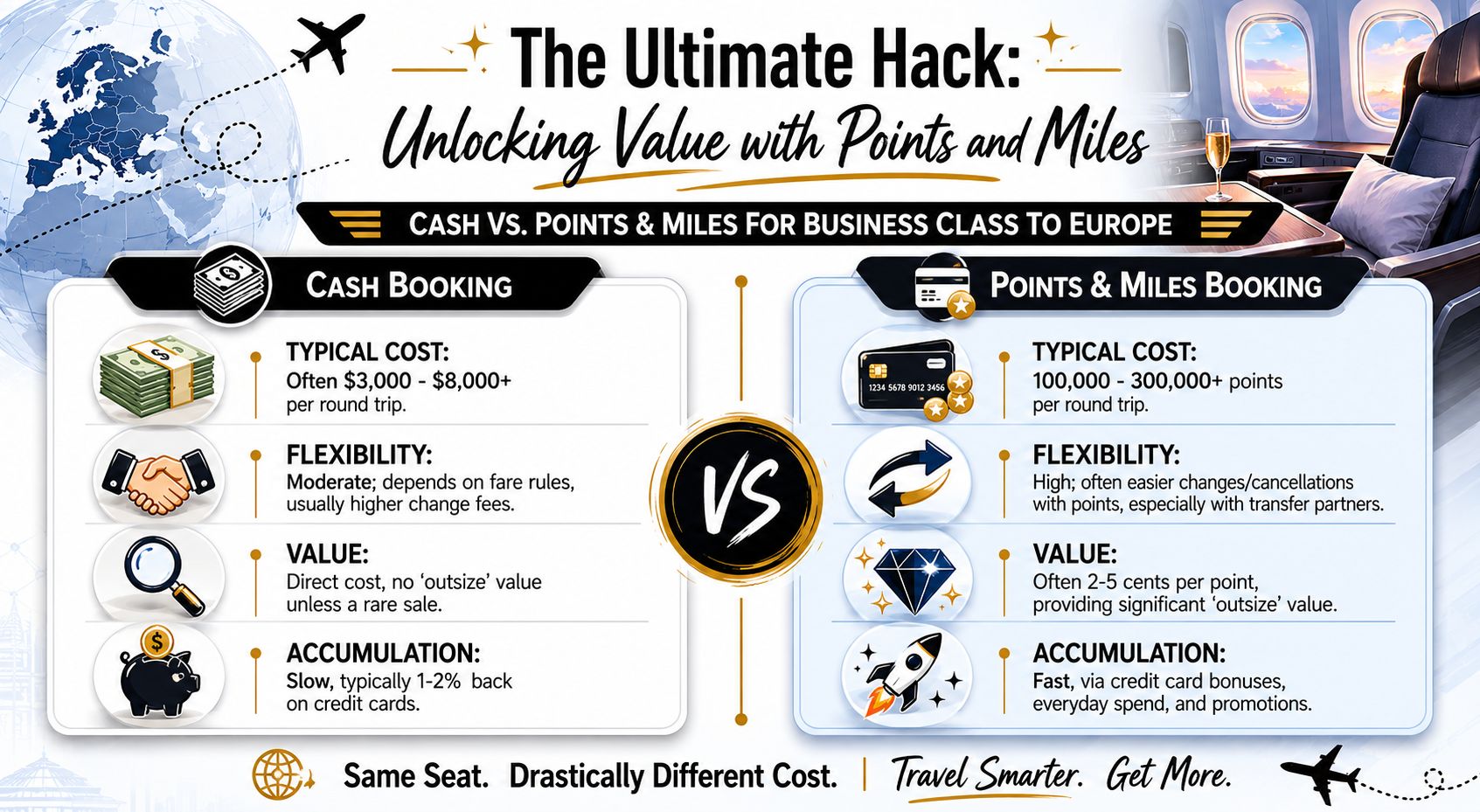
A strong miles strategy starts with understanding transfer partners. Bank points often move into airline programs, and those airline programs can provide better pricing than what you'd ever get from a cash search.
According to Momondo's business-class Europe page, strategic award bookings can be far better value than cash fares. Examples noted there include Iberia business class starting around 40,500 Avios each way from cities such as New York, Boston, Washington, Dallas, and Toronto, plus Alaska awards to Dublin as low as 45,000 points each way.
When points win
Points usually win in a few clear situations:
- Cash fares are stubbornly high: If the route won't break into a reasonable cash range, miles become the pressure-release valve.
- You can transfer instantly: Flexible bank points are powerful because they let you move only when you find space.
- You've got departure-city options: Some award sweet spots work best from specific gateways.
- Transfer bonuses show up: They can improve the deal without changing the seat.
For more strategy on building the right points balance, review these travel rewards credit card options.
Cash versus points decision drill
Don't get hypnotized by the word “free.” Award bookings aren't automatically better. Compare them.
Ask yourself:
| Booking method | Best use case |
|---|---|
| Cash fare | Book when the route drops into a strong deal range and the schedule is ideal |
| Points booking | Book when cash is bloated, award pricing is available, or a transfer bonus improves value |
| Either option | Choose the one that gives you the better overall trip, not just the lower headline number |
Here's a practical video if you want to sharpen that instinct before you move:
Keep your award search disciplined
Award travel is not a license to get sloppy. You still need to compare routes, taxes, schedules, and available dates.
A simple operating method works well:
- Check cash first so you know what problem you're solving.
- Search partner awards next for your target cities.
- Review transfer options only after confirming the seat exists.
- Book quickly when the value is obvious.
The cheapest seat in business class might not be a cash fare at all. It might be sitting inside a frequent flyer program you haven't checked yet.
That's the advanced play. Not chasing random points hype. Using miles only when they beat the cash alternative cleanly.
Advanced Tactics Snagging Mistake Fares and Hidden Deals
This is special operations territory. Not for reckless travelers, but absolutely for alert ones.
Mistake fares happen when an airline or booking system briefly prices a premium seat far below what it should cost. They are rare, unpredictable, and fast-moving. If you hesitate, they vanish. If you overthink them, someone else gets your seat.
The right posture is simple. Be prepared before the fare appears.
How to act when a fare looks wrong
If you spot a business-class fare to Europe that looks dramatically lower than normal market pricing, move through this sequence:
Verify the route and cabin
Make sure it's business class and not premium economy or a mixed-cabin trap.Check the booking path
If the fare appears on a reputable booking platform or airline site, that's your green light to take it seriously.Book first, inspect second
Don't spend an hour congratulating yourself. The inventory won't wait.Hold off on nonrefundable extras
Don't rush into prepaid hotels or separate onward tickets until the booking settles.
Positioning flights can unlock the real deal
A lot of travelers lose because they insist on starting from one airport. That's not loyalty. That's stubbornness.
If a major hub has a much better long-haul business-class fare, a short domestic hop to reach that hub can be worth it. This is called a positioning flight. It adds complexity, yes. But it can also turn an impossible fare into a workable one.
Use positioning only if you can handle the logistics:
- Leave buffer time: Tight self-made connections are how trips fall apart.
- Travel light if possible: Baggage can complicate separate tickets.
- Price the whole mission: Add the positioning cost before declaring victory.
The mixed-cabin trick
Sometimes one segment prices in business class while a shorter feeder leg does not. That can still be a win.
If the long overnight segment is in the premium cabin and the short hop is not, the deal may still be excellent. Don't reject a useful fare just because every minute of the itinerary isn't wrapped in luxury.
Flexibility creates opportunities. Rigidity creates expensive screenshots and no ticket.
Use the right websites for surveillance
General search tools help, but dedicated discount platforms and deal sites can help you catch unusual pricing faster. If you want more options for your watchlist, check this roundup of discount travel websites worth comparing.
The rule is simple. Watch more channels than the average buyer. Deals don't reward casual attention.
Your Pre-Flight Booking Checklist
You've got the intel. Now run the checklist before you pull the trigger.
You prevent the dumb mistakes. Not glamorous, but effective.
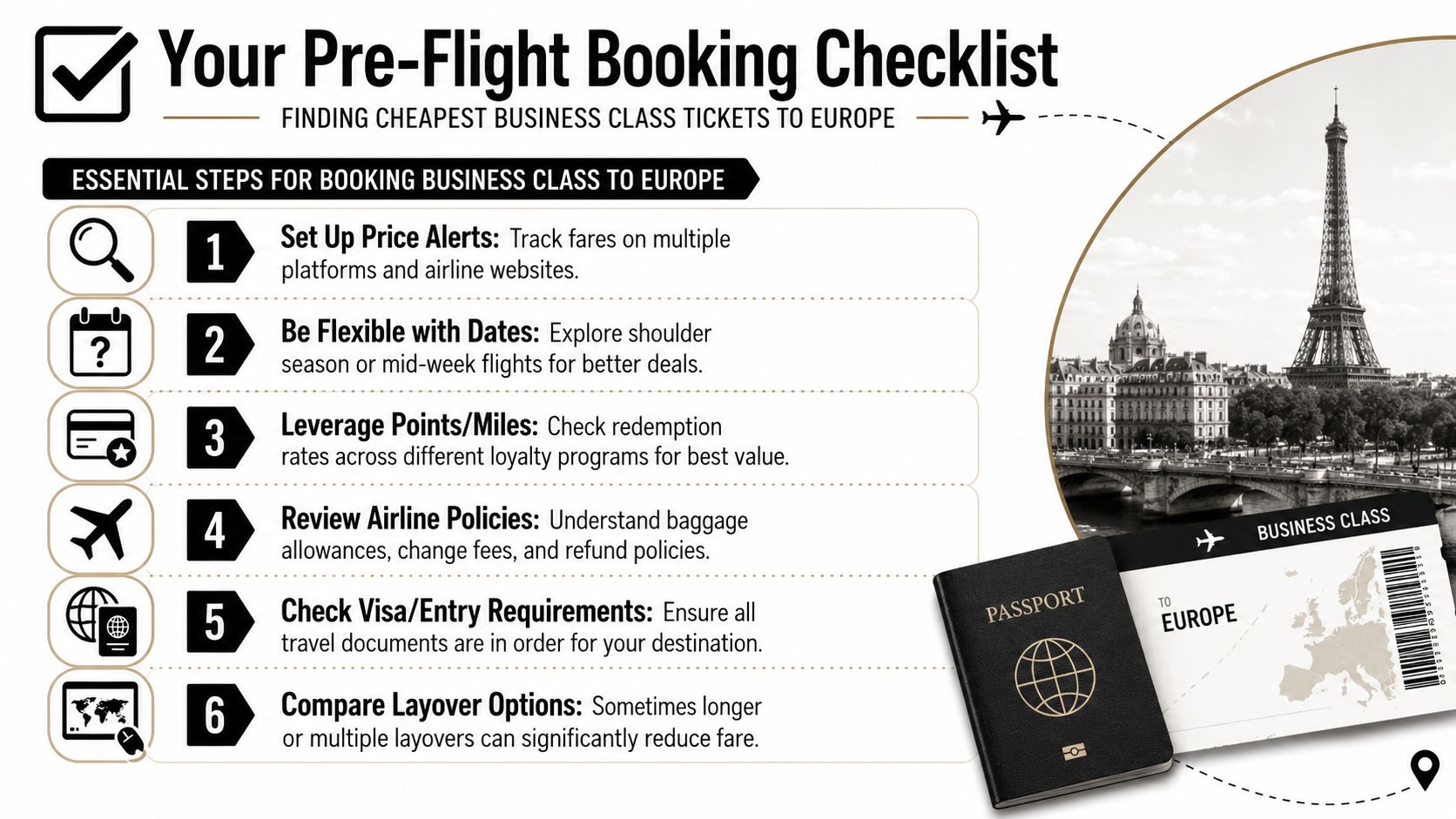
The six-point inspection
- Set your price alert net: Don't rely on memory. Use alerts across multiple platforms and keep watching until you book.
- Stay loose on dates: A small shift can expose a better fare pattern. Fixed-date shopping is often self-sabotage.
- Check points before paying cash: If you've got transferable points, compare the redemption before spending real money.
- Read the fare rules: Baggage, changes, cancellation terms, and seat selection all matter.
- Confirm entry requirements: Passport validity and destination rules are mission essentials.
- Compare layovers with intent: A less convenient routing can still be the right call if the savings and cabin quality justify it.
Rookie mistakes to avoid
A lot of bad bookings happen because the fare looked exciting and the buyer got tunnel vision. Don't do that.
Watch for these traps:
| Mistake | Better move |
|---|---|
| Booking the first low fare you see | Compare airports, dates, and miles before committing |
| Ignoring total trip friction | Evaluate layovers, aircraft, and timing together |
| Forgetting departure-city differences | Check alternate origins every time |
| Skipping fare rules | Read the restrictions before handing over your card |
Final command before you book
If the fare fits your target, the dates work, the route is sensible, and the points option doesn't beat it, book it. Don't drift into endless comparison mode.
That's how good fares die. Not from lack of options. From hesitation.
The cheapest business class tickets to Europe go to travelers who stay organized, search widely, and strike with confidence.
If you want a veteran-owned travel platform built for deal hunters, enlist with Sgt. Travel Deals Army. It's free to join, built to help travelers compare smarter, and backed by a no-nonsense mission to make better travel deals easier to find. When you're ready to book, check STD Army Deals and put your training to work.