

You’re probably doing what most smart travelers do. You want Southern California sunshine, walkable waterfront spots, solid food, and a hotel that doesn’t punch your bank account in the throat.
That’s why Long Beach works.
It gives you coastal energy without forcing you into blind booking panic. But only if you book like a strategist. If you treat long beach hotel deals like a random scroll through five tabs and a prayer, you’ll overpay, miss better room options, or get burned by messy listings.
This guide is your field manual. Tight, practical, and built for people who want the inside scoop without the fluff. If you want a better room, cleaner pricing, and smarter timing, fall in.
Your Mission Should You Choose to Accept It
Friday hits. You want a waterfront weekend in Southern California, not a financial ambush at checkout. Long Beach can deliver that. But only if you book with a plan instead of tapping the first decent room you see.
Here’s the straight truth. Long Beach has enough hotel competition to create real savings opportunities, but the cheap stay rarely lands in your lap by accident. Good deals go to travelers who compare listings, check the fine print, and move fast when the numbers make sense.
That matters even more if you want more than the standard tourist play. Sgt. Travel Deals Army exists for exactly this mission. Use stdarmy.com and stdarmydeals.com as your base camp to sort through deal options faster, spot practical savings, and keep an eye out for the discounts plenty of booking guides ignore, especially military and veteran rates.
What separates a smart booking from an expensive one
Bad bookings usually come from the same three mistakes:
- Booking on impulse: One decent photo, one flashy rate, no comparison. That’s how you end up overpaying for a weak room.
- Ignoring the full cost: Resort fees, parking, and cancellation rules can wreck a “cheap” rate fast.
- Skipping special rates: Military, veteran, government, AAA, and member discounts often sit one click below the public price.
Your mission is simple. Compare first. Read the fee details. Check special-rate tabs before you pay.
Mission rule: The best long beach hotel deals go to travelers who stay flexible, verify total cost, and use the right tools before booking.
Long Beach is still one of the smarter coastal picks in Southern California. You get ocean access, solid neighborhoods, and plenty of lodging options across different budgets. Approach it like a strategist, use the S.T.D. Army toolkit, and you put yourself in position to save real money instead of hoping for a miracle rate.
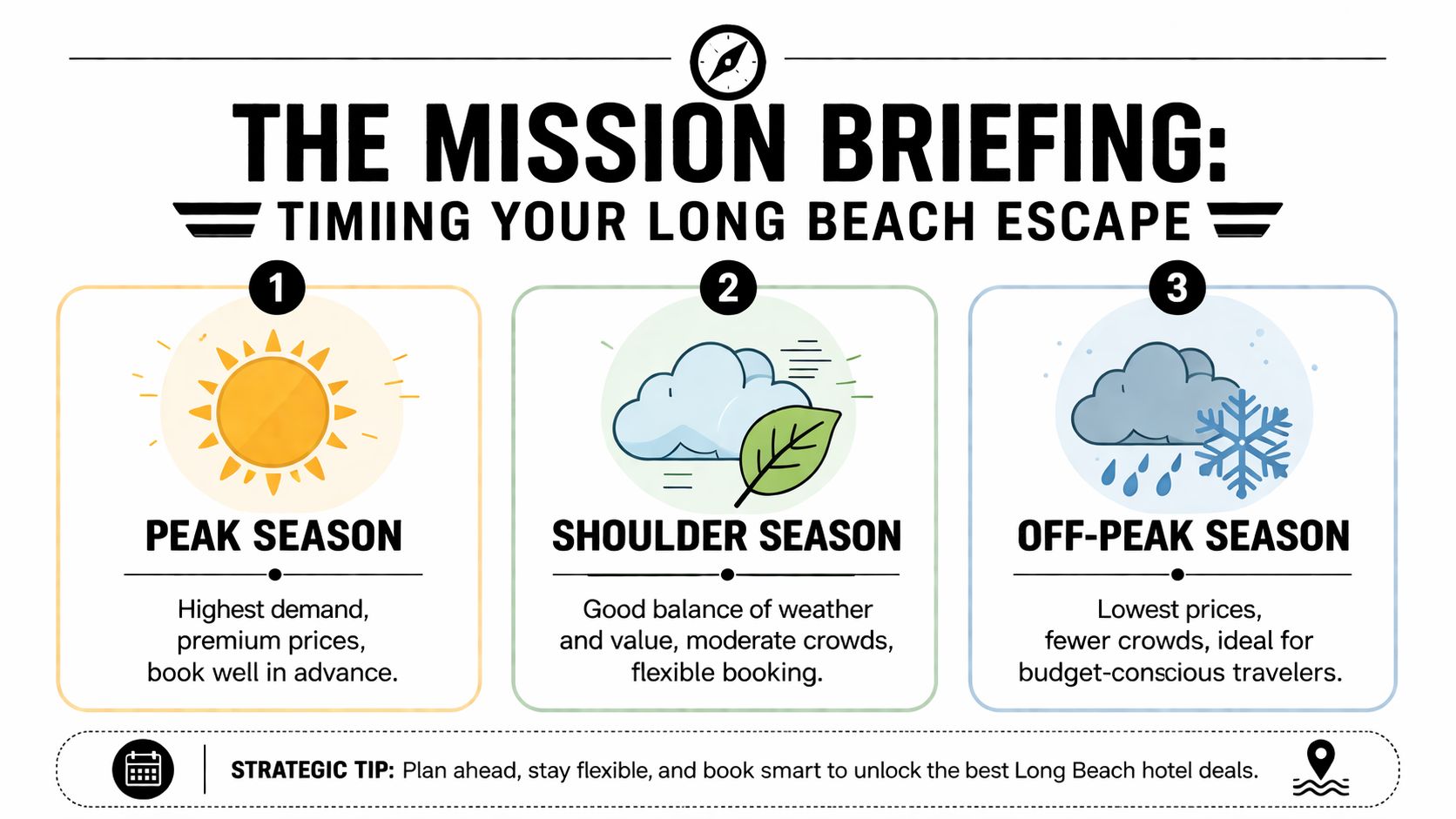
The Mission Briefing Timing Your Long Beach Escape
You pick a Long Beach hotel on the wrong week, then wonder why the same room drops in price three days later. That is how travel budgets get smoked.
Timing does more work here than brand loyalty ever will. Long Beach rates swing with summer demand, convention traffic, weekend patterns, and school breaks. If you stay flexible and check the calendar before you fall in love with a property, you put yourself in position to save real money.
January gives you the cleanest shot at a deal
As noted earlier, January is usually the friendliest month for bargain hunters, while summer pushes rates higher and squeezes out easy wins. If your schedule has any give at all, start there.
July is the expensive side of the map. You can still go, but do it on purpose. Summer in Long Beach brings stronger demand, fuller hotels, and less room to negotiate with your budget.
Here is the simple read:
| Travel period | What it means for you |
|---|---|
| January | Best value window for travelers who care about price first |
| June to August | More competition, higher rates, fewer easy discounts |
| July | Toughest month for budget-focused bookings |
Your check-in day can make or break the deal
Long Beach does not always follow the lazy rule that every weekend stay costs more. One check-in day can price out much lower than the next, and one-night shifts can change the total enough to make a different hotel suddenly worth it.
Do not guess. Test it.
Run at least three date combinations before you book. Friday arrival, Sunday arrival, and a midweek option are the first three I would check. If you want a faster system, use a hotel price comparison website strategy that helps you test dates side by side before you commit.
That is where the Sgt. Travel Deals Army approach earns its keep. stdarmy.com and stdarmydeals.com help you spot timing opportunities faster, especially if you are also hunting for military, veteran, or government-rate options that do not always show up clearly on the first search.
Mission rule: Never book Long Beach on your first date search. Check multiple arrival patterns first.
The timing plan I’d actually recommend
Use this playbook:
- Target January first if your travel dates are flexible.
- Cut Saturday-heavy stays when price is your top concern.
- Compare a Friday arrival, a Sunday arrival, and a midweek arrival before picking a room.
- Search the full stay cost, not just the nightly rate.
- Book summer trips earlier because waiting rarely helps in a high-demand window.
- Check military and veteran pricing every time on stdarmy.com and stdarmydeals.com, especially if public rates look stubborn.
For a quick reality check before you lock anything in, watch recent Long Beach clips on YouTube travel coverage. Off-peak trips still give you plenty of coastal atmosphere, and they usually treat your wallet a lot better.
Your Recon Toolkit Comparing Prices Like a Pro
The internet makes hotel shopping look easy. It isn’t.
You’re often comparing slightly different room types, inconsistent taxes, vague amenity lists, and pricing that changes depending on device, membership status, or booking channel. That mess is exactly why travelers think they found a great deal, then realize the final checkout total or room details don’t match what they expected.

The listing problem is real
Hotels struggle to keep content consistent across platforms. Amenities, fees, room descriptions, and availability details often drift out of sync, which creates confusion and kills trust. That’s the core takeaway from this industry discussion on inaccurate hotel listings and booking friction.
That problem gets worse in a competitive market like Long Beach, where travelers often compare direct sites, Google Hotels, and OTAs side by side. One listing says breakfast included. Another doesn’t mention it. One shows taxes later. Another mixes in mandatory fees late in the funnel. One labels a room as harbor-facing, another uses a generic room code nobody understands.
That’s nonsense. You need cleaner intel.
What a disciplined comparison looks like
Here’s the right workflow:
- Pick your exact stay window first. Don’t compare vague “sometime in spring” rates.
- Match the same room conditions. Same occupancy, same cancellation rules, same stay length.
- Check fee treatment. Some channels show base rate first and layer taxes later.
- Look for rate type differences. Member rate, package rate, prepaid rate, and flexible rate aren’t the same animal.
- Cross-check the room details before paying.
If you want a deeper breakdown of how comparison tools stack up, this guide to hotel price comparison websites is worth your time.
Why multi-source checking wins
The smartest hotel data teams don’t rely on one feed. They compare price and tax signals, availability and restriction signals, and side-by-side placement across direct sites, OTAs, and Google Hotels. That three-layer approach is outlined in this overview of hotel data scraping for pricing intelligence.
You don’t need to build that system yourself. But you should think like someone who understands it.
Here’s the practical takeaway:
- Direct sites can carry offers OTAs don’t show
- OTAs can surface short-term rate dips
- Tax treatment can distort “cheapest” claims
- Availability restrictions can make a low rate unusable
That’s why comparison is not optional.
A quick explainer video helps make the booking-channel chaos easier to spot:
My recommendation
Don’t trust any single listing, no matter how polished it looks. Trust verified side-by-side comparison, matching room rules, and final-price discipline.
That’s how you book with confidence instead of gambling on a thumbnail and a fake urgency banner.
Unlocking Classified Perks with The S.T.D. Army
Some travelers only want a room. Smart travelers want an advantage.
That’s where community-based travel platforms matter. A good one doesn’t just dump listings in your lap. It gives you a faster path to deals, a cleaner booking experience, and a reason to come back the next time you need a hotel, flight, car rental, or activities in one place.

Why membership-style platforms matter
Big booking apps are built for volume. That usually means noise. More tabs, more interruptions, more half-clear pricing, more pressure.
A better travel platform should do three things well:
- Show deals clearly
- Work smoothly on mobile, tablet, and desktop
- Make repeat booking easier, not harder
That’s the appeal of a platform tied to a real travel community. You’re not starting from zero every time. You already know where to check first, what kind of offers show up there, and how the experience behaves when you’re booking from your phone in the middle of a workday.
Practical reasons travelers like this model
Some people join because they want lower rates. Others like the idea of member appreciation giveaways, easier deal discovery, and supporting a veteran-owned business that talks like a human instead of a corporate chatbot.
That matters.
Good travel platforms reduce friction. Great ones make you feel like you’ve got backup.
If you want to get a feel for the tone and community side of the brand, spend a few minutes on the Sgt. Travel Deals Army YouTube channel. You’ll get the vibe quickly.
Who gets the most value
This style of platform tends to fit three types of travelers especially well:
| Traveler type | Why it works |
|---|---|
| Budget-focused vacationers | They want a simpler way to spot deal windows without endless tab-hopping |
| Frequent business travelers | They need a responsive booking experience and quick repeat use |
| Veterans and supporters of veteran-owned businesses | They appreciate the mission, community, and more direct tone |
You don’t need another bloated app on your phone. You need a booking setup you’ll return to.
Advanced Maneuvers Booking Hacks for Max Savings
Basic comparison gets you in the fight. Advanced tactics win it.
Long Beach hotel deals start getting interesting. Not because the internet suddenly gets honest, but because you learn how to use flexibility, location, and timing against the market.
Use flexibility like a weapon
Rigid travelers pay retail.
If your schedule has any give at all, run flexible date searches before you commit. You’re looking for odd little pricing valleys. Maybe one arrival day is ugly, but shifting by a day or trimming a night changes the whole picture. The market won’t send you a thank-you note for being flexible, but it often rewards you anyway.
The same goes for location. Don’t lock yourself into the most obvious tourist pocket unless you’ve already confirmed the rate justifies it. A hotel a little outside the main hotspot can give you a stronger room, easier parking situation, and less pricing insanity.
Last-minute booking can work, if you’ve got nerve
This is not the rookie play. But if you can tolerate uncertainty, last-minute hotel hunting can pay off.
Recent contrarian data for Long Beach shows last-minute deals near the convention center can drop by 20% to 40%, with one example falling from $535 to $453, according to HotelTonight’s Long Beach deal view. That’s not a promise. It’s proof that waiting can create openings for flexible travelers.
Field note: Last-minute booking works best when you’re flexible on exact property, not when you’re obsessed with one hotel.
Bundle if the math actually helps
Bundling hotel with a car rental can provide value, but don’t assume it always does. Some packages are real savings. Others just hide the moving parts better.
Check the bundled total against separate booking totals. If the package wins cleanly, take it. If it’s muddy, walk away.
For more tactical ideas on rate strategy, this guide on how to get better hotel rates is a solid supplement.
Four advanced moves worth using
- Book outside the obvious core: A short distance from the busiest zone can mean a calmer stay and better pricing.
- Search flexible windows first: Don’t marry your dates before you test alternatives.
- Watch for same-week price drops: Especially if demand softens or inventory opens up.
- Compare final totals, not teaser rates: The cheapest headline price can still lose after fees and restrictions.
The point isn’t to get cute. The point is to stay disciplined and let the market make a mistake in your favor.
Honoring Our Heroes Special Intel on Military Deals
Most major booking sites do a lousy job on military discounts.
They’ll gladly show you a “cheap” hotel list. What they often won’t do is make military and veteran pricing easy to find, easy to compare, or easy to trust. That’s a problem in a place like Long Beach, where the military connection is part of the broader regional fabric and the traveler base absolutely includes service members, veterans, and their families.

The gap most travel sites ignore
The opportunity here is straightforward. Military and veteran-specific discounts can offer 10% to 20% savings with a veteran ID at major chains, yet many mainstream OTA listings don’t highlight those offers clearly, as noted in this look at cheap Long Beach hotel listings and the military discount gap.
That means a veteran can easily miss a valid discount because the site experience doesn’t surface it well.
I don’t like that, and neither should you.
What to have ready before you book
If you qualify for military or veteran rates, don’t be casual about verification. Be ready with the ID or documentation the hotel expects. Read the rate terms before checkout and again before arrival.
Use this quick checklist:
- Check the rate label carefully: Make sure it specifically references military or veteran eligibility.
- Bring the required ID: Don’t assume the booking confirmation alone is enough.
- Verify cancellation terms: Discounted rates sometimes come with stricter rules.
- Confirm what’s included: Breakfast, parking, and room type details still need review.
Service members and veterans shouldn’t have to dig through vague promo language to find rates they’ve earned.
My direct recommendation
If military pricing matters to you, don’t rely on generic search results. Use tools and content built with that need in mind. A focused resource like cheap hotels for veterans is a better starting point than a broad OTA results page stuffed with generic “deal” labels.
This is one area where specialization beats scale. Every time.
Mission Accomplished Your Long Beach Debrief
You’re in a better position than the average traveler now. You know how to book Long Beach with a plan instead of handing over extra cash because a big site threw a flashy price in front of you.
That matters in a city where hotel demand stays active and every smart booking choice can save real money. Long Beach also rewards visitors who show up ready to spend wisely. Visitor spending in Long Beach generated a $1.97 billion economic impact in the latest reported year, according to Visit Long Beach’s tourism impact report.
Here’s my final call. Don’t book on autopilot.
Use the tactics from this guide. Compare rates carefully. Read the terms. Check the actual total after fees. If you’re military or veteran, go straight to tools built to surface the discounts you’ve earned instead of wasting time on generic hotel search pages that bury them.
That is the whole mission. Spend less on the room. Keep more for the waterfront, the food, and the parts of Long Beach you came to enjoy.
Ready to book with backup? Join Sgt. Travel Deals Army and put the plan to work. Search deals directly at stdarmydeals.com. Enlist free, compare smart, and lock in your Long Beach stay.