

You’ve got a browser full of tabs, a half-finished coffee, and one mission on your mind: find solid flights to the virgin islands without getting smoked by hidden costs, confusing airport choices, or bad routing.
That’s where most travelers mess up. They chase the cheapest fare, click too fast, and only later realize they booked the wrong island, forgot about ferry transfers, or showed up without the right documents for the trip back. Paradise is still paradise, but rookie mistakes make it more expensive and more annoying than it needs to be.
I’m going to give you the straight brief. No fluff. No vague “travel hacks.” Just the decisions that matter if you want a smoother, smarter trip to the Virgin Islands.
Your Mission Briefing Getting to Paradise
You’re probably not reading this because life feels too relaxed right now. You’re reading it because you need a break that feels like a true break. Blue water. Warm air. Sand that doesn’t require a filter to look good.
The good news is the Virgin Islands are one of those trips that can still feel legendary without turning into a logistical circus. The bad news is a lot of people book them badly. They pick an airport based on sticker price, ignore transfer time, and end up spending more money and more patience than necessary.

What smart travelers do first
They answer one question before they ever hit “book”:
Are you going to the U.S. Virgin Islands, or are you trying to reach the British Virgin Islands?
That single choice changes everything. It affects whether you need a passport, whether your return trip is simple, whether a cheap fare is actually cheap, and whether your arrival day feels smooth or like a relay race.
Practical rule: Don’t shop for airfare first. Pick the island goal first, then build the flight plan around it.
This guide is your complete mission briefing. You’ll get the difference between USVI and BVI routing, which airports make the most sense, when to travel for better value, how regional carriers fit into the picture, and what non-U.S. citizens need to know before heading back to the mainland.
The right mindset
A Virgin Islands flight isn’t just a ticket purchase. It’s a chain of decisions. Airport. Island. Transfer. Timing. Baggage. Entry rules.
Get that chain right, and the whole trip feels easy. Get it wrong, and you burn time and money fixing problems you could’ve avoided in ten minutes.
That’s why this article is built like a field manual. Friendly, yes. Soft, no. You want the beach chair. I want you to get there without getting hustled by the booking process.
Choose Your Destination USVI or BVI
This is the first fork in the road, and it matters more than most travelers realize.
If you want the simplest path, choose the U.S. Virgin Islands. For U.S. citizens, it’s the easier move. You’re dealing with a U.S. territory, familiar payment systems, and a more straightforward arrival experience.
If you want the British Virgin Islands, you need to think harder before grabbing the lowest fare. BVI trips often look cheaper on the front end if you fly into St. Thomas first, but that’s where people get sloppy.
USVI vs BVI at a glance
| Attribute | U.S. Virgin Islands (USVI) | British Virgin Islands (BVI) |
|---|---|---|
| Best for | Easier air access and simpler planning | More remote feel and a more international trip |
| Main trip style | Direct arrival into the island group | Often requires extra routing decisions |
| Passport for U.S. citizens | Generally not needed for entry to the territory | Needed |
| Common gateway strategy | Fly directly into USVI airport | Either direct to BVI or via St. Thomas plus transfer |
| Hidden cost risk | Lower | Higher if you use the “cheap STT fare” without pricing transfers |
| Best booking mindset | Keep it simple | Calculate total trip cost, not just airfare |
The biggest rookie mistake
A lot of travelers say they’re “going to the Virgin Islands” when what they really mean is “I want the BVI, but I found a cheaper flight to St. Thomas.”
That can work. It can also backfire.
According to the Go Sail Virgin Islands travel guide on ferry and routing costs, travelers who save $50 to $200 on airfare by flying into St. Thomas often spend an additional $30 to $50 per person on ferry tickets, plus 1 to 2 hours of travel time, which wipes out a lot of the bargain.
That’s the part most booking pages don’t spell out clearly enough.
Flying into St. Thomas for a BVI trip isn’t automatically wrong. Booking it without adding transfer cost and transfer time is wrong.
My blunt recommendation
Use this rule set:
- Choose USVI if you want the easiest planning, fewer moving parts, and less chance of day-one frustration.
- Choose BVI direct if your real goal is Tortola or the broader BVI and the fare is reasonable once you compare total cost.
- Choose STT plus transfer only when the all-in math still works for you after adding ferry expense, travel time, and the hassle factor.
Some travelers focus only on airfare because it’s the number they see first. That’s lazy math. The better move is door-to-door trip cost.
Who should choose which
- Families with kids: USVI usually wins for simplicity.
- Couples heading to Tortola or a BVI villa: direct BVI routing deserves a serious look.
- Budget travelers: compare both, but don’t ignore transfer expenses.
- First-time visitors: USVI is the safer first mission unless you’re set on the BVI experience.
If you remember one thing from this section, remember this: the cheapest ticket isn’t always the cheapest trip.
Your Primary Airfields in the USVI
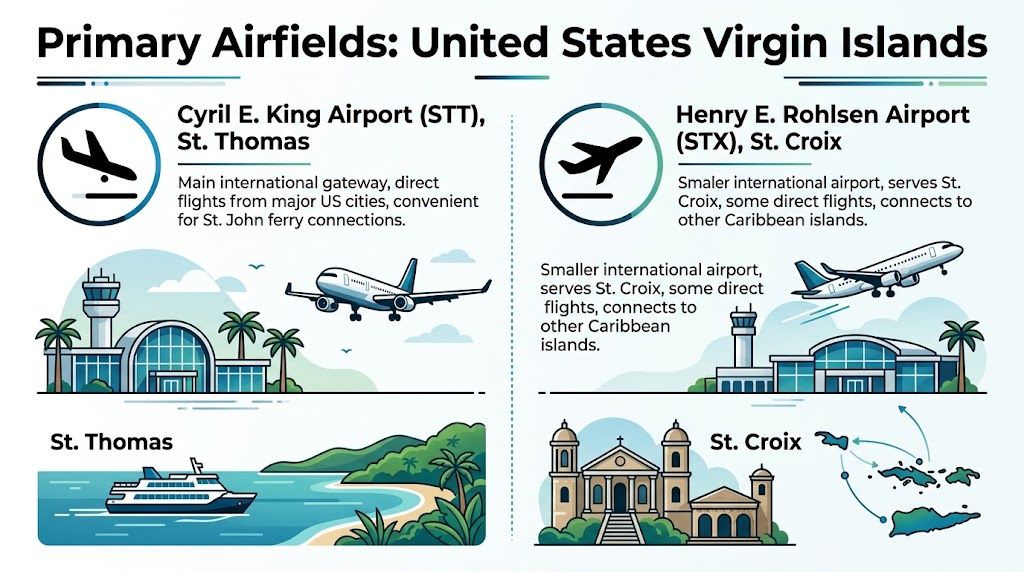
If you’re flying into the U.S. Virgin Islands, your two main airfields are Cyril E. King Airport in St. Thomas (STT) and Henry E. Rohlsen Airport in St. Croix (STX). Pick the right one, and your entire trip starts cleaner.
Most travelers default to St. Thomas, and for good reason. It’s the main international gateway and the obvious choice if you’re staying on St. Thomas or planning to connect onward toward St. John.
STT for convenience
STT is the workhorse. It handles the bulk of inbound traffic and gives you the broadest shot at a practical itinerary from major U.S. cities.
The U.S. Virgin Islands welcomed nearly 1 million airline passengers in 2025, and projections for 2026 were nearing 927,000 arrivals, with carrier growth including Delta’s 33% seat increase to St. Thomas and American Airlines’ 29% increase to St. Croix, according to the official USVI tourism performance update.
That matters because more airline capacity usually means more options, more schedule flexibility, and a better shot at a fair fare.
STX for a calmer arrival
St. Croix is the better choice if St. Croix is your actual destination. Sounds obvious, but people still book St. Thomas out of habit and then bolt on extra movement they didn’t need.
STX tends to fit travelers who want a quieter arrival and aren’t trying to maximize island-hopping on day one. If your lodging is in St. Croix, land in St. Croix whenever the pricing is sensible.
My recommendation by traveler type
- Going to St. Thomas or St. John: book STT
- Going to St. Croix: book STX
- Just chasing the cheapest fare: slow down and compare total transit time before deciding
- Need backup routing options: STT usually gives you more flexibility
Field note: The best airport is the one closest to where you’ll sleep that night. Don’t create an extra transfer just to save a little on the ticket if it wrecks the first day.
Why regional awareness helps
A lot of smart Virgin Islands planning includes Puerto Rico in the search. San Juan can be a useful connection point for regional service, and that’s why it helps to understand the broader route map around the area. If you’re comparing islands in the region, this guide to airlines that fly to Puerto Rico can help you think through alternate approaches without booking blindly.
What to watch when comparing STT and STX
Look at these factors together, not one at a time:
- Arrival clock: Landing earlier usually gives you a smoother first day.
- Ground transfer burden: A cheaper fare can become annoying fast if it creates more handoffs.
- Connection quality: A short, risky connection is not a deal. It’s a gamble.
- Destination match: Don’t land on one island when your hotel is on another unless the savings are worth the added movement.
A quick airport walkthrough can also help you visualize the arrival flow before you book. Search YouTube for recent STT arrival videos and terminal walkthroughs so you know what kind of airport rhythm you’re stepping into.
Infiltrating the BVI Getting There By Air
You land in the Caribbean feeling smart, then the bill starts growing. Ferry tickets. Taxi hops. Port fees. Timing pressure. If your real target is the BVI, the cheapest airfare on the screen can turn into the more expensive arrival by nightfall.
The old standard was simple. Fly into St. Thomas, then finish the trip by ferry or a short regional hop. That route still works, and sometimes it wins on price. But you need to judge it by total trip cost, not by airfare alone.

The direct-flight shift
A major change is set to hit the map when American Airlines re-establishes direct flights to Terrance B. Lettsome International Airport on June 1, 2026, restoring service after a long break since 2013, according to the British Virgin Islands government announcement on direct U.S. flights.
That matters because direct service into EIS changes the math. If you are staying on Tortola or connecting onward within the BVI, you now have a real chance to cut out an extra border crossing and the usual handoff chain.
What actually makes BVI air planning harder
The BVI is a smaller operation. Fewer routes, fewer backup options, and tighter schedules mean a sloppy itinerary gets punished faster here than it does at a big mainland airport.
That is why I tell travelers to stop shopping this trip like a basic island flight.
Price the full arrival plan. If you fly to STT, add the taxi, ferry, baggage handling risk, and the annoying little fees that show up only after you commit. If you are not a U.S. citizen, pay even closer attention. Re-entry rules into the U.S. Virgin Islands can turn a casual island hop into an immigration problem if your documents do not support multiple entries.
Two mission plans worth comparing
Plan 1: Fly direct into EIS
Best for travelers headed straight to Tortola, travelers with limited time, and anyone who wants fewer moving parts.
Plan 2: Fly into STT and transfer to the BVI
Best for deal hunters only if the all-in numbers still beat EIS after ground transport, ferry costs, and border friction are added.
S.T.D. Army members usually beat the market here by running both plans side by side, then checking whether the “cheap” STT fare stays cheap after every extra step is counted. That is how you outsmart the booking sites. You compare the mission, not just the ticket.
Here’s a visual look at BVI air access that helps make the route feel real before you commit:
My field rules for BVI arrivals
- Choose flights that land with daylight left. Late arrivals shrink your recovery options fast.
- Build in buffer time. Tight connections are how bags and travelers get separated.
- Book for your exact island. “BVI” is too vague to make a smart routing decision.
- Treat ferry costs as airfare. They belong in the same budget math.
- Check re-entry requirements before booking split-island plans. Non-U.S. citizens cannot afford to guess.
If your hotel is in the BVI, direct service into EIS deserves serious attention even when the fare looks higher at first glance. A cleaner arrival often wins once you count the overall cost.
Timing Your Arrival Peak vs Off-Peak Seasons
You can save money on flights to the virgin islands with one move that costs nothing: pick better dates.
This isn’t glamorous advice, but it works. Timing changes the value of the whole trip more than is often acknowledged.
Peak season
Peak season is when everybody wants in. Weather is attractive, demand runs hotter, and the easiest itineraries get snapped up first.
If you’re traveling during the busiest winter stretch, don’t act casual and book late. That’s how you end up choosing between overpriced airfare and ugly connection times.
Off-peak season
Off-peak travel is where budget-minded travelers can find better opportunities, but there’s a tradeoff. Weather can disrupt plans, and flexibility matters more.
Common sense prevails over optimism. If you’re flying in the storm-prone part of the year, buy travel insurance and leave breathing room in your plans.
Cheap flights are only a win if weather doesn’t turn the itinerary into a cleanup operation.
Shoulder season is the sweet spot
My favorite booking window is shoulder season. You dodge the heaviest rush, keep a better shot at pleasant conditions, and usually avoid the worst price spikes.
That’s the move for travelers who want value without feeling like they’re rolling dice on the whole trip.
Use this date strategy
- Want the best weather: expect higher fares and book early
- Want lower prices: be flexible and accept some weather risk
- Want the best balance: target shoulder-season dates
- Traveling around holidays: lock flights down earlier than you think you need to
A lot of travelers obsess over which airport to use but ignore timing. That’s backwards. A smart date range can do more for your budget than a frantic hour of fare hunting.
If your schedule has any wiggle room, use it. Shift your departure by a day or two. Compare nearby date combinations. The traveler who treats dates as fixed usually pays more than the traveler who treats them as part of the strategy.
Intel for Finding the Cheapest Flights
Cheap fares don’t go to the most deserving traveler. They go to the traveler who searches better.
The Virgin Islands reward smart routing, especially if you stop thinking like a tourist and start thinking like a deal hunter.

Respect the regional carriers
The Virgin Islands air network is served by 12 airlines, and Cape Air and Seaborne Airlines command 64% of scheduled flights, including a major share of the 466 domestic flights in April, according to the BVI government’s overview of the regional air network. That’s why regional carriers matter for practical, cost-conscious island itineraries.
You don’t need to worship the biggest airline on the screen. Sometimes the better value comes from combining a major carrier with a regional leg.
The playbook I recommend
- Search multiple route shapes: Don’t just search your hometown directly to STT or STX. Test alternate gateways.
- Check San Juan connections: Puerto Rico can be a useful stepping stone for Virgin Islands routing.
- Stay flexible on weekday departures: Midweek often gives you cleaner pricing than weekend-heavy travel patterns.
- Compare total travel effort: A “cheap” itinerary with miserable timing isn’t a bargain if it burns a whole day.
Don’t ignore San Juan
For some travelers, San Juan is the flanking route. You may find a stronger fare into Puerto Rico and then build the final segment from there with a regional airline.
That approach isn’t automatically better. It’s just one of the smartest alternate searches you can run if direct pricing into the Virgin Islands looks rough.
If you want a broader airfare strategy that applies before you narrow down island routes, read these practical tips on how to save money on flights.
What to watch in fare searches
Here’s where travelers usually blow it:
| Mistake | Why it hurts |
|---|---|
| Booking the first “cheap” result | You may miss a better island or a better timed route |
| Ignoring regional carriers | You cut yourself off from useful connection options |
| Fixating on one airport only | Nearby island routing can change the math |
| Booking bad connection times | Tight transfers and late arrivals create stress fast |
A lot of travelers also benefit from watching YouTube walkthroughs on tools like Google Flights to understand how fare tracking and date grids work before they lock in a purchase. Learn the trend, then compare the final booking carefully.
Your goal is not to find the lowest number on the page. Your goal is to find the best value for the trip you actually want.
That distinction saves money.
Mission Logistics Baggage and Entry Rules
This is the part people skip because it sounds boring. Then it ruins their airport day.
Let’s keep it tight. Check baggage rules before you leave home, especially if your fare is basic economy or you’re mixing airlines on one itinerary. Flights to the USVI often follow the same kind of baggage fee structure you’d expect on domestic U.S. routes, and surprise bag charges are one of the dumbest ways to overspend.
The re-entry issue travelers miss
Here’s the important part.
Flights from the USVI back to the U.S. mainland are domestic, but passengers still go through an immigration checkpoint before boarding, according to the Itinerant Analyst explanation of USVI domestic travel and immigration screening.
That catches people off guard because they assume “domestic” means no document check beyond a normal U.S. airport routine. Not so.
Who needs to pay extra attention
- U.S. citizens: bring your valid government ID and don’t get sloppy.
- Non-U.S. citizens: carry your passport and visa documentation. This is not optional.
- Travelers with special status concerns: verify your paperwork before departure, not at the gate.
If you want a practical refresher on what to keep with you in the cabin, this guide to international carry-on essentials is worth reviewing before you pack.
Don’t pack important travel documents in checked baggage. Keep them on your person from departure to return.
Baggage discipline that saves headaches
Use a simple system:
- Put medication, travel documents, chargers, and one change of essentials in your carry-on.
- Assume checked baggage can be delayed.
- Recheck your airline’s bag rules if your itinerary involves more than one carrier.
Virgin Islands travel is easy when your paperwork is squared away. It gets stressful when you assume instead of verify.
Debrief Frequently Asked Questions
A few final questions always come up, so let’s close this out cleanly.
How do you move between the islands
For shorter hops, travelers use ferries and regional flights depending on the island pair and the day’s schedule. If time matters more than scenery, regional air service can be the cleaner move. If your plans are relaxed, surface transfers can work fine.
Is it expensive to fly between islands
Sometimes it’s reasonable, sometimes it isn’t. The key is to compare the fare against the time you’re saving and the complexity you’re avoiding. A short regional flight can be worth it if it cuts out a long transfer chain or keeps your itinerary from eating a full day.
What if weather threatens the trip
Stay calm and get practical. If a storm system is in play, monitor your airline closely, watch for waivers, and don’t wait until the last minute to review your options. The travelers who do best in weather disruptions are the ones who keep documents handy, stay flexible, and don’t panic-book nonsense.
What’s the single best piece of Virgin Islands flight advice
Match your airport to your actual destination and calculate the true total cost of the trip. Not just airfare. Not just the first number you see.
That one habit will keep you out of most trouble.
You’ve got the briefing now. Choose the right island. Price the whole trip. Respect the transfer time. Bring the right documents. That’s how you book flights to the virgin islands like a pro instead of a rookie.
If you want a veteran-owned platform built for travelers who like side-by-side comparisons, member perks, and smarter booking without the usual nonsense, check out Sgt. Travel Deals Army. It’s free to join, and you can also search travel deals through their booking platform at Sgt. Travel Deals Army Deals. Enlist, compare the numbers yourself, and book your next island mission with better intel.