

Your browser has too many tabs open, one spreadsheet is pretending to be a budget, and that beach wallpaper on your monitor is doing psychological warfare. You want out. You also don't want to come home wondering why your “cheap” all-inclusive trip somehow drained your card harder than a regular vacation.
That's the trap with cheap all inclusive vacation packages. The headline price gets the salute. The hidden costs launch the ambush.
I’m going to give you the field manual I’d hand to a smart traveler before they book a resort in Mexico, Jamaica, the Dominican Republic, or another warm-weather escape. We’re not chasing the lowest sticker price. We’re chasing the lowest total cost for a trip you’ll enjoy.
Your Mission Should You Choose to Accept It
You’re probably in one of two camps.
Either you’ve put off booking because every site starts to look the same after the fifth tab, or you found a deal that looked solid and then got suspicious when the details got vague. Good instinct. Vague is where your wallet gets hit.

Cheap is not the same as smart
A smart all-inclusive booking does four things:
- Locks in the basics you need: room, food, drinks, and enough on-site activities that you’re not forced to spend extra just to stay entertained.
- Cuts planning stress: you want to stop researching and start packing.
- Matches your travel style: family resort, adults-only hideout, quiet beach base, or action-heavy property.
- Keeps surprise charges from wrecking the mission: that’s the difference between a win and a budget failure.
One reason all-inclusives keep pulling people in is simple. Travelers want value and less hassle. Tourism Analytics reports that since 2019, demand for all-inclusive vacation packages has surged by 70%, and 5-star all-inclusive bookings are up 125% globally, with strong activity in places like Mexico, Jamaica, and the Dominican Republic (Tourism Analytics on all-inclusive travel growth).
That matters for you because competition creates opportunity. More inventory. More package choices. More chances to compare similar resorts instead of getting railroaded into the first “deal” a giant booking site throws at you.
Your real objective
Your goal isn't to brag that you booked the cheapest room. Your goal is to book a trip where the math still looks good after you add the stuff people forget:
Practical rule: If a package looks almost too clean on price, assume the fine print is doing the dirty work.
That’s where disciplined comparison wins. Sites like www.stdarmy.com and the booking platform at www.stdarmydeals.com are built around helping travelers compare options rather than blindly trust one glossy listing. For veterans, families, and plain old deal hunters, that kind of side-by-side checking matters.
You don’t need a luxury budget to get a strong resort stay. You need better inspection standards.
Choosing Your Battleground and Timing Your Attack
You find a package to Jamaica for hundreds less than the others. You’re ready to book. Then the flight lands late, the airport transfer costs extra, the better restaurants require surcharges, and your “cheap” trip starts leaking money from three directions. That is exactly why destination and timing matter. Cheap on page one means nothing. Cheap after all the add-ons is the target.
Pick battlegrounds with enough competition to keep prices honest
Start with the big three. Mexico, the Dominican Republic, and Jamaica.
They keep showing up for a reason. These markets usually have the most nonstop flights, the most resort inventory, and the most package combinations to compare side by side. More competition usually gives you a better shot at finding a package with solid flights, decent inclusions, and fewer fee traps.
Here’s the quick field guide:
| Destination | Strength | Cost trap to watch |
|---|---|---|
| Cancun and broader Mexico resort zones | The widest range of package options and resort tiers | Easy to get distracted by flashy listings with weak food, bad beach locations, or annoying upsells |
| Punta Cana and broader Dominican Republic resort zones | Strong resort value for the price, especially for families and longer stays | Some deals save money on paper but come with clunky flight times or isolated properties |
| Jamaica | Strong personality, memorable resorts, and good options for couples or families | Lower advertised prices can hide transport costs, premium dining charges, or thinner inclusions |
If your mission is pure comparison power, start with Mexico. If your mission is stretching your resort budget, put the Dominican Republic on the board fast. If you want a trip with more character, keep Jamaica in play, but inspect every line item like a hawk.
Time your attack around total value, not bragging rights
Peak season is expensive because people pay for certainty. Better weather windows. Bigger crowds. Higher rates. Less room to negotiate.
Shoulder season is usually the smarter move. You often get lower package prices, shorter lines, and a calmer resort experience without dropping into the sketchiest weather periods. That balance matters more than chasing the lowest number on the screen.
Use this rule set:
- Want the best weather odds? Travel closer to peak season and accept the higher total.
- Want the best overall value? Target shoulder season and stay flexible by a few days.
- Want the lowest sticker price? Check weather risk, cancellation terms, and flight quality before you touch your card.
A bad weather window, ugly flight schedule, or nonrefundable booking can wipe out the savings fast.
Quiet destination or famous hotspot? Do the math first
Travelers love the idea of finding a hidden gem. Fine. But hidden does not automatically mean cheaper.
A smaller destination can have fewer flights, worse arrival times, and fewer package combinations. That usually means less pricing pressure and fewer chances to swap into a better deal. By the time you add transfer costs and lost vacation time, the “secret bargain” can lose to a mainstream resort zone.
Use a disciplined order:
- Choose the trip type first.
- Compare major all-inclusive markets for the same dates.
- Check quieter options only if the total cost still wins.
For a family trip, big resort hubs usually make life easier. For couples, a smaller market can work if the property is strong and the flights are clean. If you need a fast way to size up your options, browse value-focused all-inclusive vacation package ideas and compare trip styles before you zero in on one resort.
Timing rules I’d enforce without apology
Keep this tight.
- Flexible dates beat fixed dates. A small date shift can improve both price and flight quality.
- Ignore the first flashy ad. Compare at least three packages in the same destination window.
- Check flight times before the resort photos. A “deal” with brutal connections costs you vacation hours.
- Read the transfer situation. Included shuttle, paid shuttle, or taxi only. It changes the price.
- Look at resort category and review patterns. A weak property in a strong destination is still a bad buy.
My blunt recommendation
Run a three-way comparison. One package in Mexico. One in Punta Cana. One in Jamaica. Use the same travel window. Then score each one on full-trip cost, flight quality, transfer setup, and included food and drink options.
That is the grown-up move. The winner is not the lowest advertised price. The winner is the package that stays affordable after the fine print takes its shot.
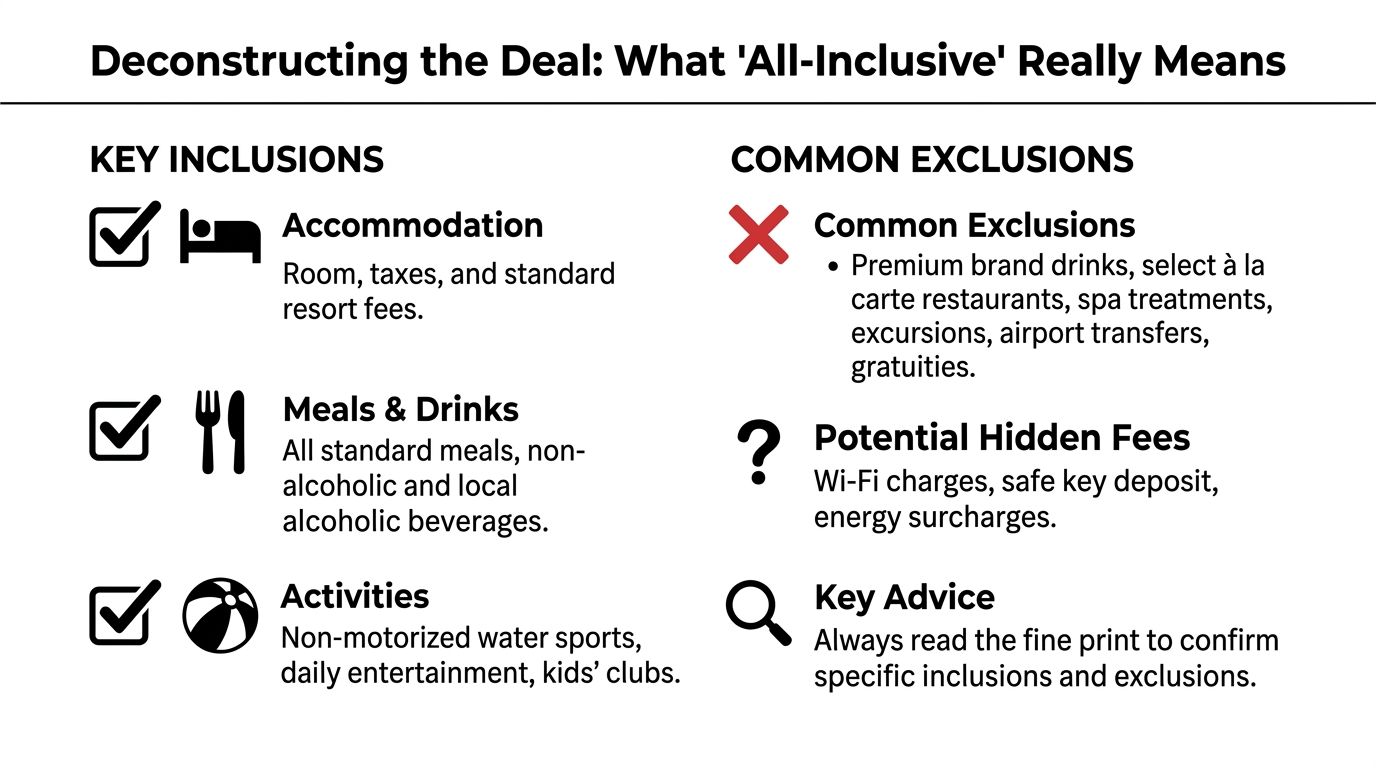
Deconstructing the Deal What All-Inclusive Really Means
Travelers often get sloppy. They see “all-inclusive,” assume it means everything, and stop asking questions. That’s amateur hour.
What the phrase usually covers
At minimum, an all-inclusive package often means your room, standard meals, standard drinks, and some on-site entertainment or activities. That’s the broad promise.
The problem is that all-inclusive is a category label, not a guarantee of equal value.
Some resorts include plenty. Others include just enough to get the badge while placing better food, better drinks, and useful conveniences behind extra charges.
The hidden cost ambush
Expedia-style package pages can show attractive pricing, but hidden exclusions are where many “budget” bookings break down. One verified data point is worth your attention here: common exclusions like premium liquors, specialty dining, and resort fees can add 20% to 30% to the final bill, and a recent traveler survey tied 65% of complaints to unexpected fees (Expedia all-inclusive package page and fee concerns).
That’s not a rounding error. That’s the difference between “great deal” and “why is this receipt bleeding.”
What to inspect before you book
Use this checklist every time. No exceptions.
- Alcohol tier: Are you getting standard local pours only, or is there any mention of premium brands?
- Restaurant access: Does the package include all dining venues, or are certain spots excluded or reservation-only with a surcharge?
- Wi-Fi: Included property-wide, limited to lobby areas, or billed separately?
- Transfers: Airport transport can be folded in, sold as an add-on, or left entirely to you.
- Gratuities: Sometimes included, sometimes expected, sometimes murky.
- Room category: Entry-level rooms can be noisy, poorly located, or missing the features shown in marketing photos.
- Activities: Non-motorized water sports might be included while premium experiences carry separate pricing.
- Resort fees and service charges: Read every line before checkout.
“All-inclusive” should trigger more questions, not fewer.
A fast method for calculating the real cost
Don’t just compare Package A to Package B by total headline price. Compare them by usable trip value.
Try this table format when you shop:
| Item | Package A | Package B |
|---|---|---|
| Base package price | Listed total | Listed total |
| Flights workable for your schedule | Yes or no | Yes or no |
| Transfers included | Yes or no | Yes or no |
| Specialty dining included | Some, all, or no | Some, all, or no |
| Better drinks included | Yes or no | Yes or no |
| Wi-Fi included | Yes or no | Yes or no |
| Likely extra spend | Low, medium, high | Low, medium, high |
No made-up precision. Just honest classification.
If one package is slightly more expensive upfront but includes the pieces you’d otherwise pay for, it may be the cheaper trip in real life.
For a plain-language overview of package mechanics, how all-inclusive resorts work on STD Army is a useful companion read.
The words that should make you suspicious
When a listing leans too hard on broad language, tighten up your inspection.
Watch for phrases like:
- Resort amenities available
- Select dining options
- Beverages included
- Fees may apply
- Transportation available
- Premium services excluded
None of those are automatically bad. But every vague phrase is an opening for extra cost.
My recommendation
If you’re trying to book cheap all inclusive vacation packages, reject any listing that makes you work too hard to understand what’s covered. Clarity is part of the value.
You’re not being picky. You’re defending your budget.
Engaging the Enemy Price War with Sgt. Travel Deals Army
Price comparison isn't optional. It’s the whole game.
A lot of travelers still book like this: they search one giant travel site, find a package that seems decent, get tired, and click buy. That’s not convenience. That’s surrender.

Run the same search more than once
Here’s the drill I recommend.
Search the exact same destination, dates, traveler count, and room type across more than one booking platform. Then compare the results line by line, not vibe by vibe.
That means checking:
- flight timing
- room category
- transfer status
- cancellation terms
- meal and drink notes
- visible taxes or resort charges
- whether the booking page hides details until late checkout steps
This sounds tedious. It’s less tedious than paying for a “cheap” trip that isn’t cheap.
Why side-by-side comparison matters
Most big travel sites are built to push speed. Speed helps them. It doesn’t always help you.
A comparison-first setup helps you notice things a glossy listing tries to blur, like whether one package includes a better room, more favorable flight times, or fewer likely add-ons. That’s especially important for travelers booking all-inclusive stays, because the gap between advertised value and actual value can be wide.
One option in that mix is cheap all-inclusive resorts on STD Army. The platform at www.stdarmydeals.com is designed to let travelers compare discounted hotels, resorts, flights, and related travel pieces in one place. That’s useful if you want a veteran-owned alternative to the usual big-name apps and you prefer to inspect deals instead of trusting a single storefront.
A practical search scenario
Let’s say you’ve narrowed it down to a family-friendly beach resort package in either Cancun or Punta Cana.
You don’t need advanced tactics. You need discipline.
First, save the listing details from the first site you check. Don’t rely on memory. Write down the destination, resort name, room class, travel dates, and any inclusion notes.
Then run the same search elsewhere.
Now ask these questions:
- Is the room the same room category?
- Are the flights equally usable, or did one site bury an ugly itinerary under a lower package total?
- Does one package include airport transportation while the other leaves you on your own?
- Are there extra dining limitations that only show up deep in the details?
- Is the cancellation policy stricter on the “cheaper” option?
Field note: The lower sticker price wins only if the rest of the package doesn’t sabotage it.
Filters that matter more than marketing photos
When you use a booking tool, stop filtering by “deals” first. Start with filters that affect your actual experience.
Use filters in this order:
| Filter | Why it matters |
|---|---|
| Resort type | Family-friendly and adults-only trips are not interchangeable |
| Meal and beverage structure | You want fewer paid surprises |
| Airport convenience | A painful transfer can wreck day one |
| Cancellation policy | Flexibility matters when plans shift |
| Guest review patterns | Look for recurring complaints, not one dramatic rant |
Photos sell the dream. Filters protect the mission.
Who benefits most from this approach
This kind of comparison shopping works especially well for:
- Families who need a resort that keeps kids fed and occupied without endless add-ons
- Veterans and military households who want value and may prefer supporting a veteran-owned business
- Couples looking for a quieter resort without paying luxury-tier pricing
- Budget-focused travelers who care more about total trip cost than flashy branding
My blunt recommendation
Use major travel sites as reconnaissance. Use comparison tools to make the decision.
If one package page feels slick but evasive, move on. If another gives you cleaner detail on what you’re paying for, that’s already a stronger candidate. Booking should feel clear. If it feels murky, the deal probably is.
Your Final Deployment Pre-Booking Checklist and Sample Itineraries
You are one click away from paying for a “cheap” getaway that stops being cheap the second the hidden charges start stacking up. This is the point where smart travelers win. Ten careful minutes now can save you from resort fees, bad flight timing, paid dining upgrades, and a transfer bill you never saw coming.
Your go or no-go checklist
Run this list before you book. No exceptions.
- Confirm the exact airport pairings: make sure the departure and arrival airports are the ones you want.
- Inspect layovers and arrival times: a low sticker price loses value fast if you land so late that day one is basically gone.
- Verify airport transfers: if transfers are not clearly included in the total, count that as an extra cost.
- Check the room category: ocean view, garden view, and run of house can produce very different stays.
- Read the current review pattern: focus on repeated complaints about noise, food quality, upkeep, beach conditions, or check-in delays.
- Understand dining limits: some “all-inclusive” packages still restrict better restaurants, premium drinks, or reservation access.
- Read the cancellation terms before payment: flexibility matters most before plans change, not after.
- Scan for hidden fee language: look for resort fees, taxes due at check-in, service charges, and paid Wi-Fi.
- Make sure the property fits your group: a party resort, a couples resort, and a kid-focused resort create completely different trips.
One rule matters more than the rest. Judge the package by total trip cost, not by the first number on the screen.
Three sample trip styles that usually make sense
Skip fantasy budgeting. Use these models to compare real packages and spot where the true value sits.
Bare-bones budget escape
This trip works for travelers who want sun, buffet access, drinks, and a decent room without paying for fluff.
Best fit:
- Dominican Republic
- Budget-friendly all-inclusive resort
- Standard room category
- Strong basic inclusions and short, workable flights
What makes this work:
- Heavy competition often keeps package prices sharp
- Fewer upgrade temptations help control spending
- Good value shows up when transfers, drinks, and taxes are already folded into the full price
What to avoid:
- Resorts with lots of paid restaurants
- Long ground transfers that eat into your trip
- Flight schedules that turn a quick escape into a grind
Mid-range family fun
This is the sweet spot for families who want enough food, pool time, and activities to avoid getting nickel-and-dimed all week.
Best fit:
- Cancun area or another major Mexico resort zone
- Family-oriented resort with kids' activities
- Multiple included dining options
- Flight times that do not wreck everyone’s mood on day one
What makes this work:
- More inventory gives you better comparison power
- Family resorts often bundle enough on-site value to reduce extra spending
- Paying a little more upfront can cut costs once you arrive
What to avoid:
- Kids’ clubs, snacks, and activities that cost extra
- Giant resorts if your crew hates long walks
- Packages with connection times that are too tight or too late
Luxury for less
This trip fits travelers who want better food, a calmer atmosphere, and a more polished resort without paying peak-season rates.
Best fit:
- Jamaica or a higher-tier resort in a major all-inclusive market
- Shoulder season travel
- Packages with strong included dining and drink access
What makes this work:
- Timing can cut the rate without wrecking the experience
- Better inclusions often lower your on-site spending
- A higher advertised price can still be the better deal if fewer extras show up later
What to avoid:
- Premium branding with weak inclusions
- Packages that lock the best food and drinks behind surcharges
- Listings that sell the look of the resort but stay vague on what the package covers
The questions I’d ask before checkout
If the listing is unclear, ask these before you hand over your card:
What restaurants, drinks, and amenities are included in this package, and what costs extra?
Are transfers, Wi-Fi, gratuities, taxes, and resort fees included in the displayed total?
Is the room category shown in the listing the exact room being booked?
Those questions do one job. They expose fake bargains.
My final call
Cheap all inclusive vacation packages are only worth it when the full cost stays under control from takeoff to checkout. A package with a slightly higher upfront price often wins if it includes better flights, fewer surprise charges, and more of what you will use.
Use comparison tools like Sgt. Travel Deals Army to line up package details side by side and check the math. Then book the deal that stays cheap after flights, transfers, dining limits, and fees are counted. That is how you stop chasing bait prices and start booking like a pro.