
Friday hits. You’ve been grinding all week, your leave calendar is finally open, and your brain is already halfway to a beach chair, a mountain cabin, or a long weekend with the family somewhere that doesn’t involve a motor pool, a duty roster, or reheated coffee.
Then reality shows up.
You open three travel tabs, check airline prices, start doing math on bags, cars, and lodging, and suddenly that “quick getaway” looks a lot less relaxing. That’s usually the moment a lot of troops shrug and say, “Maybe later.”
Sgt. Travel says don’t wave off the mission yet.
Military travel benefits are real, useful, and sometimes surprisingly powerful. The catch is that they’re scattered across official rules, airline policies, MWR options, and military-specific booking tools that nobody seems to explain in plain English. One benefit helps when you’re on orders. Another only matters if you’re on leave. Another can save the day when a standby plan falls apart at the gate.
Smart planning surpasses random Googling.
A soldier on leave might try Space-A and keep a commercial backup ready. A Guard family might qualify for benefits they’ve never been shown. A traveler heading out on official duty might save serious money just by understanding baggage rules before they reach the counter.
That’s the playbook here. Not hype. Not travel influencer fluff. Just practical military travel benefits, told the way a seasoned NCO would brief it in the hallway before a four-day weekend.
Your Mission Briefing for Amazing Travel
A lot of good trips start the same way. You’re at your desk, supposed to be focused, but your mind is already gone. You’re thinking about warm air, quiet mornings, good food, and a few days where nobody says “circle back” or “need that by close of business.”
Then you remember something important. Your service opened doors most travelers don’t have.

That doesn’t mean every trip is free. It does mean you may have access to travel options, baggage perks, standby opportunities, lodging channels, and military-focused discounts that can change the whole budget picture.
I’ve seen this play out in the most ordinary way possible. One troop thinks the flight is the only problem. Another assumes the hotel is the expensive part. A retiree focuses on airline discounts. A Guard family doesn’t realize they may qualify for benefits they’ve barely heard about.
The win usually comes from putting the pieces together.
Practical rule: Don’t ask, “Do I get a military discount?” Ask, “Which military travel benefits apply to this exact trip?”
That question changes everything.
Sometimes the answer is official travel entitlements. Sometimes it’s Space-A. Sometimes it’s on-base or MWR-connected options. Sometimes it’s a commercial airline perk that saves you from a brutal baggage charge. And sometimes it’s having a reliable backup booking option on your phone when the original plan goes sideways.
If you’ve ever felt like military travel benefits sound great in theory but confusing in practice, you’re not wrong. The rules can get messy. The wording can get bureaucratic. The websites can feel like they were designed during the dial-up era.
No worries. Sgt. Travel’s got the map.
Decoding Your Travel Entitlements
Think of military travel benefits like four lanes on the same road. If you know which lane you’re in, planning gets much easier. If you mix them up, you end up frustrated, overpaying, or assuming you don’t qualify when you do.
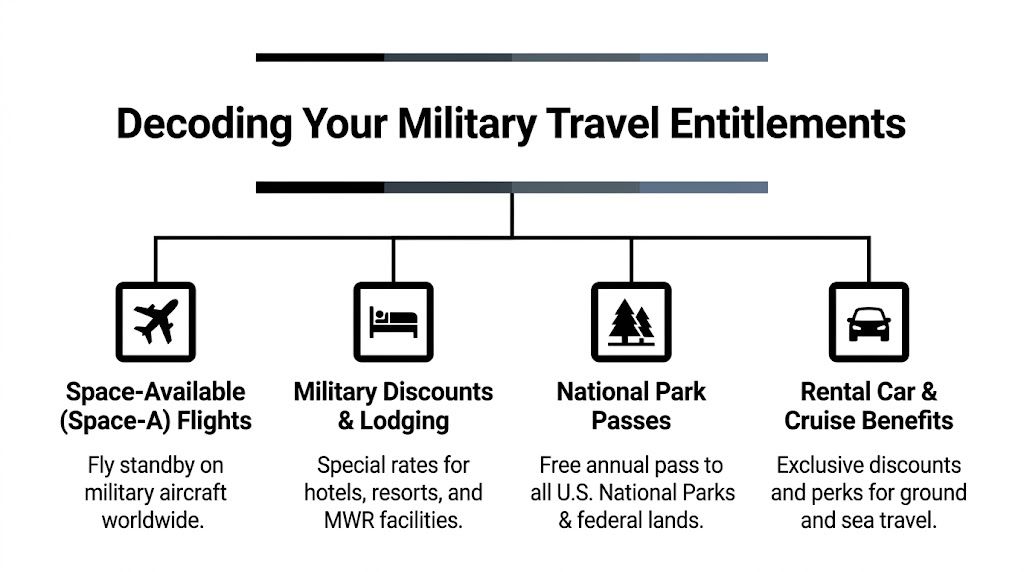
Official duty travel
This lane is the most structured. You’re traveling because the mission says so.
PCS, TDY, and other order-based travel usually come with the clearest rules. Airlines, lodging systems, and reimbursement processes often treat official travel very differently from personal leave travel. That’s why your entitlements can look generous on one trip and much tighter on the next.
When you’re on orders, always think in terms of documentation. Orders are not just paperwork. They provide access to certain benefits.
Space-A travel
This is the famous one. It’s the travel perk everybody’s heard about, and not everybody understands.
Space-Available travel is basically military standby travel. If there’s room on a military aircraft and you’re eligible, you may be able to fly for free or for a nominal fee depending on the situation. It can be an incredible money-saving option, but it runs on availability, priority, timing, and patience.
It’s not your smoothest lane. It’s your adventure lane.
MWR and exchange travel
This lane is the quiet professional in the room. Less flashy than Space-A, often more practical.
MWR, base travel offices, exchange-connected programs, and military leisure channels can help with lodging, attraction access, and trip planning. These benefits often don’t get enough attention because they’re not dramatic. But for families and routine vacation planners, this lane can be one of the easiest to use.
Commercial perks
This lane includes airline baggage policies, military rates, ID-based discounts, and partner perks you access directly with civilian travel providers.
Many people miss opportunities for savings here. They don’t ask about military baggage rules. They don’t compare military-friendly booking options. They assume a military rate is automatic when it often isn’t.
Here’s the quick mental map:
| Travel lane | Best for | Main caution |
|---|---|---|
| Official duty travel | Orders-based trips | Keep documents ready |
| Space-A | Flexible travelers | No guaranteed seat |
| MWR and exchange options | Family vacations and routine leisure | Eligibility can vary |
| Commercial perks | Everyday savings | You usually have to ask |
How to choose the right lane
Don’t start with the destination. Start with the reason for travel.
- If you’re on orders: Check every entitlement tied to official status first.
- If you’re on leave and flexible: Consider standby-style options and build a fallback.
- If you’re planning a family trip: Compare MWR, lodging channels, and commercial rates side by side.
- If you’re Guard or Reserve: Verify eligibility instead of assuming you’re excluded.
Some trips are won by finding a cheap flight. Others are won by understanding which rulebook applies before you book anything.
That’s the essential insight. Military travel benefits aren’t one benefit. They’re a stack of separate systems. Once you stop treating them like one big mystery bundle, the choices get a lot cleaner.
Mastering the Art of Space-A Travel
Space-A is the kind of perk that makes junior troops lean in and retirees smile. It sounds almost too good to be true. Military aircraft. Open seats. Minimal cost. Big savings potential.
It’s also the travel version of rolling into a training event with a solid plan and then finding out conditions changed overnight.
Why Space-A feels legendary
When Space-A works, it feels like you cracked a code. You’re moving on military air instead of paying full commercial fares, and that can make a huge difference for a leave period or family travel budget.
But this isn’t regular airline booking with a confirmation email and a seat assignment. You’re working inside an availability system. If the seats aren’t there, they aren’t there.
That means your attitude matters almost as much as your paperwork. Flexible travelers tend to do better than rigid itineraries.
Who qualifies and where the rules get tricky
According to the Military Times recreation and travel perks guide, active-duty members on leave and military retirees with DD Form 2 qualify worldwide, while National Guard and reserve members need DD Form 1853 for domestic travel within the U.S. and territories. The same guidance notes an important family rule: dependents of deployed service members can fly Space-A globally without the sponsoring service member present when the deployment exceeds 120 consecutive days.
That one catches people off guard.
A family member may assume Space-A only works if the service member is standing right there. In some deployment situations, that’s not true. The deployment documentation becomes the gatekeeper.
There’s another nuance in that same guidance. The dependent authorization also extends to certain Navy situations involving permanent change-of-station orders aboard deployed ships. That’s a detail worth checking carefully before travel day.
The high reward and the real risk
The risk isn’t theoretical. It usually shows up in the ugly parts of travel.
Summer leave windows. Holiday travel. Full terminals. Waiting on movement that never opens up the way you hoped. Then the backup commercial ticket costs more than it would have if you’d booked earlier. Add a hotel night and meals, and the “cheap” trip starts getting expensive fast.
Space-A works best when you can afford to be patient, not when you must arrive by a specific hour.
That’s why I tell people to treat it like a special operation. Great upside. Demands discipline.
A practical Space-A decision drill
Use this quick self-check before you commit:
- Mission flexibility: Can you leave later, arrive later, or reroute without wrecking the trip?
- Documentation: Do you have the right leave forms, ID, and any deployment-related paperwork if dependents are traveling?
- Budget backup: Can you pivot to a commercial ticket and cover lodging or meals if needed?
- Season check: Are you traveling during a period when competition for seats is likely to spike?
If you’re shaky on any of those, tighten your backup plan.
For a simple explainer on standby mechanics, this guide on how standby flights work is a useful companion read before you start gaming out your options.
The smart way to use Space-A
Space-A isn’t “good” or “bad.” It’s situational.
It’s strong for travelers with time, patience, and a second plan. It’s weaker for weddings, hard-report dates, fixed hotel bookings, or family schedules that can’t bend. If you use it with that mindset, it stops being confusing and starts being tactical.
And that’s really the whole point. Don’t romanticize it. Respect it. Then use it when the conditions fit.
Unlocking Commercial and MWR Discounts
Last summer, one of my soldiers showed up for a family trip with two giant duffels, a car seat, and the confident look of a man who had done zero homework. At the counter he learned the hard way that military baggage perks change based on the airline and whether you are traveling on orders or heading out on personal leave. Same uniform in the closet. Very different bill at the airport.
That lesson sticks.
Commercial discounts and MWR tools usually do their best work in trips like that. Not flashy. Just practical savings that keep nibbling down the total. A waived bag fee. Better boarding. A military rate on lodging. A resort package that beats the public price once you compare the full cost.
The airline counter can save you money, or cost you money
Airline policies are not one-size-fits-all, and they definitely do not read your mind.
Delta’s published military policy is a good example. Active-duty personnel on military orders can check five bags at 100 pounds each, while personal or leisure travel allows two bags at 50 pounds each in Basic Economy through Delta Comfort+. Premium cabin leisure travel follows its own allowance. Delta also notes that military treatment varies by carrier. You can check the current details on Delta’s military travel overview.
That means your script at the counter matters. Say exactly what applies. Active-duty on orders. Active-duty on personal travel. Guard member on personal travel. If you leave that fuzzy, the agent is going to default to the standard rule or ask you to prove eligibility while the line stacks up behind you.
Preflight checks that save headaches
Do the boring admin before you leave home. Sgt. Travel approves.
- Read your airline’s military policy page. Baggage, boarding, and fare rules vary a lot.
- Match the benefit to the trip. Official travel and leisure travel often get different treatment.
- Keep proof ready. Military ID, orders, and any supporting documents should be easy to access.
- Ask direct questions. “I’m traveling on orders” works better than “I’m military.”
Simple beats clever at the ticket desk.
MWR and military leisure channels are built for predictable savings
A lot of troops chase the dramatic score and ignore the steady wins. Meanwhile, the family that checks MWR travel, military leisure portals, and exchange-linked offers often books a cleaner trip with fewer surprise costs.
That can mean lodging with a military rate, attraction tickets through an approved leisure office, or a vacation package that comes in cheaper once all parking, fees, and baggage are counted. If you are comparing beach packages or family resort trips, this guide to military discounts on all-inclusive resorts is a solid place to start.
And yes, compare those rates against public sites and the deal platforms you already trust. The smart playbook is not “official only” or “commercial only.” It is both. Use the military-specific channels for access and eligibility. Use commercial deal sources, including options like Sgt. Travel Deals Army elsewhere in your planning, to compare what wins on total price.
Guard and Reserve families miss savings when nobody passes the word
Active-duty installations have a built-in rumor mill. Somebody in the unit usually knows which airline is generous with bags, which leisure office is helpful, or which travel portal is worth checking.
Guard and Reserve families often do not get that same constant flow of tips. You drill, you head home, and a lot of useful travel info never reaches you. That is why part-time service members leave money on the table. Not because they are ineligible, but because nobody gave them the playbook.
If you are Guard or Reserve, check eligibility instead of assuming “that’s probably for active duty only.” A surprising number of discounts depend on your ID status, your orders, or the vendor’s own policy.
A simple Guard and Reserve check card
| Check item | Why it matters |
|---|---|
| Current ID status | Many military-linked discounts start with valid identification |
| Orders or travel documentation | Some airline and lodging benefits change with official status |
| MWR or exchange eligibility | Access can vary by service category and trip type |
| Airline military page review | Baggage and boarding perks differ by carrier |
| Family eligibility questions | Dependents may qualify for some offers, but not all |
That is the low-drama method. Verify what applies. Ask clean questions. Stack the official perks with the commercial deals that make sense for your mission and your budget.
Your Tactical Savings Maximizer Plan
The cheapest trip isn’t always the smartest trip. The smart trip is the one that keeps your options open and your costs under control even when Plan A slips on a wet floor.
That’s where stacking military travel benefits starts to pay off.
One trip, several layers
Take a family trip to Florida.
You could attempt a Space-A leg if your schedule has breathing room. If seats don’t open, pivot to a commercial airline where you’ve already checked baggage rules and military policies. For lodging, compare on-base or military-access options against public rates. For the ground portion, check military-friendly car rental channels before you lock anything in.
That’s not overplanning. That’s adult supervision.
Build a travel readiness kit
Don’t scramble through screenshots and old emails at the check-in desk. Keep one digital folder ready to go.
Mine would include:
- Military ID images and backups: For quick reference if a booking platform asks for verification details
- Orders or leave documents: Especially important when an airline policy changes based on travel type
- Dependent paperwork if applicable: Useful for any family-related eligibility check
- Saved account logins: MWR portals, airline profiles, and loyalty accounts
- Plan B notes: Alternate flight ideas, hotel options, and local transport backups
A simple folder on your phone can save a lot of frustration when travel gets chaotic.
Use if-then thinking
This is the habit that separates a smooth trip from a parking lot meltdown.
- If Space-A works, then use the savings on better lodging or extra activities.
- If Space-A doesn’t move, then book the commercial backup you already researched.
- If you’re on orders, then maximize order-based baggage entitlements.
- If the military rate isn’t better, then take the lower public price and move on.
That last one matters. Being military doesn’t mean every military rate wins. Compare first.
Here’s a helpful visual refresher on thinking through travel tradeoffs and backup plans:
Compare before you commit
The trap is booking the first “military” option you find and assuming you’ve done your job. Don’t do that.
Open two or three options. Check the cancellation terms. Look at baggage rules, not just airfare. Compare the total trip, not the headline price. For packaged vacation planning, military discount travel packages are worth reviewing alongside your official and commercial options so you can see what fits the mission.
The strongest travel plan is the one that survives contact with reality.
That’s how you use military travel benefits like a pro. Not by chasing one magic discount. By layering practical options until the trip becomes affordable, flexible, and hard to derail.
Adding Sgt Travel Deals Army to Your Arsenal
Friday hits, leave finally clears, and you’re standing in the commissary line with your phone out, trying to piece together a trip before prices jump again. One tab has a hotel. Another has a rental car. A third has flights. Then your spouse texts, “Can we add tickets for the kids if we save enough on lodging?” That’s when a single comparison tool earns its keep.

Sgt. Travel here. The troops who save the most usually aren’t using one discount source. They’re combining the official benefits they rate, the commercial deals that beat the “military” price on certain dates, and one fast way to compare the whole trip without burning half the night.
That’s where Sgt. Travel Deals Army and its booking site www.stdarmydeals.com fit into the kit. The platform lets you check hotels, resorts, flights, car rentals, activities, and event options in one place. It works well as a comparison tool when you need to make a quick call from your phone, especially if your trip has moving parts and no patience for ten open tabs.
Why Guard and Reserve families get extra value from it
Active-duty travelers often hear about benefits during in-processing, PCS season, or from somebody in the shop who already knows the drill. Guard and Reserve families don’t always get that same steady flow of travel gouge. They may qualify for certain perks, have access to others only in specific statuses, and still end up doing a lot of detective work just to figure out what applies.
I’ve seen this one a bunch. A Guard family knows they might have access to military lodging or a special rate somewhere, but they still have to compare it against regular public pricing, baggage costs, rental car fees, and whether the timing even works with drill weekends and civilian work schedules. A centralized booking tool saves time because it shortens the comparison process. Less hunting. Faster decisions.
How to use it without wasting money
Use the platform for speed and confirmation.
- Check the full trip price: Look at the room, taxes, parking, resort fees, and cancellation rules.
- Build a ready backup: Save a bookable option in case the first plan falls apart.
- Search from the road: Handy when plans change at the airport, on leave, or halfway through a family travel day.
- Compare categories together: Flights, hotel, car, and activities often affect each other more than people expect.
Here’s the smart play. If you already found an official benefit that clearly wins, take it. If the answer is murky, or the public market might be better, run a quick comparison and make the call with the total cost in front of you.
The company presents the service as free to join, and the booking setup works on mobile, tablet, and desktop. That makes it practical for troops who do trip planning in short bursts, between duty, family life, and whatever else the week throws at them.
Keep Sgt. Travel in your ruck, not on a pedestal
Use every tool for the job it does best. Official benefits can save you big in the right situation. Commercial offers can beat the military rate on some dates. A comparison platform helps you sort the options fast and catch the better play before you book.
This is the essential travel playbook. Stack your benefits. Cross-check the market. Give yourself a backup. Then roll out with a plan that survives first contact with reality.
Frequently Asked Questions From the Ranks
Can my non-military parents or girlfriend use my military travel benefits with me
Usually, eligibility depends on the specific benefit.
Some benefits are tied directly to the service member. Others may extend to eligible dependents. That does not automatically include every family member, friend, partner, or guest traveling with you. Airline baggage perks, Space-A rules, MWR access, and military rates can all have different definitions of who qualifies.
Your safest move is to verify the exact traveler category before booking. If the benefit language says “active-duty,” “retiree,” or “dependent,” interpret those words precisely.
Are military discounts always available during holidays and peak travel periods
No; travelers often become annoyed, assuming the military rate is guaranteed.
Some providers limit inventory, apply blackout rules, or offer a rate that isn’t the lowest option during peak demand. That’s why comparing total price still matters. A public promo may beat a military offer on some dates.
The move is simple. Check the military option, check the standard option, and book the one that gives you the better total value.
I’m a veteran but not retired. Do I still have military travel benefits
In some cases, yes. In others, not automatically.
Eligibility varies widely. Some official perks are narrower. Some commercial discounts are broader. Some military-linked travel tools and exchange-connected options may still offer access depending on the program and your status. The problem isn’t always lack of benefits. It’s lack of clear guidance.
If you’re a veteran planning a trip, build from verified eligibility, not assumptions. Check each provider’s current policy and keep your identification and account access organized.
What’s the biggest mistake people make with military travel benefits
They chase one discount instead of building one plan.
A traveler hears about Space-A and ignores the backup. Or they focus on airfare and forget baggage rules. Or they assume the military rate wins without comparing final cost. Or they skip MWR-style options because they sound less exciting than a flashy travel hack.
The winning move is to think like a planner.
- Start with eligibility
- Match benefits to the type of trip
- Keep documents handy
- Compare total cost, not just one line item
- Have a fallback
The trip usually gets easier the moment you stop hunting for a miracle and start building a system.
What should I do today if I want to use these benefits on my next trip
Keep it basic.
Pick one upcoming trip. Check whether it’s official travel, personal leave, or a family vacation. Review the airline baggage policy that applies. Decide whether flexibility makes Space-A realistic. Then compare lodging and transport options using military-access channels and civilian prices side by side.
That one exercise will teach you more than saving twenty random travel posts.
If you’re ready to compare options for your next trip, take a look at Sgt. Travel Deals Army. It’s a veteran-owned travel platform where you can review discounted hotels, flights, car rentals, activities, and more in one place, then check the booking side at www.stdarmydeals.com to see what fits your mission and budget.
1 thought on “Military Travel Benefits: Unlock Exclusive Perks”