
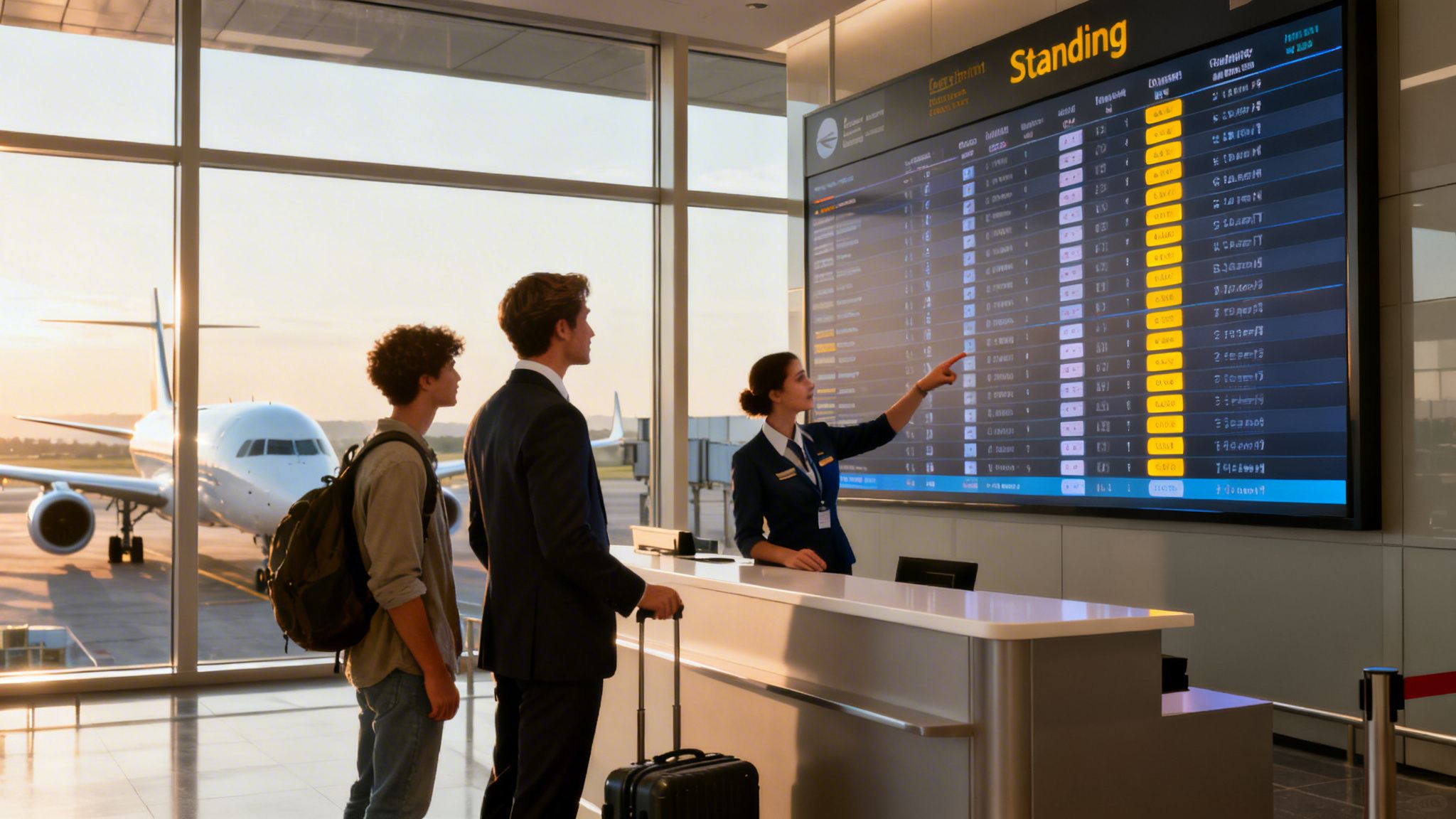
Your meeting ended early. Your bag is packed. You are staring at the departures board and thinking the same thing every smart traveler thinks.
Can I get on that earlier flight and get home today?
Yes, maybe. But standby is not the old movie version where you sprint to the airport, sweet-talk the counter agent, and buy a mystery seat for pocket change. That era is dead. Modern standby is a rules game, and if you know the rules, you stop guessing and start moving like a pro.
I’m Sgt. Travel for today, and your orders are simple. Learn the system, read the list, and don’t make rookie mistakes at the gate.
Your Mission to Master Standby Flying
You are probably in one of three situations right now.
Maybe your work trip wrapped up faster than expected and you want your couch back tonight. Maybe your original flight looks ugly and you want a shot at something sooner. Or maybe you just hate wasting a whole afternoon in Terminal Nowhere when a better option is sitting on the board.
Such situations highlight standby's value.

Standby is not magic
Standby is a tactical move. You already have a ticket, and you ask the airline to place you on a list for another same-day flight. If a seat opens, you get it. If not, you keep your original plan.
That last part matters. Most travelers overcomplicate this. They act like standby is a casino bet. It isn’t. In many cases, it is a low-risk play for extra flexibility.
Your mission objective
If you want to understand how do standby flights work, focus on three things:
- What standby means now and what it no longer means
- How airlines rank people on the standby list
- What actions increase your odds once you get to the airport
Tip: Treat standby like a mission with a fallback plan, not a desperate last-second gamble.
Who should care most
Standby is especially useful for:
- Business travelers who finish early and want to get home sooner
- Budget travelers trying to avoid costly same-day rebooking
- Military travelers who may benefit from special treatment or waived fees on some carriers
- Flexible flyers who can handle a little uncertainty without melting down at the gate
If that sounds like you, good. You are in the right briefing room.
Decoding Standby What It Really Means Today
Old-school standby used to be a very different beast. Travelers could show up at the airport, buy a last-minute airport ticket, and hope to fill an empty seat. That was common before post-9/11 security changes.
According to Travelpro’s guide to how standby flying changed after 9/11, heightened TSA security measures required pre-purchased tickets and advance passenger manifests, which ended true walk-up standby by 2002. Today, standby is generally for travelers who are already ticketed and want a same-day switch.
What standby means now
Modern standby is best understood as a waitlist for a different flight on the same day.
You do not buy mystery airfare at the counter anymore. You request a shot at another departure, and the airline places you in line behind other standby travelers based on its rules.
The three standby situations that matter
Voluntary standby
This is the type of standby many travelers consider.
You booked Flight A, but you want Flight B on the same day. Maybe your conference ended early. Maybe traffic was light and you got to the airport faster than expected. You ask to be placed on standby for that other flight.
If a seat opens, great. If not, you still take your original flight.
Involuntary standby
This happens when the airline causes the problem.
A missed connection, an operational disruption, or an oversold flight can push you onto a standby list for another flight. This version is less about convenience and more about recovery.
Same-day confirmed change
This is not the same as standby, and people confuse the two constantly.
A same-day confirmed change gives you a seat right away on the other flight. Standby gives you a chance at the seat later if space opens. If you like certainty, pay attention to whether the airline is offering a confirmed switch or only standby.
The clean way to think about it
Use this quick comparison.
| Option | Do you already have a ticket | Seat guaranteed | Best for |
|---|---|---|---|
| Voluntary standby | Yes | No | Getting out earlier or later on the same day |
| Involuntary standby | Usually yes | No, until re-accommodated | Disruptions and missed connections |
| Same-day confirmed change | Yes | Yes | Travelers who want certainty |
The big mental shift
Standby used to reward boldness. Now it rewards preparation.
That means you need to know your fare rules, your airline’s app, and your own tolerance for uncertainty. If you show up expecting a miracle, you will get frustrated. If you show up with a plan, you may save the day.
The Standby Priority List How Airlines Decide Who Flies
Gate agents do not pick names out of a hat. The standby list runs on a strict pecking order.
If you have ever wondered why someone who showed up after you still got the seat first, this is why.
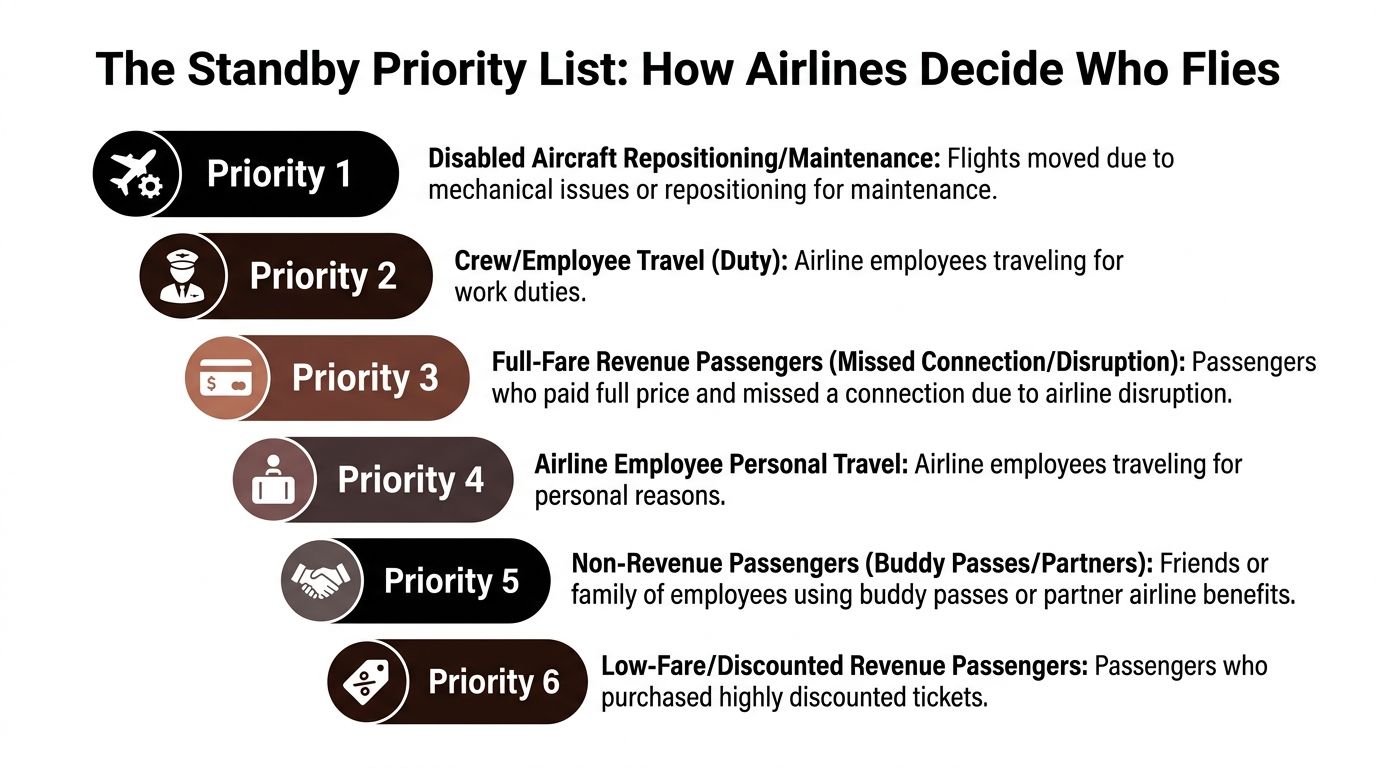
According to Otto the Agent’s breakdown of standby priority, airline standby lists use a rigid hierarchy where fully refundable tickets outrank discounted fares, and even mid-tier elites can clear ahead of travelers with no status. The same source notes that this structure mirrors staff non-rev travel, where many airline employees are part of the system, often on flights with high occupancy.
Fare class comes first
Your ticket type matters. A lot.
If you paid for a flexible or fully refundable fare, the airline often values that ticket more than a discounted one. That usually means a stronger position on the standby list.
Basic economy is often the problem child. Many airlines either restrict it heavily or make standby harder with those fares.
Status beats ordinary loyalty
You can be a nice person, a tired person, or a person with a gate latte. None of that matters like elite status matters.
Airlines reward their frequent flyers. If two travelers want the same last seat, the one with status often gets the nod over the one without it. Mid-level elites can leapfrog general members, even when both are requesting the same flight.
Special categories can matter
Some airlines also build in priority for special groups.
Active military travelers may receive better placement or fee waivers on some carriers. Disrupted passengers can also receive favorable handling depending on the situation. If the airline caused the problem, it may try to move you faster than someone making a purely voluntary change.
Timing still matters, but not first
Check-in and request timing do matter. They just do not usually outrank fare class and status.
That means being early helps, but being early on a restrictive cheap fare may still leave you behind a status traveler who joined later.
Key takeaway: The standby list is not first come, first served. It is first qualified, then timed.
Where airline employees fit
Airline employees often travel on a non-revenue basis, sometimes for duty and sometimes for personal travel. Their systems run on their own internal hierarchy.
For regular travelers, the practical lesson is simple. You are not always competing only against other paying passengers. You may also be competing against operational needs, repositioning decisions, or employee travel priority.
A field guide to the usual order
Every airline tweaks the recipe, but the flow often looks something like this:
Operational and crew needs
If the airline needs to move crew or handle an operational issue, those travelers can rise fast.High-value revenue passengers
Flexible fares and disruption cases often receive stronger treatment.Elite members
Status is a serious weapon in standby battles.General ticketed passengers
This category includes the majority of travelers.Low-fare or restricted tickets
Cheap fares often come with weaker standby rights.
How to use this intel
Do not just ask, “Is there an open seat?”
Ask better questions:
- What fare did I buy
- Does my airline allow standby on this ticket
- Do I have status or military eligibility that changes my rank
- Am I choosing a flight where fewer people are fighting for the same seat
If you know those answers, you stop feeling blindsided by the list on the screen.
Your Step-by-Step Gameday Guide at the Airport
The airport experience reveals whether travelers are veterans or rookies. We are going with veteran.
Your job is simple. Get on the list correctly, get to the gate early, and stay alert.

According to KAYAK’s standby explainer, standby priority is based on a hierarchical algorithm, and passengers generally need to arrive at the gate 30 to 60 minutes before departure. The same source notes that American Airlines charges a $75 fee for economy standby but waives it for AAdvantage elite members and active military.
Step one, request standby the smart way
Start with the airline app if it offers the option. If not, use a kiosk or ask an agent at check-in.
You want to confirm three things immediately:
- Whether your fare is eligible
- Whether there is a fee
- Whether you are now on the list
Do not assume the request “probably went through.” Probably is how people get stranded.
Step two, protect your original reservation
Voluntary standby usually leaves your original booking intact until you clear onto the new flight.
That is the beauty of this move. You are not usually surrendering your original flight just by trying. You are asking for an upgrade in timing, not jumping off a cliff.
Step three, move to the gate early
Get to the gate with time to spare. Standby clearance often happens late, sometimes close to boarding closeout.
If the airline says be there early, obey. Missing your name being called is one of the dumbest ways to lose a seat.
Step four, watch the screens like a hawk
Many airlines show standby lists on gate monitors or in the app.
That list is your battlefield map. It tells you where you stand, how many people are ahead of you, and whether your odds are improving or collapsing.
Step five, talk to the gate agent like an adult
Be brief. Be polite. Be ready.
Good script: “Hi, I’m on the standby list for this flight. I just wanted to confirm I’m checked in and in the system.”
Bad script: a ten-minute life story delivered while boarding is starting.
Tip: Gate agents control a messy process under time pressure. Calm travelers get better outcomes than dramatic ones.
What the gate process looks like
Here is the usual rhythm:
- Confirmed passengers board first
- Final no-shows get identified
- Open seats appear
- Gate agent clears standby names in priority order
- If your name is called, move immediately
If you clear, the agent gives you a seat assignment and updates your itinerary. Move fast. This is not the moment to wander off for trail mix.
A quick visual can help if this is your first time working the gate process:
What about checked bags
Checked bags complicate standby. A lot.
If your bag is already tagged for the original flight, moving you to another plane can be messy. Sometimes the airline can transfer it. Sometimes it cannot. Sometimes the bag catches up later.
That is why carry-on only is the cleanest standby setup by far.
If you do not clear
Then you take your original flight.
That is it. No drama. No shame. No travel identity crisis. You gave it a shot and still kept your original mission alive.
Pro Tips to Boost Your Standby Success Rate
Knowing how do standby flights work is one thing. Getting the seat is another.
Now, let's move beyond theory and get tactical. These are the moves that give you the best shot without relying on luck or fairy dust.
First rule, travel light
If you want to play the standby game well, bring a carry-on and keep moving.
Checked luggage adds friction. It slows down last-minute switches and gives the airline one more reason to leave you on your original flight. If you can avoid checking a bag, do it.
Second rule, choose the right battle
Not every flight is worth the attempt.
A packed business route at the end of the workday is usually a rough battlefield. A less popular departure can be a smarter target. You do not need a statistic to figure this one out. You need common sense and a quick scan of the app.
Third rule, check in early and stay glued to the app
Standby lists move. Your app is your reconnaissance feed.
Watch for seat maps, standby rank, gate changes, and signs that the flight is tightening up. If the list gets longer and uglier by the minute, adjust expectations fast.
Fourth rule, be useful to the gate agent
Politeness is not a gimmick. It is operational intelligence.
Gate agents deal with stressed-out travelers all day. The person who is prepared, present, and respectful is easier to help than the person performing a public meltdown beside the boarding lane.
Tip: Short question, clear name, boarding pass ready. That is how professionals do it.
Fifth rule, know your airline’s policy before you need it
Some airlines are generous. Some are stingy. Some look generous until you read the fine print.
Here is a practical comparison based on the verified facts available.
2026 Standby Policies Major US Airlines
| Airline | Standby Fee (Economy) | Eligibility / Notes | Free for Elites/Military? |
|---|---|---|---|
| American Airlines | $75 economy standby on the cited example | Priority is shaped by fare class, elite status, check-in time, and military affiliation | Yes, waived for AAdvantage elite members and active military on the cited example |
| Southwest Airlines | Free standby | Offers free same-day standby if requested before departure on eligible fares mentioned in the verified data | The verified data describes free standby broadly on those fares |
| Spirit Airlines | $99 fee | Budget carrier example with a cited standby fee | No waiver confirmed in the verified data |
| United Airlines | Qualitative only | Fare restrictions can apply, especially on lower fares | Elite status affects priority |
| Delta Air Lines | Qualitative only | Elite status strongly influences who clears first | Elite members receive priority |
If flexible travel is part of your playbook, pairing standby strategy with a refundable ticket is smart. This guide on how to book refundable flights is worth reading before you lock in your next itinerary.
Sixth rule, military travelers should use every legitimate advantage
If you are active military and the airline offers a waiver or priority handling, speak up politely and verify it.
Do not assume the system will magically recognize every detail of your eligibility without you checking. Bring the right ID. Ask the right question. Let the agent confirm your options.
Seventh rule, have a backup mission
Standby works best when you are flexible.
That means:
- Keep your original flight alive unless you secure the new one
- Avoid hard commitments right after the earlier target flight unless you can absorb the risk
- Know when to stop pushing and just fly the itinerary you already have
My blunt recommendation
Use standby when the upside is meaningful.
Try it when getting home early saves your evening, when avoiding a long airport sit is worth the effort, or when the fee is lower than a painful same-day rebooking. Skip it when your schedule is fragile and uncertainty will wreck your day.
Standby is a tool. Use it like one.
Real-World Scenarios When Standby Saves the Day
Theory is nice. Real life is better.
Here are three field scenarios where standby earns its keep.
The business traveler who wants dinner at home
A consultant finishes up in Chicago hours ahead of schedule. Instead of camping at the airport until his original evening departure, he requests standby for an earlier flight.
He gets on the list, stays near the gate, and waits for final no-shows to shake loose a seat. If he clears, he gets home in time for his daughter’s game. If not, his original flight is still standing by to carry him home.
That is the beauty of the move. He risks time, not total ruin.
The backpacker with a broken connection day
A traveler heading through Denver misses a connection after a delay wrecks the timing. She talks to the airline, gets re-accommodated, and asks whether there is a standby path onto an earlier alternative that still gets her moving.
In such cases, flexibility beats pride. She does not cling to the exact fantasy itinerary. She works the options in front of her and avoids a miserable airport overnight.
If you live on last-minute travel tactics, this roundup of best sites for last-minute travel deals can help when backup planning becomes necessary.
The service member trying to get home
An active-duty traveler is trying to make it home before a holiday weekend gets away from him. He checks eligibility, confirms his status with the airline, and gets placed correctly on the standby list.
That military angle can matter when an airline recognizes it in fees or priority handling. The key is not swagger. The key is having documents ready, asking clearly, and staying in position until the gate process finishes.
Key takeaway: Standby saves the day when you are flexible, informed, and ready to move the second the window opens.
Standby FAQs Your Final Mission Briefing
Loose ends kill missions. Let’s tighten them up.
Can I still buy a cheap walk-up standby ticket at the airport
No.
That old-school version of standby is gone. Modern standby is generally for travelers who already hold a ticket and want a same-day switch.
What happens if I do not clear the standby list
You usually keep your original flight on a voluntary standby request.
That is why standby is often worth trying when the alternative is waiting around anyway.
Do I need to stay near the gate
Yes. Absolutely.
If the agent calls your name and you are off browsing neck pillows two gates away, you can lose your shot.
Can I do standby with a checked bag
Sometimes, but it is messier.
A checked bag may limit your flexibility because the airline has to deal with where that bag is going and whether it can be moved in time. Carry-on only is the cleaner setup.
Can I standby for a different city
Usually no.
Standby is generally about switching to another flight on your same route or same-day travel plan, not inventing a whole new destination because you got creative at the gate.
Is standby the same as a same-day confirmed change
No.
A confirmed change gives you the new seat immediately. Standby puts you on the waitlist and makes you wait for space to open.
Do elite members really have better odds
Yes.
Airlines use priority rules, and status often helps. If you travel often enough to earn elite perks, standby becomes a much more useful weapon.
Should I buy trip protection if I am doing flexible travel moves
If your plans are tight, trip protection can be worth a look. This guide to flight ticket insurance can help you decide whether the extra protection fits your style of travel.
What is the best mindset for standby
Simple. Be ready, not entitled.
Standby rewards travelers who understand the rules, watch the board, and stay adaptable. It punishes people who expect guarantees from a process built on leftover space.
You do that, and you will already be ahead of most of the terminal.
Ready to travel smarter with a veteran-owned crew behind you? Join the Sgt. Travel Deals Army and check out the booking platform at www.stdarmydeals.com for flights, hotels, car rentals, resorts, and more. Enlist, compare prices, and move out like a pro.