
That envelope lands on the kitchen counter, and your stomach drops. It looks official. It mentions your spouse, your kids, your health plan, and a deadline. If you're a military family, a veteran household, or a family that's moved a lot, your first thought is usually not, "No problem, I've got this." It's more like, "Which folder is the marriage certificate in, and why do they need this again?"
Take a knee. Breathe.
A dependent eligibility verification notice usually isn't an accusation. It's a roster check. Employers use it to confirm that the people enrolled in a health plan meet the plan's rules. Sgt. Travel style translation: the command wants the roster clean, current, and backed up with paperwork.
That process has a real money reason behind it. Dependent eligibility verification audits consistently find that 3% to 10% of dependents enrolled in employer health plans are ineligible, and the average annual medical cost per dependent can exceed $4,570 according to Mercer's dependent eligibility audit analysis. That's why employers keep running these audits. Even a small number of ineligible enrollments can cost a lot.
For military and veteran families, the paperwork side can feel extra annoying. PCS moves, deployments, blended families, old county records, name changes, guardianship arrangements, and living in temporary housing can all turn a simple request into a scavenger hunt. Still, this mission is manageable when you break it into steps.
Practical rule: Read the notice once for the deadline, then read it again for the exact documents requested. Most trouble starts when people skim.
So You Got the Dependent Verification Notice Now What

The letter lands in your inbox on a Tuesday afternoon. Your spouse is listed. Your kids are listed. There's a deadline, a document checklist, and a benefits portal that feels about as friendly as a locked gate at 0600.
Good news. This notice usually means "prove the roster is accurate," not "you're in trouble."
Employers run dependent verification for the same reason a unit checks names before wheels up. They need to confirm that every person on the list still qualifies under the health plan. If someone stayed enrolled after a divorce, a child aging out, a custody change, or a change in domestic partner status, the record may no longer match the plan. The fix is paperwork.
For military and veteran families, that paperwork can get messy fast. PCS moves scatter records. Name changes after marriage or remarriage can leave documents mismatched. Guardianship papers, DEERS records, and courthouse copies may all live in different places. If your family already keeps a folder for orders, IDs, and travel records, use that same mindset here. It is the same skill set you use for tracking military travel benefits and support programs. Get organized first, then move.
Why your employer cares
This review is about plan rules and plan costs. Coverage for ineligible dependents creates extra premiums, extra claims, and extra administrative cleanup. That is why employers ask for proof instead of taking old enrollment records at face value.
The pressure behind these notices is real, but the task is usually straightforward once you stop treating it like a mystery. Your mission is simple. Identify each covered dependent, find the exact document requested for that person, and submit it before the deadline.
What to do in the first 24 hours
Start with control, not panic.
- Mark the deadline in your calendar and set two reminders.
- Write down every dependent currently enrolled on your plan.
- Match each person to the proof requested in the notice.
- Check names, dates, and relationship details for inconsistencies before uploading.
- Log into the portal now so a password reset does not burn your last day.
Field rule: Missing the deadline usually creates a bigger problem than needing a day or two to track down the right file.
If you are in a military or veteran household, give yourself extra margin. Records may be split across duty stations, state agencies, old HR systems, and family law documents. That is normal. Treat this like a document readiness drill. Calm, methodical, and on time beats frantic every single time.
Understanding the Mission Who and What Is Verified
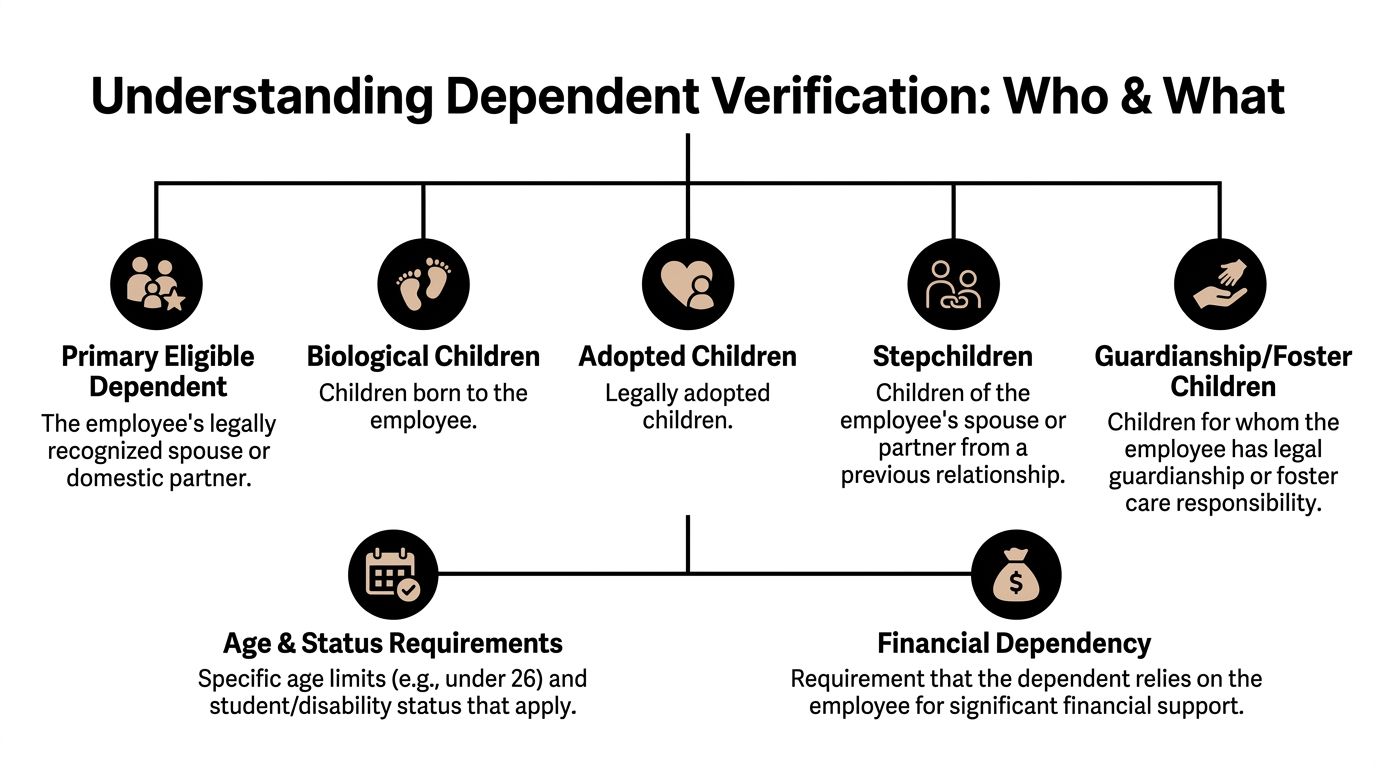
A lot of confusion starts with one bad assumption. People think "my dependent" means anyone they support. In benefits language, it means someone who fits the employer's plan rules and can be proven with documents.
The usual roster categories
Most plans review some combination of these groups:
- Spouse: A legally recognized spouse usually needs a government-issued marriage certificate and often another document showing the relationship is current.
- Domestic partner: Some plans allow this category, but the proof standard is often stricter because the plan may require evidence of cohabitation or financial interdependence.
- Biological child: Employers typically require the child's government-issued birth certificate showing the employee as the parent, according to Alight's dependent eligibility guidance.
- Stepchild: These cases usually connect two proofs. One document links you to your spouse, and another links the child to that spouse.
- Adopted child: Plans usually want adoption papers or other court-issued records.
- Guardianship or foster child: These situations often require court orders or legal guardianship documents.
- Disabled adult child: Plans may require additional disability-related certification, depending on the plan.
The exact list comes from your employer's plan documents, not from vibes, memory, or what another company accepted last year.
Intel for military families
Military households run into a few repeat problems.
Frequent moves can make proof of shared residency harder, especially if one spouse's ID still shows an old address or the family is between housing arrangements. Temporary lodging, on-base housing systems, and separate duty-related paperwork can create mismatched addresses across otherwise valid records.
Name changes also show up a lot. A spouse may have one surname on a marriage certificate, another on a utility bill, and a third version in an employer portal because of a delayed update. That's fixable, but it has to be explained with documents that create a clean paper trail.
If your family setup is less traditional, slow down and build the file carefully. Domestic partner cases, guardianship cases, and families with recent relocations often need alternate records. That's one reason many military households appreciate practical benefits explainers such as this overview of military travel benefits, because military life creates admin headaches in more than one area.
A verification team isn't trying to guess your story. They compare documents to the plan rules. Your job is to make the story obvious on paper.
Your Arsenal Required Documents and Evidence
Open your file like you're packing for PCS travel. Put the must-have documents on top, keep the backups close, and do not stuff in a bunch of random papers that slow the reviewer down.
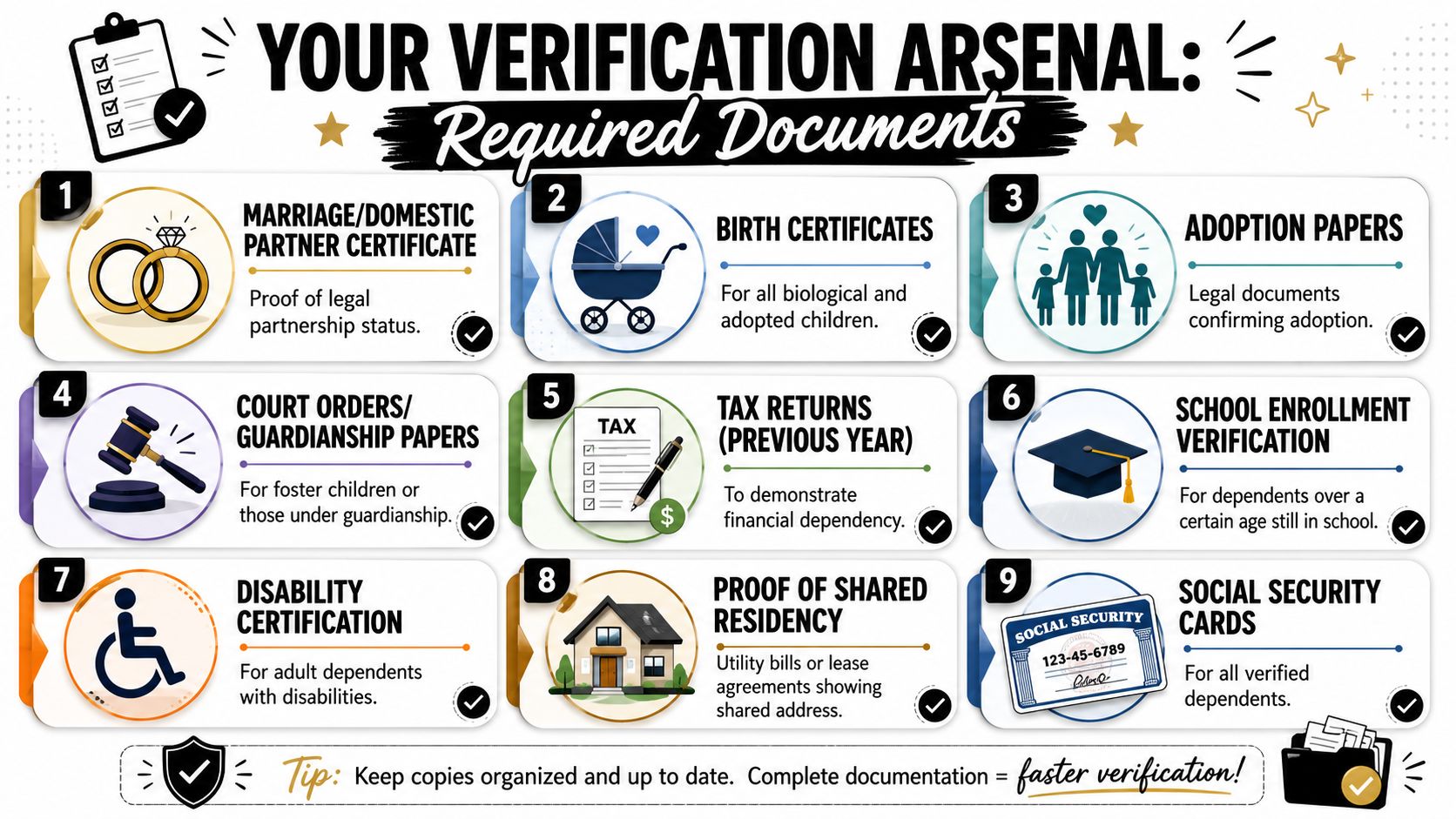
The best document is the one that proves the relationship directly. Government-issued records usually carry the most weight because they connect names, dates, and legal status in one place. Sgt. Travel rule. Lead with the paperwork that answers the question fast.
The two-document setup that trips families up
A lot of spouse reviews need two pieces of proof, not one. Plans often ask for a primary legal record plus a recent supporting document, such as a government-issued marriage certificate and a current joint bill or lease, as shown in Microsoft's dependent verification requirements.
That second file serves a different purpose. The marriage certificate shows the relationship started. The newer document helps show the relationship still meets the plan's current rules.
Use this field guide while you build your packet.
| Dependent Type | Primary Document (Required) | Common Secondary Document (If Required) |
|---|---|---|
| Spouse | Government-issued marriage certificate | Recent Form 1040 first page, joint utility bill, lease agreement, or account statement listing both names |
| Domestic partner | Employer-approved partnership documentation if accepted by the plan | Proof of shared residency or financial interdependence, based on the employer's rules |
| Biological child | Government-issued birth certificate listing the employee as parent | Additional plan-specific proof if requested |
| Stepchild | Child's birth certificate plus proof of marriage to the child's parent | Current supporting document if the plan asks for one |
| Adopted child | Adoption papers or court-issued adoption record | Additional plan-specific proof if requested |
| Guardianship or foster child | Court order or guardianship papers | Current supporting documentation if requested |
| Disabled adult child | Documents proving relationship | Disability-related certification if the plan requires it |
What makes a document usable
Good documents still get rejected for simple admin reasons. Review each file like you're checking IDs at the gate.
- Readable scan: Names, dates, seals, and page edges should be clear.
- Correct date window: If the notice asks for something recent, use a document from that time period.
- Matching names: Check maiden names, suffixes, middle initials, and spelling differences.
- Complete page: Keep headers, issue dates, account holder details, and page numbers visible.
- Right document for your plan: One employer may accept a record that another employer will not.
If you need a refresher on how official record ordering works, this quick video can help:
Smart document prep for military and veteran families
Military families often have paper trails that look messy even when everything is legitimate. One spouse may still have an old address. A child may have records from a different state. A recent move, deployment, retirement transition, or name change can leave you with documents that are all real but do not line up neatly at first glance.
Your mission is to build a clean chain of proof. If the marriage certificate shows one last name and the utility bill shows another, include the name-change record that connects them. If your family just moved, pick supporting documents that show the same address and similar dates. If you are using alternate records, make sure they work together instead of raising fresh questions.
A simple folder system helps. Keep one secure digital folder for marriage records, birth records, court papers, tax forms, and current household proof. The same habit that keeps trip confirmations in order for all-inclusive resorts with military discount options will save you time here too.
Clean paperwork wins battles. Messy paperwork creates extra email.
The Verification Process Step by Step
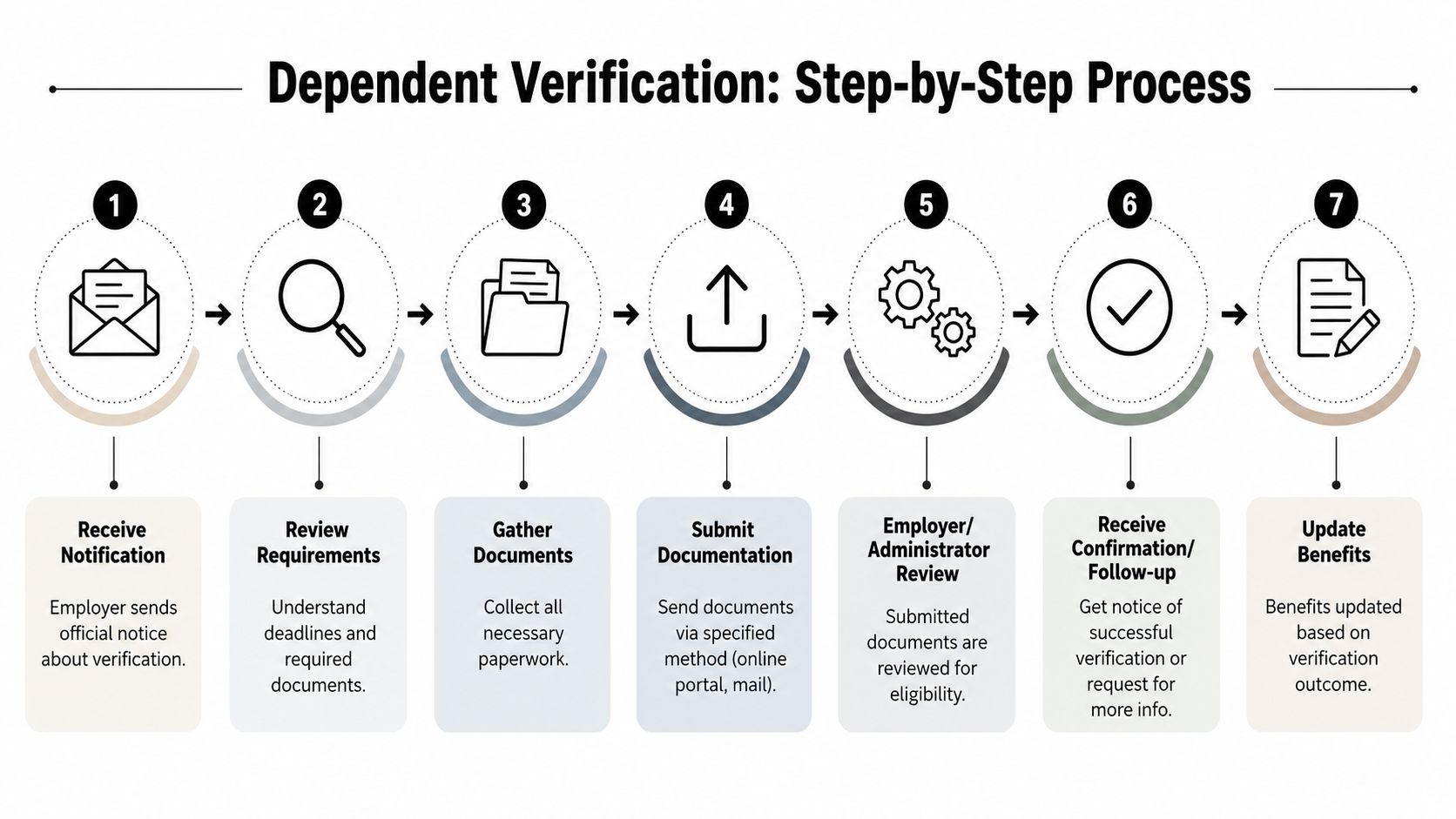
You open the notice after dinner, see a deadline, and your brain goes straight to worst-case mode. Easy, troop. This process usually follows a predictable route, and once you know the order, it feels a lot more like a checklist than a crisis.
For military and veteran families, the paperwork trail can look less tidy than the relationship itself. PCS moves, deployments, retirements, remarriages, and children with records from different states can make a normal family file look like mixed luggage after a long connection. Your job here is simple. Follow the sequence, submit clean proof, and answer questions fast.
Step 1 through Step 3
Receive the notice
Start with the deadline. Then confirm exactly which dependents are under review and what response method the notice requires.Match each dependent to the right rule
A spouse, biological child, stepchild, disabled adult child, or domestic partner may each need different proof. Do not assume one set of documents works for everyone on your plan.Build one file for each person
Give each document a plain, boring filename that makes sense at a glance, such as "Spouse-Marriage-Certificate" or "Daughter-Birth-Certificate." Boring wins here. Boring prevents wrong uploads.
Step 4 through Step 5
Submit only what fits the request
Use the employer's portal, upload tool, or mail process exactly as instructed. Send the required pages and supporting proof that clearly connect the dots. Skip extra paperwork unless it helps explain a mismatch in names, addresses, or dates.Wait while the reviewer checks the chain of proof
Reviewers are usually asking a plain question: do these records prove this person is eligible under the plan? They look for matching names, valid dates, readable pages, and current supporting documents when the plan asks for them.
Here is a common spouse example. Plans often want a government-issued marriage certificate plus a recent document that shows the relationship is current, such as a tax record or household bill with both names. As noted earlier, that kind of two-part standard is common. If your family has military-specific quirks, such as a recent move or one spouse still tied to an older address, include the connecting record that clears it up the first time.
Step 6 through Step 7
Watch for the decision
You may get an approval, a request for more information, or a denial. Approval means you are done for now. A follow-up request means the reviewer sees a gap, not always a fatal problem.Counter fast if the file gets kicked back
If they ask for another document, send the cleanest match you have. If the denial looks wrong, use the appeal or review instructions in the notice and stick to facts, dates, and records.
Field note: A lot of denials start as admin problems. Cropped pages, blurry photos, missing second documents, and name mismatches cause more trouble than the underlying relationship.
A few upload habits can save you a second round of headaches:
- Use PDFs when possible so pages stay in order.
- Photograph documents in bright, even light with all corners visible.
- Open each uploaded file after submission to confirm nothing got cut off.
- Save the confirmation email or screenshot in case you need to prove you submitted before the deadline.
Common Pitfalls and How to Avoid Them
Most dependent eligibility verification failures aren't dramatic. They're boring mistakes. That's the annoying part. A missed deadline, a blurry photo, a bill that's too old, a missing page, or one document submitted when the plan wanted two. Small admin errors create big consequences.
The mistakes that keep showing up
- Waiting too long: People assume they can gather records over a weekend, then discover a county office delay or portal problem.
- Submitting the wrong version: A commemorative certificate, screenshot, or cropped photo may not count if the plan wants a government-issued record.
- Ignoring date requirements: Current cohabitation proof often has a recency rule.
- Overlooking name mismatches: Maiden names, suffixes, and spelling variations can trigger follow-up requests.
- Assuming HR will "know what you mean": They won't. The file has to prove the relationship on its own.
The risk many employees don't see coming
Losing coverage isn't the only consequence. Some plans explicitly state that employees may be required to repay health care claims paid on behalf of an ineligible dependent, according to the San Francisco Health Service System DEVA Q&A. That's the part people often miss.
If a dependent was not eligible under the plan, claims paid for that person may not disappear into the fog. The plan may try to recover them. That's why this process deserves the same seriousness you'd give tax paperwork or a legal deadline.
If the notice says remove an ineligible dependent or provide proof, treat that as a real financial warning, not a routine HR memo.
Military-family trouble spots
PCS moves can scramble shared-address evidence. One spouse may still have old documents from the prior duty station while the other has newer records. If that's your situation, don't submit a random pile. Build a clean sequence of records that shows continuity.
Deployment and separation for duty can also complicate cohabitation-style requirements. If the plan allows alternate proof, contact the verification support line early and ask what combination of records works best. Be polite, be direct, and get the answer in writing through the portal or email if possible.
Mission Debrief and Your Next Steps
The notice is on your screen. Your kid needs coverage. Your spouse has appointments coming up. You are staring at a checklist that feels like it was written by a courthouse clerk and a copier repairman working together.
Good. Take a breath and go to work.
This mission is very doable when you treat it like a pre-deployment gear check or a PCS binder. The goal is not to tell your whole family story. The goal is to hand the reviewer a file that answers one question fast: is this person eligible under the plan?
That matters even more for military and veteran families. Records may be split across duty stations, counties, old addresses, maiden names, DEERS history, or periods when the family was separated for service. A reviewer does not know your situation unless the documents make it plain. Your job now is to make the trail easy to follow.
Your action plan from here
- Find the deadline today. Put it on your calendar and set a reminder a few days earlier.
- Make a roster of each dependent. List the exact proof the plan asks for next to each name.
- Start with official records. Birth certificates, marriage certificates, court orders, and other government-issued documents usually carry the most weight.
- Check names, dates, and legibility. If a name changed or an address shifted after a PCS, include the record that connects the dots.
- Submit before the deadline and save proof. Keep the confirmation email, screenshot, or portal receipt.
- Respond fast if there is a denial. A missing page or unreadable upload is often fixable if you act quickly.
One more Sgt. Travel tip. Build your packet for a tired stranger on the other end of the portal. Label files clearly. Keep them in order. If the plan asks for two items, send the two best items, not eight confusing ones.
Messy paperwork does not mean you did something wrong. It usually means life happened. Military and veteran households deal with moves, deployments, blended families, reserve activation, and records coming from three different offices that never seem to talk to each other. Clear organization wins here.
Then, once this admin drill is complete, reward yourself with something better than scanning documents at the kitchen table. If you are ready for a little morale boost after the paperwork fight, check out these military travel deals for service members and families.
Sgt. Travel Deals Army is built for people who like smart planning, solid value, and a little personality with their logistics. You can enlist for free with Sgt. Travel Deals Army, and when you're ready to book your next hotel, resort, flight, car rental, or activity, head to Sgt. Travel Deals Army's booking site. You've handled the paperwork. Time to claim some R&R.