

You’re probably staring at flight tabs right now, bouncing between airline sites, Google Flights, and random “deal” pages that all look the same. One minute Rome feels doable. The next minute the fare jumps, the layover turns ugly, and you’re wondering if this trip needs to wait another year.
It doesn’t.
If you want to fly to Rome Italy without getting ambushed by bad timing, weak airport choices, or overpriced booking paths, you need a plan. Rome has pulled travelers in for centuries. By the early 4th century AD, the Romans had built 53,000 miles of roads, all pointing back to the city, a legacy noted by The Travel Bunny’s Rome facts guide. Today, the roads are digital and airborne, but the mission is the same. Get to Rome smart.
Your Mission Should You Choose to Accept It Fly to Rome
Your Rome trip usually starts the same way. You see a photo of the Colosseum at sunset, think about pasta that wasn’t microwaved in a strip mall, and decide it’s time. Then the practical side hits. Which airport? Which airline? Should you use cash, points, or both? Are military perks worth chasing? Yes. They are.
Rome rewards travelers who show up prepared. It’s one of those destinations that feels bigger than a vacation. Ancient streets, espresso bars, church domes, fountains, noise, scooters, late dinners. You don’t drift into a good Rome trip. You build one.
Start with the mission mindset
Treat this like an operation, not a random impulse buy.
- Pick the right landing zone: Rome has two main airport options, and they serve different types of travelers.
- Decide your priority: Cheapest fare, easiest arrival, best points redemption, or best fit for a family.
- Lock in ground transport early: A smooth landing matters almost as much as the flight itself.
- Use veteran-specific perks if you qualify: Too many travelers leave these on the table.
Practical rule: Don’t chase the lowest headline airfare if it creates a miserable arrival, weak baggage rules, or a bad connection.
What a good Rome booking looks like
A solid booking isn’t always the prettiest one on the screen. Sometimes it’s a midweek departure with a decent connection, a better carry-on policy, and an arrival time that doesn’t dump you into Rome exhausted and directionless.
For service members and veterans, this matters even more. If you’ve got family in tow, extra bags, or a tighter budget, the “cheap” option can turn expensive fast. That’s where a disciplined booking process pays off. You want flexibility, clarity, and a route that fits the mission.
The smart play is simple. Build around the arrival experience, not just the fare. Then tighten the budget with better timing, smarter airport selection, and points if you’ve got them.
Choosing Your Landing Zone Fiumicino vs Ciampino
You land in Rome after a long flight, your bag feels heavier by the minute, and now the airport choice you made two months ago starts to matter. Pick well, and the city opens up fast. Pick poorly, and your “cheap” flight gets paid back in stress, time, and transfer costs.
Fiumicino for the cleanest arrival
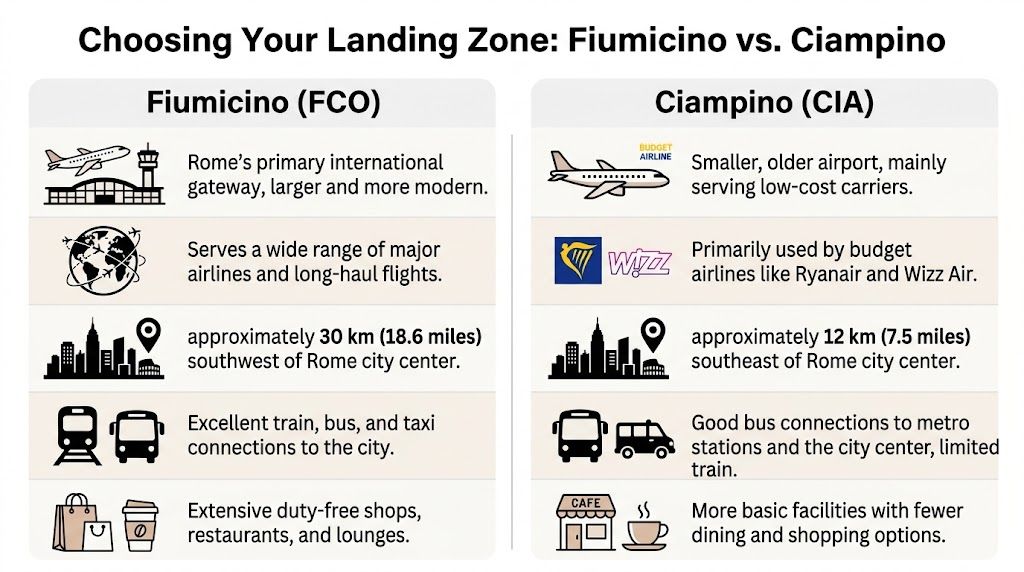
Fiumicino Airport, FCO, is the main gateway for Rome. If you are flying from the United States, using points on a major carrier, traveling with family, or carrying more than a backpack, start here.
FCO gives you more airline options, better odds of a straightforward itinerary, and an arrival setup that is easier to handle when you are tired. That matters. A lot. Service members and veterans using familiar airline programs will usually find FCO fits the mission better because major carriers and alliance partners are concentrated here, which also pairs well with fare-timing tactics like those in this guide on the best time to book flights for cheaper international fares.
Choose FCO if you want:
- More nonstop and major-carrier routes
- Better odds for points redemptions and military-friendly baggage policies
- Simpler planning for families, older travelers, and first-time Rome visitors
- More transport choices into the city after landing
Ciampino for stripped-down budget runs
Ciampino Airport, CIA, is the sharper tool for a specific job. Use it when you are already in Europe, traveling light, and hunting the lowest fare on a budget airline.
CIA is smaller and usually easier to move through. That sounds great, and sometimes it is. But do not force it into the wrong mission. If you build a transatlantic trip around a tiny fare and then get hit with extra baggage fees, awkward schedules, or a clunky transfer into town, the savings disappear fast.
CIA works best for:
- Carry-on-only travelers
- Solo travelers doing a quick city hop
- Budget airline itineraries within Europe
- Veterans and military travelers who care more about total trip cost than lounge access or premium airport amenities
A practical overview from Hardcore Italians on lesser-known airlines flying to Italy is useful if you are comparing lower-cost carrier options that may route through Rome.
Side-by-side call
Here’s the straight answer.
| Airport | Best for | Main upside | Main drawback |
|---|---|---|---|
| FCO | US travelers, families, first-time Rome visitors, points users | More international service and easier onward planning | Bigger airport, longer walks, more crowding |
| CIA | Budget travelers, light packers, Europe hop itineraries | Smaller airport and better fit for low-cost carriers | Fewer long-haul options and fewer airport services |
My recommendation by traveler type
For families: Pick FCO. You want the wider route network and easier recovery options if something slips.
For solo budget troops: Pick CIA only if you are already in Europe and can keep baggage to a minimum.
For business travelers: Pick FCO. Time matters more than squeezing out a tiny fare difference.
For service members and veterans: Start your search with FCO, then compare CIA only if the total savings are real after bags, transfers, and schedule pain are counted. That is the S.T.D. Army way. Save money with discipline, not with self-inflicted chaos.
A useful visual walkthrough can help before you commit. This YouTube airport transfer video for Rome travelers gives you a practical look at getting from the airport area into the city and what that journey feels like on the ground.
Basic Training How to Score Great Flight Deals
Cheap flights to Rome aren’t magic. They’re the result of controlled habits. You don’t need a travel guru. You need a repeatable system and the discipline to stop panic-booking the first fare that looks halfway decent.
Use timing like a weapon
The easiest mistake is booking emotionally. You get excited, see one acceptable fare, and smash purchase. Slow down.
Search broadly first. Check a full month view when you can. Midweek departures often give you better options than weekend-heavy itineraries, and they usually come with less chaos at the airport too. Shoulder season is usually the sweet spot for Rome because you avoid the worst summer pressure while still getting a lively city.
If you want a deeper tactical read on timing, this guide on the best time to book flights lays out the booking windows and timing habits worth watching.
Compare the fare class, not just the fare
A bargain fare can be a trap if it strips out seat selection, carry-on rights, or change flexibility. Read the fare family before you celebrate.
Use this quick test:
- If you’re taking one small bag and won’t change plans: Basic economy might work.
- If you’re checking luggage or traveling as a group: Standard economy is often the safer call.
- If you need flexibility: Pay for the fare that gives it up front. Rebooking stress will wreck the savings.
Run this booking drill
Search your home airport plus a backup airport
Bigger metro areas often produce very different fare calendars. One airport may have the better schedule. Another may have the better routing.
Check direct versus one-stop
A one-stop itinerary isn’t automatically worse. If the connection is clean and the price gap is meaningful, it can be the smarter move.
Set alerts before you commit
Google Flights is solid for reconnaissance. Set the route. Watch the pattern. Don’t babysit the screen all day.
Review baggage before checkout
Here, “cheap” fares start lying.
Buy the itinerary you can live with after a long overnight flight, not the one that only looks good at noon on a laptop screen.
Airlines worth checking
For Rome, major network carriers matter because they offer stronger schedules and easier disruption handling. Budget-friendly transatlantic options can still be useful, especially if your dates are flexible and you know exactly what’s included.
This tutorial is useful if you want a walk-through on fare tracking and search tools before you lock in your route:
YouTube guide to using flight search tools and price alerts
The bottom line is simple. Flexibility beats obsession. A slightly different departure day, alternate airport, or smarter fare class choice can save you more pain than endless searching ever will.
Enlist the STD Army for Unbeatable Rome Fares
Most booking sites act like vending machines. You type in dates, they spit out options, and you’re on your own. That’s not enough when you’re trying to fly to Rome Italy on a budget, especially if you’re military, a veteran, or traveling with a family that needs every dollar to work harder.
Why military-focused travel advice matters
A lot of Rome content talks about “cheap flights” in generic terms and leaves it there. That misses a key opportunity. Service members and veterans often qualify for policies and perks that regular travel content barely mentions.
The gap is real. Travel Off Path’s write-up on veteran travel discounts says over 18 million U.S. military veterans travel annually, 40% seek discounts, and only 15% know airline-specific programs. The same source notes those savings can help budget-conscious families cut flight costs by 20-30% when they use the right veteran-focused tactics.
That’s not minor. That’s mission money.
What to look for before booking
If you qualify for military or veteran travel benefits, check these before you buy:
- Baggage policies: Extra checked bags can swing the value of a ticket fast.
- Change and standby options: Useful if your plans shift.
- Airline-specific military pages: Don’t assume the booking engine highlights what you’ve earned.
- Fare comparisons after perks: The lowest base fare isn’t always the lowest real cost.
A travel platform that surfaces discounts, flights, hotels, car rentals, and side-by-side comparison options can help. Sgt. Travel Deals Army’s military flight discounts page is built around that kind of search behavior, with a veteran-owned focus and a booking path through STD Army Deals for travelers who want to compare options in one place.
My blunt recommendation
If you served, act like it matters. Because it does.
Too many veterans book the same way everyone else does. They skip the baggage check, ignore airline military pages, and leave discount opportunities behind because nobody put the info in one clear place. That’s lazy travel planning, and it costs money.
Don’t assume the booking site is looking out for you. Verify the fare rules, verify the perks, and compare the total trip cost with your military benefits in play.
For non-military travelers, the lesson still holds. Compare everything. Fare rules, bag fees, airport choice, and schedule quality matter more than a flashy headline price.
Advanced Reconnaissance Pro Tips for Your Flight
Once you’ve mastered the basics, you can start playing offense. At this stage, points, transfer partners, and route strategy start doing heavy lifting.

Use points with intent
If you’ve got transferable points from Amex or Chase, Rome is a good target when partner availability lines up. The strongest move isn’t always booking through a bank portal. Often, it’s transferring points to the airline program that prices Europe more efficiently.
According to Upgraded Points’ guide to flights to Italy with points, Star Alliance redemptions to Rome cost 30,000 to 70,000 miles one-way, depending on cabin and program. The same guide notes that ANA Mileage Club can offer half-cost one-ways and that transferring to Virgin Atlantic can let you book Delta or ITA business class off-peak for 47.5k miles, which helps avoid huge surcharges.
That’s the kind of play that changes a trip.
Three point strategies that actually matter
Bank points beat airline loyalty in many cases
Flexible points give you options when one program prices badly or doesn’t show space.
Business class is often more realistic than people think
Not easy. Not guaranteed. But on the right dates, a transfer partner can make premium seats far more attainable.
Off-peak beats holiday dreaming
If your schedule has room, your miles go farther when demand eases up.
Strategic layovers can beat direct flights
A direct flight into Rome sounds ideal. Sometimes it is. Sometimes it dumps you into congestion, weak arrival timing, or a brutal fare.
A cleaner move can be connecting through another European hub and arriving into Rome on a schedule that fits your energy and your budget. That matters most for travelers who value reliability over bragging rights. I’d rather take a sane connection than a messy nonstop that blows up the first time weather or airport pressure hits.
Smart travelers don’t worship nonstop flights. They choose the itinerary with the fewest ways to ruin the day.
Watch this before you start moving points
Points transfers are one-way. Once you send them, you can’t take them back. That means you need a little discipline before you start firing.
This video is a strong primer on how to think through miles and booking strategy for international flights:
My recommendation for different traveler types
| Traveler | Better move |
|---|---|
| Cash buyer | Prioritize schedule and total trip cost over vanity routes |
| Points beginner | Start with transferable points and verify availability before transfer |
| Frequent business traveler | Consider alliance strength and disruption recovery, not just seat comfort |
| Military family | Use points for the long-haul and preserve cash for baggage, ground transport, and lodging |
You don’t need to become a points maniac. You just need to know when a transfer partner is giving you a cleaner shot at Rome than a straight cash fare.
From Tarmac to Trastevere Your Arrival and Transport Plan
A sloppy arrival can sour the first day in Rome. You’ve crossed an ocean. Don’t fumble the last leg because you didn’t think past the booking screen.
Your first moves after landing
Passport. Bags. Bathroom. Water. Then transport.
Keep it simple on arrival day. Don’t try to prove how “local” you are by improvising after a red-eye. If you land tired, your job is to get from airport to hotel with the fewest decisions possible.
For most US citizens on short tourist stays, a passport is typically the key document, but check official government travel guidance before departure because entry rules can change. Also check your airline baggage allowance before you fly. That’s basic discipline.
FCO arrivals need a transport plan
Rome Fiumicino is the major gateway, and Miles Mastery’s Rome flight guide notes that FCO handles over 15,000 flights monthly. The same source says the Leonardo Express reaches the city center in 32 minutes, and that summer congestion can delay 15-20% of arrivals. That last part matters. If you’re landing in summer, don’t wing it.
Here’s the practical breakdown:
- Leonardo Express: Strong choice if you’re staying near Termini or want a straightforward rail arrival.
- Official taxi or pre-booked car: Better if you’re carrying more luggage or arriving wiped out.
- Ride app plus airport confusion: Skip the gamble if you’re tired.
If you’ll be driving beyond Rome or heading into the countryside after arrival, compare your rental options in advance through a practical resource like this page on cheapest car rental companies.
CIA arrivals are simpler but less forgiving
Ciampino usually feels smaller and faster. That’s good. The flip side is that your transport options can feel more bare-bones if you arrive unprepared.
For CIA, I’d usually lean bus transfer over trying to invent a custom route after landing. Keep the extraction clean. Get into the city. Drop your bags. Then start enjoying yourself.
Land with your transfer decision already made. Rome is a lot more fun when you’re not negotiating your first move on zero sleep.
Your arrival checklist
- Save your hotel address offline
- Know which airport train, bus, or taxi option you’ll use
- Carry a backup payment method
- Pack one change of clothes in your carry-on
- Don’t stack major sightseeing on landing day
Final call on transport
If you’re landing at FCO and staying central, the Leonardo Express is the cleanest public option. If you’re arriving with kids, multiple bags, or a later arrival, pre-booked transport is often worth it just for the reduction in friction.
Rome isn’t hard. It’s just easier when you stop pretending every choice needs to be spontaneous.
Mission Accomplished Your Roman Holiday Awaits
Your Rome mission starts the moment the booking is done. Now the win is different. Protect your energy, leave room in your schedule, and give yourself permission to enjoy the city instead of treating it like a checklist.
Rome rewards travelers who slow down enough to notice it. The good stuff is rarely the big-ticket photo. It is the first espresso standing at the bar, the wrong turn that drops you into a quiet piazza, the late dinner that turns into a two-hour story. Get there with your budget intact and your stress level under control, and you give yourself a much better shot at that version of the trip.
That matters even more for service members and veterans.
A lot of travel advice stops at the fare search. S.T.D. Army is built for the part that comes after that too. Use the savings to stay one more night, book a better-located room, or keep cash free for trains, museum entries, and real meals instead of panic spending. That is how a smart flight choice improves the whole operation, not just the flight itself.
So put a date on the calendar. Stop waiting for the mythical perfect time. Rome has been there a long time. Your window to go still deserves a hard yes.
Ready to move from “someday” to booked? Enlist with Sgt. Travel Deals Army and start comparing smart travel options built for deal hunters, veterans, service members, families, and travelers who want a simpler way to plan.